Dumping by Construction Crews Killing Bahrain Coral

dump coral reefs bahrain A death trap for corals: Is Abu Dhabi’s Bu Tinah island atoll next in line for dumping?

We have heard this issue before: corals are being killed from human caused environmental damage. We’ve heard this in a lot of places, especially in the areas like the Persian Gulf; where large scale construction projects in Dubai, Abu Dhabi, and Bahrain are causing serious damage to the Gulf’s very fragile ecological infrastructure. After finding many examples of this problem, especially in regards to Dubai’s mega artificial island project, The World, the nearby United Arab Emirates state of Bahrain is now facing a serious problem to its coral formations due to the dumping of construction waste into the sea. These incidents, reported in the Gulf Daily News, include everything from truck tires, to concrete cinder blocks and other building materials, as well as old fishing nets, are found lying in the Gulf seabed.

The debris is becoming a “death trap” for various forms of marine life that become trapped in it and die. Corals, which depend on a very fragile natural ecosystem, are changing color from their normal blue and orange to shades of grey and are dying; according to Bahrain-based environmentalist Dutchman, Ben van Hoogen:

“This is damage you can’t ever express in amounts of money. It’s robbing the resources of fishermen, the environment, tourism; and this pollution will backfire on the water we take from the sea.”

van Hoogan, who also works for an environmental NGO, the Seal Rehabilitation and Rescue Center in Holland, is now organizing a project to remove parts of this debris by monthly “clean up dives” to try to save what is left of the corals not already damaged beyond repair.

“The coastguard doesn’t have time to do this work, as they need to concentrate on catching and arresting vessels that are doing the actual dumping,” he added.

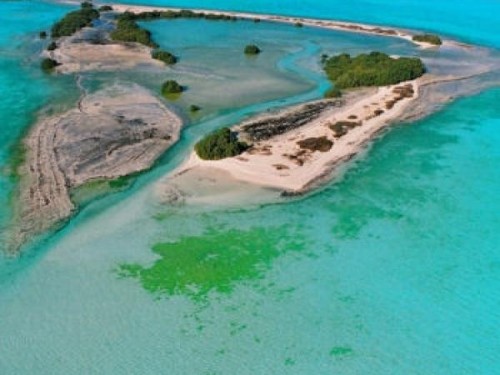
Persian Gulf marine life includes that found in very unique natural areas such as Abu Dhabi’s Bu Tinah island atolls. It also comprises one of the worlds’ largest populations of dugongs; a large marine mammal that was once mistaken by sailors as being mermaids.

van Hoogen says that before all the current commercialism, Bahrain was an island inhabited by fishermen; many of whom lost their livelihood when the recent construction boom began to destroy the marine environment upon which the fishermen depended upon to make a living. He continued by saying that “you can kill a coral reef in a month, but it takes hundreds of years for it to grow back.”

If ever.

The problem of the destruction of Persian Gulf marine life is not going to be solved as long as construction companies continue to dump their wastes into the waters around Bahrain and other Gulf locations. “Many marine species depend on (coral) reefs for their existence. When the reefs go, so does the marine life,” van Hoogan added.

Photo: Seven Wonders

Read up on threats to Persian Gulf marine life:
Persian Gulf  “Mermaids” Face Uncertain Future Due to Man-made Threats
Dubai Artificial “The World” Islands Threatening Coral and Other Marine Life
Rare Sea Turtiles and Other Marine Life Living Happily on Persian Gult Atoll

Maurice Picow
Maurice Picowhttps://www.greenprophet.com/
Maurice Picow grew up in Oklahoma City, U.S.A., where he received a B.S. Degree in Business Administration. Following graduation, Maurice embarked on a career as a real estate broker before making the decision to move to Israel. After arriving in Israel, he came involved in the insurance agency business and later in the moving and international relocation fields. Maurice became interested in writing news and commentary articles in the late 1990’s, and now writes feature articles for the The Jerusalem Post as well as being a regular contributor to Green Prophet. He has also written a non-fiction study on Islam, a two volume adventure novel, and is completing a romance novel about a forbidden love affair. Writing topics of particular interest for Green Prophet are those dealing with global warming and climate change, as well as clean technology - particularly electric cars.

Read More

TRENDING

Can Scientists Predict Coral Bleaching Before It Happens?

Now researchers at the Woods Hole Oceanographic Institution (WHOI) in the US say they have developed a way to predict coral bleaching five to six months before it occurs, potentially giving reef managers enough time to intervene and save vulnerable corals.

Elkhorn corals planted to restore reef diversity

The project centers on “Flonduran” corals, which are offspring of Florida elkhorn corals bred with elkhorn corals from Honduras. These new corals are being evaluated alongside Florida elkhorn corals of the same age that are outplanted side by side in natural reef habitats to assess whether the new genetic diversity can enhance coral resilience and reduce coral bleaching during Florida’s warm summers.

Saving Gourmet Wild Plants For The Future

Think of truffles, a gourmet wild food. The European...

Middle-Eastern spices and natural medicine (A through C)

In the Middle East, aromatic traditional foods are regarded...

Ocean Action Forum 2025: Can Saudi Arabia Redefine the Future of Marine Stewardship?

Saudi Arabia, a nation better known for its oil...

Yerukim Forms a New Green Economy Where the Money is Really Green

The Yerukim members who pick up the recyclables get to keep the monetary reward, the public earns "green" bills that can be used in shops, and business owners get to be associated with environmentalism.

Choosing Riyadh over Dubai? What Investors Should Know

Saudi Arabia is deploying capital at unmatched scale to catalyze tourism and advanced industry while rewiring its power-and-water backbone. The investable frontier is widening—especially in renewables, grid storage, water efficiency/desal retrofits, and hospitality operating platforms. Prudent investors will insist on phased delivery, enforceable KPIs (energy, water, biodiversity), and RHQ/zone compliance—while pricing political-economy and reputational risks alongside growth upside.

Sell your cooking oil for biodiesel money

Want to make money on old french fry oil? Sell it.

Qatar Alternative Energy Summit Pairs Investors And Innovators

Alternative energy investors and innovators can meet n' greet in Doha, Qatar March 16 and 17.

Here’s How To Implement The Four Pillars Of Employee Engagement

If you throw a party for your work team and they are vegans, don't make it a barbecue. Know the sustainability values of your team to boost moral and retain good people.

Locals From Rishon Fight IKEA

Big Box stores are a pretty new concept in Israel, and thank God that not every Israeli city wants them in their backyard. A word from someone who has see the beautiful farmland around her hometown Newmarket, Ontario stripped and converted into vulgar strip malls of big box shops: they have no place in a healthy and sustainable town or city.

The Jewish National Fund Meets An Inconvenient Truth

According to the JNF, it has transformed thousands of acres of barren land into green forests in Israel. They state that each person emits about 23 tons of carbon per year, estimating that each tree planted can absorb one ton of carbon in its lifetime. That's a whole lot of trees you'd need to be planting. Could so many fit in Israel?

How to quiet noise from construction in your office

Streets need to be resurfaced in New York but the humming and grinding noise is unsettling. Noise is environmental pollution. 

Popular Categories