
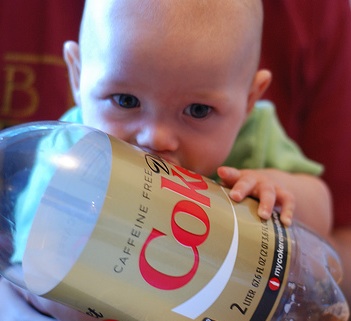

 Soft drinks. Fast foods. Cigarettes.
Companies that market these products are well-known for targeting children and teens in order to develop “brand loyalty.”
But the campaign to capture the taste buds of future consumers begins even earlier–in the hospital nursery, where formula companies use aggressive methods to ensure that babies’ first taste of artificial milk comes early and bears the name of their company.
They know that parents are most likely to continue feeding the brand served to babies in the hospital.
What’s the problem with formula, and why is this a “green” issue?
Ironically, early introduction of formula and a diet of “junk” food are both implicated in increasing the incidence of diseases such as diabetes and obesity.
Formula companies insist that they do not want to undermine breastfeeding–they merely want to compete for their share of the formula market for women who cannot or choose not to breastfeed. Sound familiar?
Cigarette companies have long claimed that they do not encourage smoking and only want current smokers to switch brands. Most governments reject this claim and severely restrict the way tobacco companies market their products.
Breastfeeding is an easy target. It’s free, already under attack, earns little profit for anyone and therefore has virtually no corporate funds backing it. But just one bottle of formula compromises a baby’s immune system and increases the risk of illness in the short and long term.
A bottle of formula implies that formula is endorsed by the hospital, and worse, sends the not-so-subtle message that the mother’s own milk is not good or plentiful enough. And just like it only takes a few cigarettes to become addicted, early introduction of formula can lower milk supply and is associated with early weaning.
Israel and the WHO Code
The World Health Organization (WHO) recognized the deleterious effects of formula marketing on the health of babies and mothers and its World Health Assembly passed the International Code of Marketing of Breast-milk Substitutes in 1974.
The aim of the Code is to. . . contribute to the provision of safe and adequate nutrition for infants, by the protection and promotion of breast-feeding, and by ensuring the proper use of breast-milk substitutes, when these are necessary, on the basis of adequate information and through appropriate marketing and distribution.
The Code prohibits companies from targeting pregnant women, parents and health-care workers with free samples and promotional and “educational” materials.
Israel is a signatory to the Code, indicating passive support. Unfortunately the Code has never been passed into law. There has been some progress: Gift bags of formula samples are no longer given out to mothers as they leave the hospital, and formula advertising and samples have largely disappeared from Tipat Halav, the government-sponsored well-baby clinics. Yet serious infractions occur with the tacit approval of the health ministry.
Formula Companies Target Public Israeli Hospitals
In January 2008, Ynet investigated the relationship between Israeli maternity wards and the two large formula importers, Materna and Similac. (A third company, Remedia, withdrew from the market after a lack of vitamin B-1 in a batch of soy formula led to the deaths of three babies.)
Despite the fact that the hospitals are publicly owned, the hospitals and the health ministry refused to release data regarding their agreements.
Related: Muslims and breastfeeding
Ynet reported that every three years hospitals submit a tender for their supply of infant formula. Usually, an institution tries to buy a product at the lowest possible price. But in the case of formula the companies actually pay hospitals for stocking their products exclusively. Reportedly these contracts earn hundreds of thousands of dollars of shekalim for the public hospitals, and at least one hospital received valuable state-of-the-art equipment.
Others received outings for its staff, linens, and funds to hire additional “lactation consultants,” creating a serious conflict of interest. In return companies earned the right to provide a constant supply of pre-mixed bottles of formula with the company’s name and logo in large letters.
Ninety percent want to nurse, only 70% do

According to health ministry statistics, 90% of pregnant women intend to nurse, but a full 70% of babies receive their first bottle in the hospital. It’s easy for a nurse to offer a bottle to a mother who has even a mild concern about her baby’s feeding patterns. Worse, babies often receive formula against parents’ wishes. Hospitals allow a situation where overworked staff suggest formula instead of ensuring that trained staff sit with the mother, answer her questions and help her breastfeed. But Israel’s health-care system may be acting against its own interests by accepting formula money–one study showed that the it costs huge sums to treat health problems of formula-fed babies in the first year alone.
Big business must be kept out of the public health system through legislation, and Israel should not permit infant-formula companies to influence health-care decisions relating to newborns. Parents deserve accurate, unbiased information about the risks of formula. The health ministry must ensure that all mothers have easy access to instruction, information, and their babies–without input from self-interested parties.
Often there are questions about whether a newborn is getting enough to eat. The appropriate medical response is to evaluate the situation, and, if necessary, encourage the mother to express colostrum–her own antibody-rich milk. Formula should be reserved for cases when it is truly needed. Stopping formula gifts to hospitals is a critical step in ensuring that our babies get the healthy start they deserve.




[…] how much GM soy is present in foods you pick up at the supermarket. Starting from baby formula (and we know that breast is best), some form of soy is present in about 60% of processed foods. At my local grocery store, even […]
[…] of course, includes vegetarian hot dogs and veggie shnitzels, not to mention baby formula and other food children grow up on. More basic staples, like cooking oil, are soy or canola oil, […]
this may entite the world ..thank you..
Companies then simply stamped the word “supplies” on their free samples, so in 1986 the WHA passed another resolution banning free supplies as well.Find more jobs: http://www.staffingpower.com/
Companies then simply stamped the word “supplies” on their free samples, so in 1986 the WHA passed another resolution banning free supplies as well.Find more jobs: http://www.staffingpower.com/
Actually, it’s called the International Code of Marketing of Breast-Milk Substitutes and was passed by the World Health Assemby (for which WHO serves as the secretariat) in 1981 with the only “no” vote coming from the USA at Ronald Reagan’s personal insistance (causing one official from USAID and one from the State Department to quit their jobs).
Voting did not make a country a “signatory” obliged to do anything, as it was a voluntary Code; countries had to pass their own laws to bring its provisions into force.
The Code itself banned “free samples” but allowed charitable “free supplies” which by definition have to be given free to a given child for as long as that child needs it. Companies then simply stamped the word “supplies” on their free samples, so in 1986 the WHA passed another resolution banning free supplies as well.
Abbott Labs bragged in an annual shareholder report (back before it was getting public criticism) that 95% of mothers who got free samples of Similac in hospital went on to buy the product. So one can see how commercially effective–and unethical–free samples are.
Israel has never put the Code into law, and the violations seem to be getting more blatant.
http://www.greenprophet.com/2009/08/09/11245/maccabi-health-fund-gives-out-free-formula-to-new-mothers/
Ted, I updated the post and I appreciate your comments. I recommend globalbreastfeeding. org to anyone interested in the subject.
EMP,
Thank you for sharing your story–I’m sorry to hear about what sounds like a frustrating experience. I am glad that your daughter is growing properly now.
I want to comment on what you wrote– perhaps it will be useful for others or yourself, if you are planning to have another child. If a baby is not gaining weight it’s important to be in contact with a lactation consultant and a doctor and follow up regularly. If a baby needs a supplement a mother’s own milk is preferred, if available. Low weight gain can affect the baby’s development.
Except in extreme cases, a mother’s diet has little relationship to the quality and quantity of her milk. Changing the mother’s diet does not increase milk supply. (By the way, formula company brochures often recommend unnecessary and restrictive diet suggestions for breastfeeding mothers.) Low weight gain is most often related to latch-on problems and/or poor breastfeeding management (scheduling feedings or stopping them in the middle,). Occasionally there may be anatomical or hormonal issues.
There are many ways to build up milk supply, depending on the reason for the low weight gain.
I LIVE IN BROOKLYN NY WHEN I LEFT THE HOSPITAL I GOT A BAG WITH SAMPLES THEN I SIGNED UP FOR THE CLUB AND THE COMPANY SENT ME SAMPLES ALL THE SAMPLES WERE PUT AWAY FOR AN EMERGENCY. AT MY BABY’S 2 WEEK CHECK UP MY BABY WAS NOT GAINING ANY WEIGHT SO I WENT TO A LACTATION SPECIALIST THEN AT HER 2 MONTH CHECK UP I WAS TOLD THAT SHE STILL WAS NOT GAINING ENOUGH WEIGHT I STARTED TAKING VITAMINS ATE FOOD LIKE YOGURT, ALMONDS, AND OTHER FOODS THAT IS SUPPOSED TO THICKEN BREAST MILK AT 3 MONTHS MY BABY ONLY GAINED 2 POUNDS AND I WAS TOLD TO GIVE HER A BOTTLE A DAY STILL HARDLY ANY WEIGHT GAIN BY 4 MONTHS I WAS TOLD BY HER DOCTOR TO STOP BREAST FEEDING AND GIVE FORMULA I WAS SO HAPPY I HAD THE SAMPLES ON HAND SINCE FORMULA IS SO EXPENSIVE I EVEN GOT SAMPLES FROM MY SISTER WHO BREAST FEEDS HER BABY SO IT IS GOOD TO GET SAMPLES.