
How Torvinen Jaakko’s ugly wood can lay the foundations for green building

Canada’s forest sector contributes roughly 25 billion USD to the country’s economy every year, while the US forest products industry generates an estimated $288 billion USD per year. Together, North America’s timber economy is worth hundreds of billions of dollars.

Yet an astonishing amount of perfectly good wood never becomes part of a building. A friend of mine works in grading wood. Only the straightest, unblemished trees fetch the high prices. The rest? Off to the chipper or back to the forest floor.

ugly wood, misfit wood, Canada forestry, Canadian timber industry, sustainable timber, timber architecture, mass timber, cross laminated timber, CLT, Jaakko Torvinen, Peter Osborne, Carleton University, Aalto University, wood waste, forest innovation, circular economy, sustainable construction, green building, architecture, bent timber, irregular wood, arborist wood, urban forestry, timber research, low carbon buildings, wood utilization, forest products, bioeconomy, Ottawa, sustainable design, timber engineering, climate friendly construction, forestry innovation, wood recycling, organic wood shapes
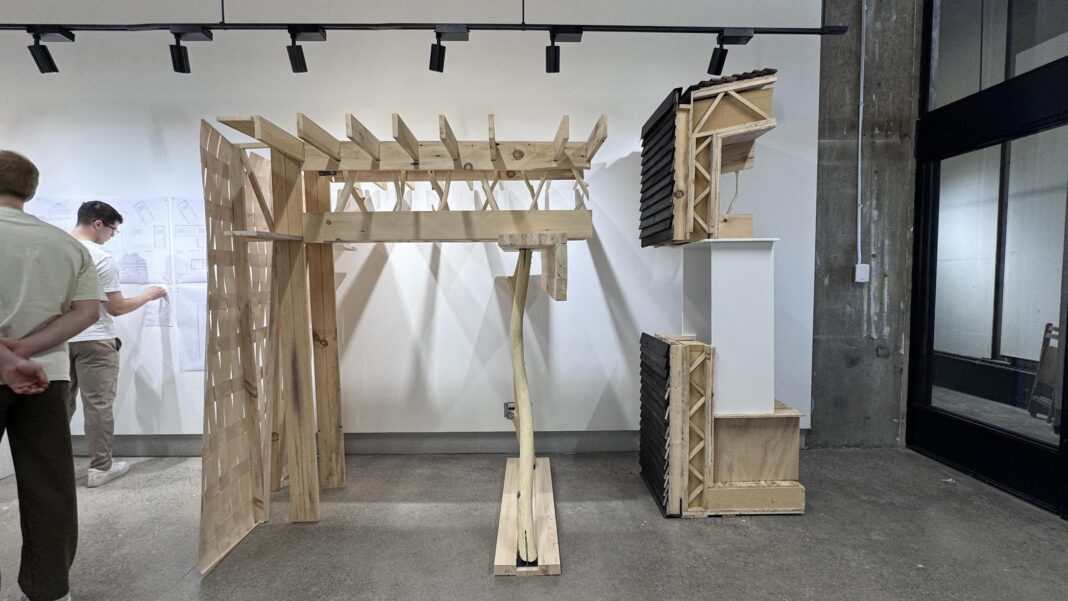
Torvinen Jaakko: Instead of chipping bent and irregular trees, researchers at Carleton University and Aalto University are exploring how “ugly wood” can become the foundation for a new generation of sustainable architecture.

Those castaways, the bent trunks, twisted branches, unusual forks and organically shaped knots and sections are chipped, burned, or left as firewood or to rot (the mushrooms are happy!) because they don’t fit the standardized lumber industry.

misfit wood, timber construction, sustainable building materials, Jaakko Torvinen, Aalto University, roundwood construction, curved timber, forked trees, wood waste, circular economy, sustainable architecture, green building, timber engineering, load-bearing wood, sustainable construction, architecture research, eco design, wood innovation, mass customization, building materials
Torvinen’s work in Finland

The problem here is economic as much as aesthetic. Timber markets reward straight, uniform logs that can be milled efficiently into dimensional lumber. Those unusual trees with bends, curves, knots that might resemble the face of your uncle, or which are used in weekend cottage projects, are typically downgraded to low-value pulpwood.

Yet for foresters and landowners, these “misfit” trees often sell for only a fraction of the value of premium sawlogs, representing millions of dollars in lost value every year while also shortening the time carbon remains locked away in buildings.
Researchers at Carleton University and Aalto University are proving that bent and irregular “ugly wood” can become valuable building material, offering Canada’s timber industry a new path to reduce waste, increase profits, and build more sustainably.

Architect and Aalto University PhD researcher Jaakko Torvinen believes it’s time to rethink the way we see forests. And he’s been working with a Canadian university, Carleton, for proof on how it can be done.

After Green Prophet featured Torvinen’s work in Finland, where he demonstrated how “ugly wood” could become beautiful architecture rather than biomass, he brought the idea to Canada, co-leading a graduate design studio at Carleton University in Ottawa with Dr. Peter Osborne.

The collaboration merged two complementary research directions.
ugly wood, misfit wood, Canada forestry, Canadian timber industry, sustainable timber, timber architecture, mass timber, cross laminated timber, CLT, Jaakko Torvinen, Peter Osborne, Carleton University, Aalto University, wood waste, forest innovation, circular economy, sustainable construction, green building, architecture, bent timber, irregular wood, arborist wood, urban forestry, timber research, low carbon buildings, wood utilization, forest products, bioeconomy, Ottawa, sustainable design, timber engineering, climate friendly construction, forestry innovation, wood recycling, organic wood shapes
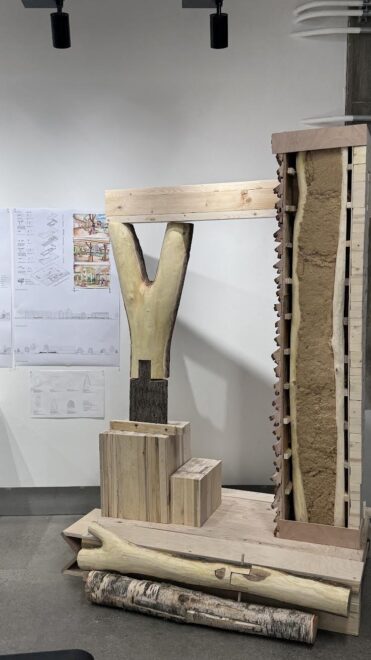
Architecture students at Carleton University transform irregular “ugly wood” into sustainable building prototypes, demonstrating how bent and misshapen timber can reduce waste in Canada’s forestry industry.

Torvinen tells Green Prophet: “The graduate studio at Carleton University was a combination of my research and Dr. Peter Osborne’s research. He focuses on trait-based wood utilization in timber construction, aiming to expand what wood species we use in building products. I am investigating how we could utilize the organically shaped parts of trees that are not utilized architecturally and structurally.”

Rather than beginning with blueprints, students began in the forest.
ugly wood, misfit wood, Canada forestry, Canadian timber industry, sustainable timber, timber architecture, mass timber, cross laminated timber, CLT, Jaakko Torvinen, Peter Osborne, Carleton University, Aalto University, wood waste, forest innovation, circular economy, sustainable construction, green building, architecture, bent timber, irregular wood, arborist wood, urban forestry, timber research, low carbon buildings, wood utilization, forest products, bioeconomy, Ottawa, sustainable design, timber engineering, climate friendly construction, forestry innovation, wood recycling, organic wood shapes

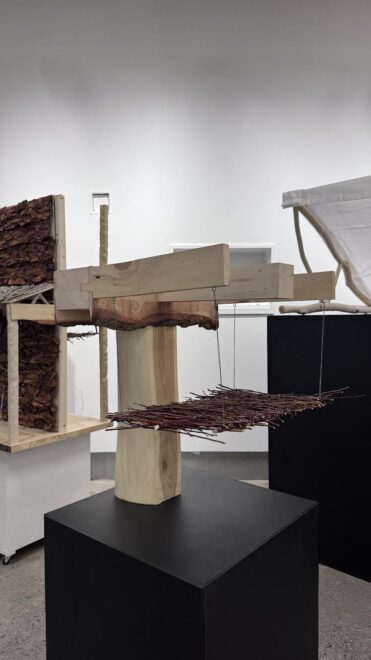
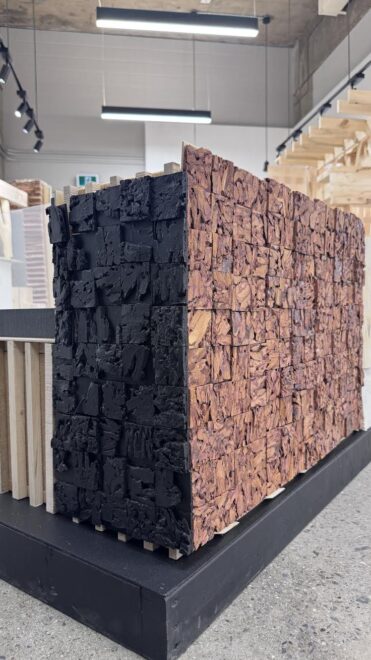
They analyzed the woodlands around Ottawa, Ontario studying which tree species grow locally and how their natural characteristics might become assets instead of defects. The class then sourced material from a local arborist, wood that otherwise would have been fed into a chipper, and transformed it into structural prototypes.

“After building the prototypes, the students designed a fictional public building, the architecture of which was guided by the prototypes they had previously made,” Torvinen explains.

The exercise turned conventional architecture upside down. Instead of forcing trees to conform to industrial standards, the buildings evolved from the shapes the trees had already grown.

For Canada’s forestry sector, the implications reach far beyond an architecture studio. As governments and industry search for ways to reduce waste, increase carbon storage locked into wood, and improve the value of every harvested tree, researchers like Torvinen and Osborne suggest that innovation may lie not only in engineered wood products like cross-laminated timber, but also in embracing the irregular forms the industry has traditionally rejected. Torvinen shows how unusual forms can be sound and solid.

Canada has an opportunity to lead. By creating new markets for crooked trunks the forestry sector could generate greater returns from every harvest while reducing waste and keeping more carbon locked inside long-lasting buildings.

Credit to Carleton students: Alvin Ahn, Dennis Avgerinos, Mostafa Bdeir, Andre Cusson, Haseena Doost, Maria Fares, Alexis Gawlina,  Rashida Leslie, Rayan Mazeh, Nadine Mustafa, Shagana Muttiah, Rebecca Sondermeyer, Katrina Tarcia.


Karin Kloosterman
Karin Kloostermanhttp://www.greenprophet.com
Karin Kloosterman is an award-winning journalist, innovation strategist, and founder of Green Prophet, one of the Middle East’s pioneering sustainability platforms. She has ranked in the Top 10 of Verizon innovation competitions, participated in NASA-linked challenges, and spoken worldwide on climate, food security, and future resilience. With an IoT technology patent, features in Canada’s National Post, and leadership inside teams building next-generation agricultural and planetary systems — including Mars-farming concepts — Karin operates at the intersection of storytelling, science, and systems change. She doesn’t report on the future – she helps design it. Reach out directly to [email protected]

Read More

TRENDING

Idols of Ganesh in Canadian lakes are causing local environmental concerns

Immersing religious idols in Canada's lakes, rivers and coastal waters remains a contentious issue. While the practice is an important tradition for many Hindu communities during festivals such as Ganesh Chaturthi, environmental regulations in many jurisdictions prohibit the disposal of foreign materials into natural waterways, even when the objects are intended as religious offerings.

Are the Great Lakes polluted?

The Great Lakes may look pristine, but a new cleanup report reveals a growing tide of plastic pollution beneath the surface. From cigarette butts and food wrappers to tiny plastic fragments and discarded nicotine pouches, researchers are finding evidence that everyday consumer waste is making its way into North America's largest freshwater ecosystem. New technologies, including Canada's first BeBot beach-cleaning robot, are helping scientists understand how plastic travels through lakes, shorelines and stormwater systems before breaking down into microplastics.

Barnacle glue could fix coral reefs, inspire new advances in building and medicine

Aalto University researchers create a protein-based adhesive inspired by barnacles and mussels that works underwater and could aid coral reef restoration.

Sámi shaman drums and why owning one could get you killed

For centuries, the Sámi shaman drum was one of the most powerful sacred objects in northern Europe, and one of the most feared by church and state. If ISIS looks bad to us today for its religious fundamentalism, Christians were just as fervent. 

Exposure to wildfire smoke leads to strokes

Short-term surges in air pollution in New Jersey from the 2023 Canadian wildfires were associated with a higher stroke rate and more serious strokes, according to a preliminary study

Yerukim Forms a New Green Economy Where the Money is Really Green

The Yerukim members who pick up the recyclables get to keep the monetary reward, the public earns "green" bills that can be used in shops, and business owners get to be associated with environmentalism.

Choosing Riyadh over Dubai? What Investors Should Know

Saudi Arabia is deploying capital at unmatched scale to catalyze tourism and advanced industry while rewiring its power-and-water backbone. The investable frontier is widening—especially in renewables, grid storage, water efficiency/desal retrofits, and hospitality operating platforms. Prudent investors will insist on phased delivery, enforceable KPIs (energy, water, biodiversity), and RHQ/zone compliance—while pricing political-economy and reputational risks alongside growth upside.

Sell your cooking oil for biodiesel money

Want to make money on old french fry oil? Sell it.

Qatar Alternative Energy Summit Pairs Investors And Innovators

Alternative energy investors and innovators can meet n' greet in Doha, Qatar March 16 and 17.

Here’s How To Implement The Four Pillars Of Employee Engagement

If you throw a party for your work team and they are vegans, don't make it a barbecue. Know the sustainability values of your team to boost moral and retain good people.

Locals From Rishon Fight IKEA

Big Box stores are a pretty new concept in Israel, and thank God that not every Israeli city wants them in their backyard. A word from someone who has see the beautiful farmland around her hometown Newmarket, Ontario stripped and converted into vulgar strip malls of big box shops: they have no place in a healthy and sustainable town or city.

The Jewish National Fund Meets An Inconvenient Truth

According to the JNF, it has transformed thousands of acres of barren land into green forests in Israel. They state that each person emits about 23 tons of carbon per year, estimating that each tree planted can absorb one ton of carbon in its lifetime. That's a whole lot of trees you'd need to be planting. Could so many fit in Israel?

How to quiet noise from construction in your office

Streets need to be resurfaced in New York but the humming and grinding noise is unsettling. Noise is environmental pollution. 

Popular Categories