

Looms Ran on Binary Code Before Computers Existed

Before computers, there were looms. London’s Softwear exhibition traces the surprising links between weaving, women, punched cards and modern computing.

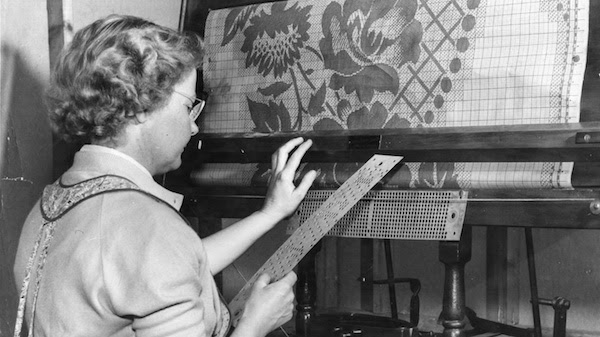
Looms ran on binary code more than a century before computers. Think about that the next time someone tells you artificial intelligence was invented in Silicon Valley. In 1804, the Jacquard loom transformed weaving by using punched cards to tell a machine which threads to lift and which to leave alone. Hole or no hole. On or off. The weaver could effectively program an intricate flower, geometric pattern or portrait into cloth.

It wasn’t binary code in the strict modern computer science definition, but the principle is startlingly familiar. Information was encoded outside the machine, stored and then read as instructions. And it came from women and it came from weaving.

I studied science and have spent much of my life writing about technology, but I love these moments when the histories we are taught fall apart. Computing didn’t just descend from mathematicians and electrical engineers in the US. Some of its roots run through looms, textiles, punched cards and the precise handwork so often performed by women.

That is the idea behind Softwear, an exhibition curated by Kira Wainstein opening at No Show Space in London on September 18 in London.

“This foundational principle of computers was first harnessed not by scientists or engineers, but by weavers,” the exhibition notes.

The history of computing may have started with Charles Babbage who later borrowed the punched-card idea for his Analytical Engine, the extraordinary 19th-century design for a programmable mechanical computer.

Ada Lovelace understood the connection. Writing about Babbage’s machine in 1843, she famously observed that the Analytical Engine could weave algebraic patterns just as the Jacquard loom wove flowers and leaves.

Punch cards were inspired by the loom

Lovelace is now recognized as an important pioneer of computer programming. A century later, women were again doing the invisible work of computation. Before computers were machines, “computers” were people, many of them women performing mathematical calculations by hand.

Then came war: World War II accelerated computing because governments needed machines to calculate trajectories, crack codes and solve military problems faster than humans could. ENIAC, one of the earliest general-purpose electronic computers, was developed for the US Army to calculate artillery firing tables. Its original programmers were women.

Related: How Canada’s Farmerettes played a central role in WWII

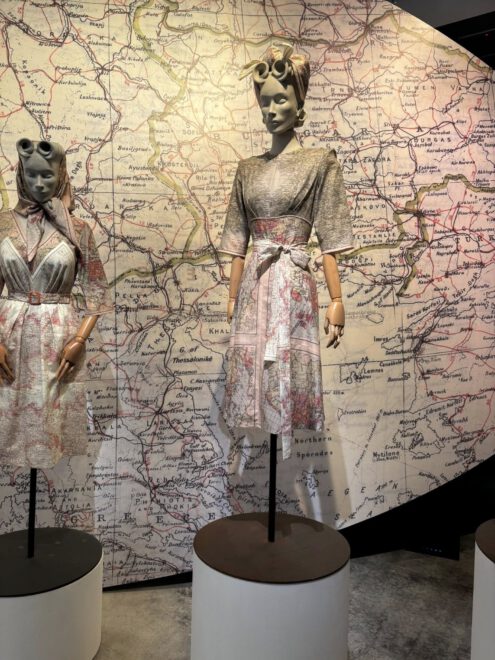
There is a strange parallel here with another exhibition we covered at Green Prophet, from flour sacks to ecological ingenuity. That exhibition showed how women manipulated whatever materials remained available during war: a bra sewn from coat lining, belts made from electrical wire, handbags from telephone wire. Silk maps used to escape from enemies could become clothing.
Follow the map to her heart

Charlotte Johannesson’s Guardian? from 1984 was created after the Swedish artist traded her loom for a computer. Crystal Bennes’s When Computers Were Women translates 2,131 computer punch cards from a CERN experiment into woven textiles.

Shannon Swinburn’s IBM 1401 reconstructs the hand-threaded memory of an early computer. Steph Linn reproduces a digital image through hand-punched knitting cards. Artists daniela brill estrada and Monica C. LoCascio emboss lace drafts alongside physics and poetry onto copper.

Magnetic core memory used tiny magnetic rings threaded with wires. The work required extraordinary dexterity and was often performed by women. Before our information disappeared into something we misleadingly call “the cloud,” you could practically hold computation between your fingers.

Softwear runs September 18 through October 17, 2026 at No Show Space, 39 Temple Street, London. The exhibition features Crystal Bennes, daniela brill estrada & Monica C. LoCascio, Charlotte Johannesson, Steph Linn and Shannon Swinburn and was selected through apexart’s Open Call.

Read More

TRENDING

Why Taking Care of Your Health as a Woman is So Important

This collaborative model ensures that women receive holistic care; care that sees the whole person, not just isolated symptoms.

How to make mushroom paper

Learn how to make sustainable paper from mushrooms using tough, fibrous fungi like artist’s conk, turkey tail, and birch polypore. This eco-friendly craft transforms woody polypores into strong, chitin-based sheets perfect for art projects, greeting cards, or handmade journals. Our step-by-step guide to mushroom papermaking covers soaking, pulping, forming sheets with a mould and deckle, and drying methods—showing how fungi can replace traditional wood pulp for unique, natural paper.

Long-term coffee drinking food for women’s health

If you’re a woman in your 40s or 50s enjoying your morning brew, this study gives new reason to sip with purpose. But even more importantly, it underscores a simple truth we often return to: wellness is cumulative. The choices we make today—how we move, what we eat, how we rest, and yes, how we caffeinate—are the building blocks of the decades to come.

Chewing gum releases thousands of bits of microplastics in your mouth

While chewing gum may seem like a harmless habit, recent studies have revealed a concerning reality: microplastics are a part of our daily lives, even in the things we put in our mouths. As we transition further into a world dominated by synthetic materials, it's crucial to stay informed about the potential risks of microplastics. As Mohanty and his team continue to explore this issue, we must remain cautious and mindful of the products we consume, taking steps to reduce our exposure to plastics and advocating for more sustainable alternatives.

Don’t Be Afraid to Ask Your OBGYN if These Things Are Normal

If you’re postpartum, your provider will give you a questionnaire to assess your risk for depression. Answer the questions honestly and, if you notice depressive or anxious thoughts later, reach out right away. Your provider is there to help you throughout your lifetime and through every phase of reproductive health.

The Essential Guide To Sustainability in Project Management

Sustainability is an approach where businesses and individuals balance the environmental, social, and economic aspects of a project such that current and future stakeholders are not overburdened with the impacts of the project in future.

Yerukim Forms a New Green Economy Where the Money is Really Green

The Yerukim members who pick up the recyclables get to keep the monetary reward, the public earns "green" bills that can be used in shops, and business owners get to be associated with environmentalism.

Choosing Riyadh over Dubai? What Investors Should Know

Saudi Arabia is deploying capital at unmatched scale to catalyze tourism and advanced industry while rewiring its power-and-water backbone. The investable frontier is widening—especially in renewables, grid storage, water efficiency/desal retrofits, and hospitality operating platforms. Prudent investors will insist on phased delivery, enforceable KPIs (energy, water, biodiversity), and RHQ/zone compliance—while pricing political-economy and reputational risks alongside growth upside.

Sell your cooking oil for biodiesel money

Want to make money on old french fry oil? Sell it.

Qatar Alternative Energy Summit Pairs Investors And Innovators

Alternative energy investors and innovators can meet n' greet in Doha, Qatar March 16 and 17.

Here’s How To Implement The Four Pillars Of Employee Engagement

If you throw a party for your work team and they are vegans, don't make it a barbecue. Know the sustainability values of your team to boost moral and retain good people.

Locals From Rishon Fight IKEA

Big Box stores are a pretty new concept in Israel, and thank God that not every Israeli city wants them in their backyard. A word from someone who has see the beautiful farmland around her hometown Newmarket, Ontario stripped and converted into vulgar strip malls of big box shops: they have no place in a healthy and sustainable town or city.

The Jewish National Fund Meets An Inconvenient Truth

According to the JNF, it has transformed thousands of acres of barren land into green forests in Israel. They state that each person emits about 23 tons of carbon per year, estimating that each tree planted can absorb one ton of carbon in its lifetime. That's a whole lot of trees you'd need to be planting. Could so many fit in Israel?

Popular Categories