
Medical company goes solar to safeguard against power outtages

Solar power at Staar Surgical manufacturing

Forget about buying carbon credits: a medical device company in the US becoming the carbon credits for its own manufacturing facilities, saving money and becoming less risk averse.

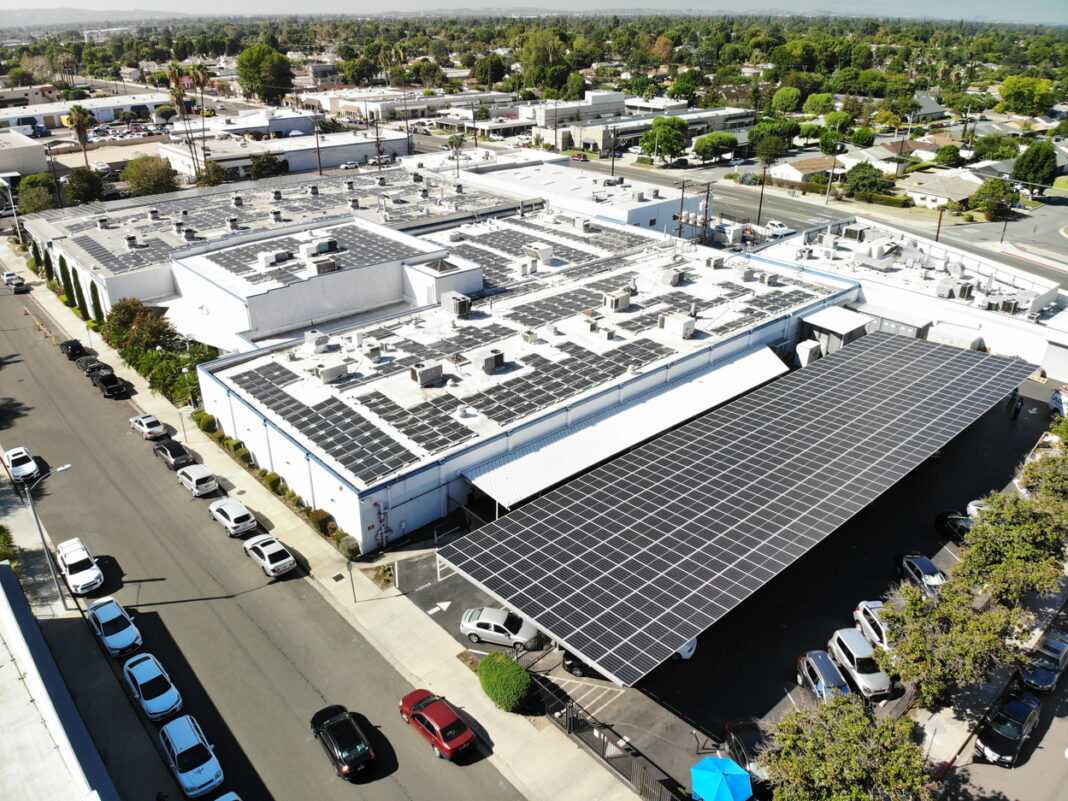
Staar Surgical (NASDAQ: SAAA) is a leading manufacturer of implantable lenses used in ophthalmic surgery has decided to power its manufacturing plant with solar energy. It has inaugurated a 1.1MW grid-tied microgrid on its production facility in Lake Forest, California.

Now operational, the system was installed to meet three important goals: reduce energy costs, improve sustainability, and, most importantly of all, safeguard production in the event of grid outages caused by extreme weather events.

The microgrid is powered by a 780kW SolarEdge DC-optimized inverter solar system located on the facility’s roof and two newly-constructed carports. The 1752-module system is expected to cut Staar Surgical’s energy costs by approximately 50%, representing an annual saving of around $325,000.

However, this figure could be a drop in the ocean compared to the savings that could potentially be achieved by preventing spoiled production runs.

Jay Cutting, Snr., President of building and solar contractor, ReVamp Energy, which designed, installed and will maintain the microgrid, explains: “Manufacturing contact lenses is a highly energy-intensive process that requires each lens to be heated in an industrial kiln continuously for several days.

SolarEdge nuder the hood

“Any reduction in power of more than a few seconds has the potential to ruin an entire production run, leading to losses of potentially hundreds or thousands of dollars. The increasing frequency of red flag weather events in California necessitated that Staar Surgical address the mission-critical challenge of identifying a cost-effective and sustainable method to safeguard production.”

Excess solar energy produced during the day will be stored in a 450kW battery to power the site’s 24/7 production lines and provide essential backup in the event of power outages. The battery is expected to provide between eight and 24 hours of back-up power, dependent upon the manufacturing facility’s load requirements. In the rare event that an outage lasts even longer, the system also includes a generator, giving Staar Surgical the ability to maintain production.

Estee Lauder went solar in 2020 in order to create a zero emissions supply chain.

To ensure seamless operation, ReVamp Energy designed custom-made switchgear that will automatically switch the site’s energy supply to back-up power in the event of a power outage. For added convenience, the microgrid is manageable via the SolarEdge monitoring platform. This will enable Staar Surgical and ReVamp Energy to track a variety of key parameters such as solar energy production, consumption and battery energy levels in real-time and from a single platform.

Cutting, Snr. comments: “We have worked with Staar Surgical on several solar installations and for each one we have used SolarEdge technology – it is a key component of realising the client’s requirement for high energy production, reliability, and intelligent control.

“This starts with the use of Power Optimizers to pull more power from the solar arrays, and extends through to the generation of highly-granular performance data that will enable us to operate and maintain not just the solar installation, but the entire microgrid, in the most efficient and cost-effective way possible.”


Read More

TRENDING

Etihad crew denies female doctor from helping passenger in medical distress

A female physician says she and another woman doctor were prevented from helping a passenger during a medical emergency aboard Etihad flight EY16. Was it airline protocol, poor judgment or sexism? Etihad has been asked to explain.

How to Read Your PG&E Bill After Installing a Heat Pump — and What to Expect the First Year

Electricity bill went up after your heat pump installation? Before you call the contractor, read this. A wrong rate plan, unadjusted thermostat schedule, and a missed baseline allowance are usually the culprit — not the system.

The Best of Hobart: Experiences to Have, Places to Visit, and Flavours to Try

Hobart, Tasmania’s capital, is the kind of city that makes you regret not having come sooner. Mount Wellington/kunanyi that shapes the skyline, Bruny Island's dolphins, Port Arthur's convict ruins and Salamanca's Saturday market are all close enough to fit into the same week.

How Responsible Tourism Could Help Protect the World’s Last Wild Places

From Antarctica and South Georgia to the Galápagos and Thailand, fragile destinations are finding ways to manage tourism without shutting visitors out. Visitor caps, conservation fees, biosecurity rules and controlled access can reduce environmental damage while helping fund the protection of wild places.

How Slow Travel Is Changing the Way We Explore

From trekking fees in Nepal and wildlife conservancies in Kenya to visitor limits in Patagonia and strict Arctic rules in Svalbard, responsible adventure travel can help fund conservation, protect habitats, and create sustainable income for local communities.

The Essential Guide To Sustainability in Project Management

Sustainability is an approach where businesses and individuals balance the environmental, social, and economic aspects of a project such that current and future stakeholders are not overburdened with the impacts of the project in future.

Yerukim Forms a New Green Economy Where the Money is Really Green

The Yerukim members who pick up the recyclables get to keep the monetary reward, the public earns "green" bills that can be used in shops, and business owners get to be associated with environmentalism.

Choosing Riyadh over Dubai? What Investors Should Know

Saudi Arabia is deploying capital at unmatched scale to catalyze tourism and advanced industry while rewiring its power-and-water backbone. The investable frontier is widening—especially in renewables, grid storage, water efficiency/desal retrofits, and hospitality operating platforms. Prudent investors will insist on phased delivery, enforceable KPIs (energy, water, biodiversity), and RHQ/zone compliance—while pricing political-economy and reputational risks alongside growth upside.

Sell your cooking oil for biodiesel money

Want to make money on old french fry oil? Sell it.

Qatar Alternative Energy Summit Pairs Investors And Innovators

Alternative energy investors and innovators can meet n' greet in Doha, Qatar March 16 and 17.

Here’s How To Implement The Four Pillars Of Employee Engagement

If you throw a party for your work team and they are vegans, don't make it a barbecue. Know the sustainability values of your team to boost moral and retain good people.

Locals From Rishon Fight IKEA

Big Box stores are a pretty new concept in Israel, and thank God that not every Israeli city wants them in their backyard. A word from someone who has see the beautiful farmland around her hometown Newmarket, Ontario stripped and converted into vulgar strip malls of big box shops: they have no place in a healthy and sustainable town or city.

The Jewish National Fund Meets An Inconvenient Truth

According to the JNF, it has transformed thousands of acres of barren land into green forests in Israel. They state that each person emits about 23 tons of carbon per year, estimating that each tree planted can absorb one ton of carbon in its lifetime. That's a whole lot of trees you'd need to be planting. Could so many fit in Israel?

Popular Categories