Superpower “Laxative Nut” Jatropha Tree Could Solve Egypt’s Fuel Crisis

biofuel, Egypt, jatropha, agriculture, desert, desertification, fuel crisis, pollution, climate changeIn Egypt, people often have to line up for hours to fill their cars and trucks with diesel fuel – particularly during summer months when it comes at a premium.

Concerned to ease these shortages, as well as pollution and climate change, Egyptian agricultural engineer Wadad Khaireddine is pushing to grow a desert full of “Laxative Nut” trees.  More commonly known as the Jatropha, this wonder tree has multiple benefits: it fights desertification, requires very little water, and – most importantly – can be used to provide biofuel.

Speaking with Al-Shorfa, Khaireddine said that the Jatropha tree is a wild plant native to South America that belongs to the Euphorbiaceae family.

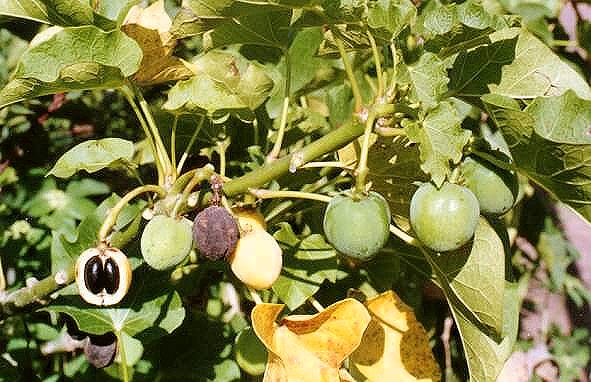
The tree has yellow flowers that first turn into seeds and then a fruit that resembles olives. Seeds inside the fruit are comprised of up to 45 percent oil that can be used as biodiesel.

“Unfortunately, the plant’s oil is unsuitable for human consumption because it contains toxic substances,”  Khaireddine told the paper.

She says unfortunately, but the fact that the oil is not fit for human consumption is a benefit since it ensures that hungry people are not being denied food because of fuel, which is a common complaint in the biofuel industry.

Also, while some crops are water intensive (and Egypt doesn’t have much H20 to share), the Jatropha tree is said to be a low maintenance species that requires very little water to thrive.

The wood is strong and can be used for building projects, and essential oils can be used to make candles, soap and glycerine.

“The tree can be planted twice a year, at the beginning of spring and autumn,” Khaireddine explained to Al-Shorfa in a recent interview.

Plus “… it can be planted densely in desert areas, with one tree per every two metres, and it does not require any sort of pesticide or organic and mineral fertilizers, especially if irrigated by treated wastewater.”

She adds that a forest of Jatropha trees could stave off desertification by acting as a wall that prevents wind from sweeping away the desert sands.

Through her land reclamation company Al-Wadad, Khaireddine has raised some money from private sources in order to develop a pilot project that will prove to potential investors and the Egyptian government that Jatropha is a viable solution for Egypt’s energy and pollution crisis.

It can also provide a host of jobs in a country that has at least a 13 percent unemployment rate (though we suspect those numbers are a lot higher.)

But she is still looking for land, which she hopes to acquire under the government’s land reclamation scheme.

Image via Wikipedia
Tafline Laylin
Tafline Laylinhttp://www.greenprophet.com
As a tour leader who led “eco-friendly” camping trips throughout North America, Tafline soon realized that she was instead leaving behind a trail of gas fumes, plastic bottles and Pringles. In fact, wherever she traveled – whether it was Viet Nam or South Africa or England – it became clear how inefficiently the mandate to re-think our consumer culture is reaching the general public. Born in Iran, raised in South Africa and the United States, she currently splits her time between Africa and the Middle East. Tafline can be reached at tafline (at) greenprophet (dot) com.

Read More

10 COMMENTS
  1. Have you ever thought about writing an e-book or guest authoring on other websites?
    I have a blog centered on the same ideas you discuss
    and would really like to have you share some
    stories/information. I know my audience would enjoy your work.

    If you’re even remotely interested, feel free to send me an e-mail.

    Here is my web-site :: flappy bird hacks [Stephan]

  2. The only long term way to lessen traffic problems is to peacefully reduce the humen population with family planning programs. But people are addicted to the growth of money and economic power, while the Earth is slowly shrinking — a trip toward ecocide and self-extinction. They could live in peace and balance on this planet
    for thousands of years, but it wouldn’t be as much fun as trying to conquer the universe.

      • because the link explains far better than I ever could why this will never be a replacement for petrolium. It will require a lot more water and energy to produce a biofuel than its worth. The painful truth is that there is no practical replacement for the energy density and low cost of petrolium. Read the link, its not that hard.

  3. This idea seems to have a very high probability of success. It seems like the provenance could already be completed by simply taking the nuts, planting them in a very small area, and watching them thrive. Why do you need to acquire land and make a huge project out of it in order to prove it? Perhaps in my naivete I am over-simplifying this.

TRENDING

How a tick bite can lead to a life-threatening meat allergy AFG

Imagine developing a severe allergy to steak after a single tick bite. That's the reality for people with alpha-gal syndrome, a rapidly emerging condition linked to lone star ticks and other tick species. As researchers uncover how tick saliva rewires the immune system, health officials warn that hundreds of thousands of Americans may already be living with this unusual red meat allergy.

Understanding Food Production: Karl Studer on the Urban-Rural Knowledge Gap

Karl Studer occupies an unusual position in American business. As President of Quanta Services, he oversees electrical infrastructure operations across the United States, Canada, and Australia, managing thousands of employees and multibillion-dollar projects.

Wave wind energy for Nvidia’s next AI energy boom?

As AI factories consume unprecedented amounts of electricity, NVIDIA is looking beyond chips and data centers to the ocean. The company recently spotlighted Israel's Eco Wave Power and its wave energy projects in Jaffa and Los Angeles, highlighting how AI, digital twins and renewable energy can work together to meet future power demands. The collaboration reflects a growing realization that the future of artificial intelligence may depend as much on clean energy infrastructure as it does on computing power.

Who Owns the Farm Robot? A State of Jefferson Startup Takes on Carbon Robotics

In California's self-proclaimed State of Jefferson, a small agricultural technology company is challenging the dominant laser-weeding business model. Laudando & Associates believes farmers should own and repair their AI-powered weeding tools rather than pay ongoing subscription fees. The approach has put the company on a collision course with industry leader Carbon Robotics, sparking a patent dispute that has pushed the Jefferson startup toward overseas markets while raising broader questions about ownership, right-to-repair, and the future of farm automation.

Regenerative Wool or Greenwashing? Zentera Responds to Critics

Zentera responds to questions about ZQ wool, animal welfare, regenerative farming, ethical fashion and the fallout from PETA's New Zealand investigation.

The Essential Guide To Sustainability in Project Management

Sustainability is an approach where businesses and individuals balance the environmental, social, and economic aspects of a project such that current and future stakeholders are not overburdened with the impacts of the project in future.

Yerukim Forms a New Green Economy Where the Money is Really Green

The Yerukim members who pick up the recyclables get to keep the monetary reward, the public earns "green" bills that can be used in shops, and business owners get to be associated with environmentalism.

Choosing Riyadh over Dubai? What Investors Should Know

Saudi Arabia is deploying capital at unmatched scale to catalyze tourism and advanced industry while rewiring its power-and-water backbone. The investable frontier is widening—especially in renewables, grid storage, water efficiency/desal retrofits, and hospitality operating platforms. Prudent investors will insist on phased delivery, enforceable KPIs (energy, water, biodiversity), and RHQ/zone compliance—while pricing political-economy and reputational risks alongside growth upside.

Sell your cooking oil for biodiesel money

Want to make money on old french fry oil? Sell it.

Qatar Alternative Energy Summit Pairs Investors And Innovators

Alternative energy investors and innovators can meet n' greet in Doha, Qatar March 16 and 17.

Here’s How To Implement The Four Pillars Of Employee Engagement

If you throw a party for your work team and they are vegans, don't make it a barbecue. Know the sustainability values of your team to boost moral and retain good people.

Locals From Rishon Fight IKEA

Big Box stores are a pretty new concept in Israel, and thank God that not every Israeli city wants them in their backyard. A word from someone who has see the beautiful farmland around her hometown Newmarket, Ontario stripped and converted into vulgar strip malls of big box shops: they have no place in a healthy and sustainable town or city.

The Jewish National Fund Meets An Inconvenient Truth

According to the JNF, it has transformed thousands of acres of barren land into green forests in Israel. They state that each person emits about 23 tons of carbon per year, estimating that each tree planted can absorb one ton of carbon in its lifetime. That's a whole lot of trees you'd need to be planting. Could so many fit in Israel?

Popular Categories