
Jerusalem’s Western Wall for the Birds

western wall jerusalem swifts
Swifts return to nest at Judaism most sacred site

When the swifts came back to Jerusalem’s Western Wall last week there was rejoicing as bird watchers and the religious welcomed them home to Judaism’s most sacred site. The common swift, which spends is entire life flying or sitting its nest, returns from wintering in South Africa to nest between the cracks in the ancient wall. For over 2,000 years, the crevices between the wall’s massive limestone blocks have served as the perfect nesting location for the swift (Apus apus).

“The big story is that the swifts are coming almost on the same day every year to the Western Wall,” Yossi Leshem, director of the Israel Ornithological Center for the Study of Bird Migration, told The Media Line. “We believe that in the Western Wall is maybe the oldest common swift nesting site in the world.”

Built by King Herod in the first century, the Western Wall supported a huge platform where the ancient Jewish Temple once stood and today serves as the foundation of Islam’s Al-Aqsa mosque and Dome of the Rock. It was destroyed by the Romans in 70 A.D. and only a small portion of the once enormous retaining was still remains today. Still, it stands some 20 meters (65 feet) high and the cracks between the stones and cavities behind them are preferred nesting sites for the swifts.

“They come at the same time every year. They are a special bird because they are so good on wing that they sleep on wing, eat on wing, drink on wing and even mate on wing,” Leshem said.

While not as well know as the return of the swallows to San Juan Capistrano, the historic Spanish colonial mission near San Diego made famous in song by 1950s crooner Pat Boone, the homecoming of the swifts is receiving its due when Jerusalem Mayor Nir Barakat, Western Wall Rabbi Shumel Rabinovitz and bird enthusiasts officially welcome the small birds.

Weighing only 35-45 grams (about 1.5 ounces), with scythe-like wings, they are superior fliers. At dusk, the colonies of swifts assemble above the plaza of the Western Wall, flying higher and higher while screaming loudly.
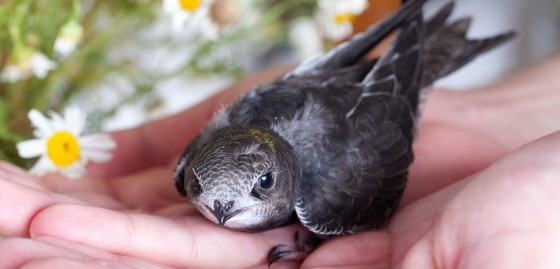
apus apus swift common jerusalem

“The problem is they cannot nest on the ground. They need to nest on high walls. Even in nature they are nesting on big cliffs. In towns the walls are the natural solution for them. The Western Wall is so ancient and for them it is the best place and that is the reason we have already 88 pairs nesting on the Western Wall,” Leshem said.

Leshem added that other buildings besides the Western Wall have swift colonies, including the ancient Church of Nativity in Bethlehem, where tradition says Jesus was born.

“I’m a religious person and I believe the Western Wall is not only an important place for the stones but also for the birds,” Leshem said. “The message is that we are trying now to develop a deeper concept, getting birds and the religious together. The swift is also nesting in the Church of Nativity in Bethlehem and mosques and we want to connect mayors from about 20 big towns where there is a lot of pilgrimage and get them connected to the birds through religion.”

In 2002, researchers Ulrich Tigges and the late Heinrich Mendelssohn conducted a special study of the swift colony at the Western wall, mapping out the 88 nesting sites and ensuring that they were not disturbed during any maintenance of the wall.

Their future, however, is not secure. They are in competition with sparrows, jackdaws and pigeons that also call the holy stones their home. The Friends of the Swifts Association (FSA), headed by Amnon Hahn, is working with Tel Aviv University and the Society for the Protection of Nature in Israel to safeguard the common swift’s future by saving existing nesting sites and designing and building new ones.

In addition, the FSA is setting up educational programs in schools, assisting wildlife rehabilitation centers and carrying out a campaign to increase public awareness of the problems the swifts are facing.

This article is reprinted from the Mideast News Source, The Media Line.

Top image of the Western Wall from Shutterstock
Lower image of common swift from Shutterstock

Read More

1 COMMENT
  1. Once at the Wall a bird dropped “his load” on my shoulder. A Hasid who had lent me his tallit, which was now “soiled” told me it was a sign of good luck. I could only answer that I hoped he was right.

TRENDING

Dan Zaslavsky’s energy tower dream is rising again in Iran and China

The Energy Tower idea never made the leap from drawings and engineering studies to full-scale construction. But nearly two decades after most people stopped talking about it, the concept is quietly evolving in two unexpected places: China and Iran. The concept let dreamers dream and doers do - figuring out more pleasing designs and engineering.

A visit to Amirim, Israel’s first all-vegetarian village in the Galilee

Just 15 kilometers from Tzfat there is a moshav that was founded in the late 50s that was ideologically influenced by organic, vegetarian and vegan principles. My hostess at Ohn-Bar, the tzimmer where I stayed, explained that the people of Amirim were among the pioneers of Israel’s strong vegetarian movement.

Israeli Hydrogen Startup H2Pro Are Trying to Solve Clean Energy’s Hardest Problem

The company has attracted backing from major investors including Breakthrough Energy Ventures, the climate fund founded by Bill Gates, along with industrial partners such as Sumitomo, ArcelorMittal, and Temasek, a multi-billion dollar company that owns Singapore airlines. H2Pro has raised more than $100 million USD and is moving from pilot projects toward commercial-scale deployments.

10 Amazing Facts About the Sidr Tree

Most people in the West have never heard of the Sidr tree. That's strange when you think about it. This tough, thorny desert tree has fed people, bees, birds, and camels for thousands of years. It appears in Islamic tradition. Its honey sells for astonishing prices.

Farmer Focus Sold as Humane and Halal. PETA Says the Reality Is Far Less Ethical

According to documents obtained by PETA, and sent to Green Prophet, Farmer Focus accumulated 40 violations from the Harrisonburg-Rockingham Regional Sewer Authority between January and March 2026 for overly acidic wastewater and excessive pollutant levels.

Yerukim Forms a New Green Economy Where the Money is Really Green

The Yerukim members who pick up the recyclables get to keep the monetary reward, the public earns "green" bills that can be used in shops, and business owners get to be associated with environmentalism.

Choosing Riyadh over Dubai? What Investors Should Know

Saudi Arabia is deploying capital at unmatched scale to catalyze tourism and advanced industry while rewiring its power-and-water backbone. The investable frontier is widening—especially in renewables, grid storage, water efficiency/desal retrofits, and hospitality operating platforms. Prudent investors will insist on phased delivery, enforceable KPIs (energy, water, biodiversity), and RHQ/zone compliance—while pricing political-economy and reputational risks alongside growth upside.

Sell your cooking oil for biodiesel money

Want to make money on old french fry oil? Sell it.

Qatar Alternative Energy Summit Pairs Investors And Innovators

Alternative energy investors and innovators can meet n' greet in Doha, Qatar March 16 and 17.

Here’s How To Implement The Four Pillars Of Employee Engagement

If you throw a party for your work team and they are vegans, don't make it a barbecue. Know the sustainability values of your team to boost moral and retain good people.

Locals From Rishon Fight IKEA

Big Box stores are a pretty new concept in Israel, and thank God that not every Israeli city wants them in their backyard. A word from someone who has see the beautiful farmland around her hometown Newmarket, Ontario stripped and converted into vulgar strip malls of big box shops: they have no place in a healthy and sustainable town or city.

The Jewish National Fund Meets An Inconvenient Truth

According to the JNF, it has transformed thousands of acres of barren land into green forests in Israel. They state that each person emits about 23 tons of carbon per year, estimating that each tree planted can absorb one ton of carbon in its lifetime. That's a whole lot of trees you'd need to be planting. Could so many fit in Israel?

How to quiet noise from construction in your office

Streets need to be resurfaced in New York but the humming and grinding noise is unsettling. Noise is environmental pollution. 

Popular Categories