Ancient Egyptian Mummies Suffered From Clogged Arteries Too

mummie egypt clogged arteryFeeling bad about your junk food diet? New research on Egyptian mummies finds death by clogged arteries.

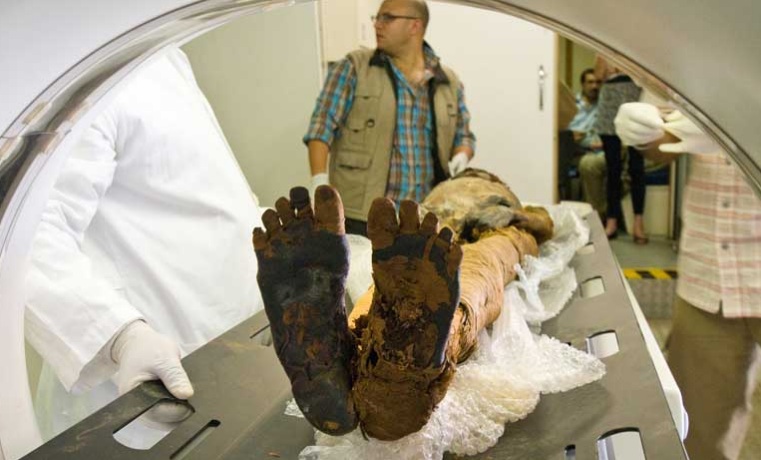
There was no Golden Arches or Krispy Kreme doughnuts for ancient Egyptian royalty. And they weren’t smokers, addicted to the Internet, or couch potatoes. But they do share similar health consequences with the people who do these things today: Their coronary arteries were clogged all the same. A new US-Egyptian research team studying CT scans of mummies — done on a sampling of the elite in ancient Egypt — found that almost half showed evidence of coronary atherosclerosis in one or more of the arteries supplying blood to the heart and brain. The research turns the tables on the understanding of underlying factors of heart disease and stroke.

The discovery also calls into question the perception of atherosclerosis — a buildup of arterial plaque that can result in a heart attack or stroke — as a modern disease. On one of the mummies, Princess Ahmose Meyret Amon born around 1580 B.C. and who died in her 40s, was found to have had blockages in two of her three main heart arteries — and these are blockages that could have led to one or more heart attacks, the researchers report.

She now represents the first person in human history known to have had heart disease.

“Commonly, we think of coronary artery or heart disease as a consequence of our modern lifestyles,” says study researcher Dr. Gregory Thomas, clinical professor of cardiology at UC Irvine: “Our results point to a missing link in our understanding of heart disease, because if this were the case, why would ancient Egyptians with lifestyles so different from ours have atherosclerosis?”

While the American and Egyptian researchers first identified atherosclerosis in a smaller 2009 mummy study, this effort involved whole-body CT scans on 52 mummies housed in Cairo’s Museum of Egyptian Antiquities. Of the 44 with identifiable arteries or hearts, 45 percent had calcifications either in the wall of an artery or along the course of an artery highly suggestive of atherosclerosis.

Half the mummies had hardened arteries

Most of the atherosclerosis was in the large arteries of the body, including the abdominal aorta, as the investigators had found in 2009. However, the current study determined that key small arteries supplying the heart and brain were also involved. About 7 percent of the mummies had obstructions in their heart arteries, and 14 percent had blockages in the arteries to the brain — the carotid arteries — a leading cause of stroke.

“We found atherosclerosis in the heart and carotid arteries to be much more prevalent than previously imagined,” says co-investigator Dr. Michael Miyamoto, a cardiologist at Mission Internal Medical Group in Mission Viejo and a student in UCI’s Health Care Executive MBA program. “Some of the mummies had evidence of vascular disease that was surprisingly widespread, similar to some of our heart patients today.”

It’s hard to know what they ate, but based on evidence, they believe that meat was a smaller part of their diet than ours today. This means that we really don’t understand heart disease as much as we have thought.

“We know that ancient Egyptians had an overall better diet and were more active, yet they still had the same disease we have. This discovery indicates that we don’t understand atherosclerosis and heart disease as well as we think we do,” says Thomas.

The research was presented at the American College of Cardiology’s annual meeting in New Orleans.

Read more health news:

Sweetened Soda Causes A Fatty Liver

Eating Real Food Can Save the Environment

ARC Looks at Faith In Food

Karin Kloosterman
Karin Kloostermanhttp://www.greenprophet.com
Karin Kloosterman is an award-winning journalist, innovation strategist, and founder of Green Prophet, one of the Middle East’s pioneering sustainability platforms. She has ranked in the Top 10 of Verizon innovation competitions, participated in NASA-linked challenges, and spoken worldwide on climate, food security, and future resilience. With an IoT technology patent, features in Canada’s National Post, and leadership inside teams building next-generation agricultural and planetary systems — including Mars-farming concepts — Karin operates at the intersection of storytelling, science, and systems change. She doesn’t report on the future – she helps design it. Reach out directly to [email protected]

Read More

1 COMMENT
  1. Arteries are blood vessels that carry blood rich in oxygen throughout your body. They go to your brain as well as to the tips of your toes. Healthy arteries have smooth inner walls and blood flows through them easily. Some people, however, develop clogged arteries. Clogged arteries result from a buildup of a substance called plaque on the inner walls of the arteries. Arterial plaque can reduce blood flow or, in some instances, block it altogether..*..”

    Enjoy your day http://picturesofherpes.co

TRENDING

Black fathers live longer than non-fathers, new study

Researchers found that fatherhood was associated with lower rates of early death among Black men, while early fatherhood was linked to poorer long-term health outcomes.

Can Scientists Predict Coral Bleaching Before It Happens?

Now researchers at the Woods Hole Oceanographic Institution (WHOI) in the US say they have developed a way to predict coral bleaching five to six months before it occurs, potentially giving reef managers enough time to intervene and save vulnerable corals.

AI data centers are triggering panic, instead of cleantech opportunities

AI may unintentionally become the economic engine that finally modernizes America’s aging grid. California is experiencing a massive AI data center boom, ranking 3rd in the U.S. with 227 operating centers and 54 more in development as of April 2026, according to Stanford.

Abortion Pills, Plan B and Mifepristone and what the new US mail ban means

Abortion pills, often confused with Plan B (the morning-after pill), and historically referred to as RU486 (mifepristone), are part of a broader category of reproductive health medications that women have been using for decades. But they are not the same thing.

SunZia comes online and America’s 11B, and largest renewable project begins wind power

The impact is already being felt. California has broken its wind generation record multiple times in recent weeks as SunZia begins feeding electricity into the grid. It’s a glimpse of what a renewable-powered future could look like when large-scale infrastructure finally comes online. Can we start saying goodbye to Saudi Aramco and Arabian Gulf oil? 

Yerukim Forms a New Green Economy Where the Money is Really Green

The Yerukim members who pick up the recyclables get to keep the monetary reward, the public earns "green" bills that can be used in shops, and business owners get to be associated with environmentalism.

Choosing Riyadh over Dubai? What Investors Should Know

Saudi Arabia is deploying capital at unmatched scale to catalyze tourism and advanced industry while rewiring its power-and-water backbone. The investable frontier is widening—especially in renewables, grid storage, water efficiency/desal retrofits, and hospitality operating platforms. Prudent investors will insist on phased delivery, enforceable KPIs (energy, water, biodiversity), and RHQ/zone compliance—while pricing political-economy and reputational risks alongside growth upside.

Sell your cooking oil for biodiesel money

Want to make money on old french fry oil? Sell it.

Qatar Alternative Energy Summit Pairs Investors And Innovators

Alternative energy investors and innovators can meet n' greet in Doha, Qatar March 16 and 17.

Here’s How To Implement The Four Pillars Of Employee Engagement

If you throw a party for your work team and they are vegans, don't make it a barbecue. Know the sustainability values of your team to boost moral and retain good people.

Locals From Rishon Fight IKEA

Big Box stores are a pretty new concept in Israel, and thank God that not every Israeli city wants them in their backyard. A word from someone who has see the beautiful farmland around her hometown Newmarket, Ontario stripped and converted into vulgar strip malls of big box shops: they have no place in a healthy and sustainable town or city.

The Jewish National Fund Meets An Inconvenient Truth

According to the JNF, it has transformed thousands of acres of barren land into green forests in Israel. They state that each person emits about 23 tons of carbon per year, estimating that each tree planted can absorb one ton of carbon in its lifetime. That's a whole lot of trees you'd need to be planting. Could so many fit in Israel?

How to quiet noise from construction in your office

Streets need to be resurfaced in New York but the humming and grinding noise is unsettling. Noise is environmental pollution. 

Popular Categories