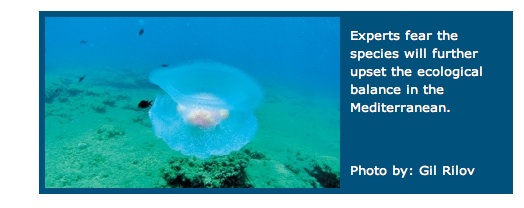
The new species, marivagia stellata, previously not known to science, doesn’t sting but is symptomatic of the environmental woes facing the Mediterranean Sea
A new species of jellyfish found off Israel’s coast the summer poses no threat to bathers but should serve warning to the countries bordering the Mediterranean Sea about the dangers posed by global warming and damage to the environment. Named Marivagia stellata and marked by a translucent hue of blue, patterned with red stars, dots, and streaks, two specimens were caught on the southern edge of Haifa Bay and off the coast of Beit Yannai beach this summer. Measuring 15 centimeters (six inches) in diameter, the fish does not sting humans.
Swimmers view them as a nuisance because of their toxic and painful sting, but scientists have much bigger problems with jellyfish. Hardy survivors, jellyfish thrive in places where overfishing, chemical pollution and rising sea temperatures have killed off other species. Indeed, they serve as a barometer of ocean health.
“It’s bad news,” says Bella Galil, a senior scientist at Israel’s National Institute of Oceanography in Haifa: “We don’t know how this particular species will develop, but the phenomenon causes the displacement, and replacement of native local communities with invasive species, and can destabilize the food chain.”
Surrounded by countries with more than 400 million people, the Mediterranean is one of the most heavily used bodies of water in the world – a fishing grounds, a transportation corridor, and the receptacle for sewage and industrial waste. About a third of the world’s total merchant shipping travels on Mediterranean waters and many species have nearly disappeared because of pollution, including the Mediterranean monk seal.
Marivagia stellata is just the latest in a series of invasive jellyfish species that has been discovered in the eastern Mediterranean over the years. Galil said the new species had probably originated in the Red Sea or Pacific Ocean and had arrived after traveling through Egypt’s Suez Canal, which connects the Red Sea with the Mediterranean.
“The Mediterranean is a very well-studied sea,” said Galil, who was among the team of scientist to identify the new species. “Because the jellyfish was found so close to shore, it is very unlikely that this jellyfish would escape notice in a sea studied so extensively.”
In fact, Marivagia stellata probably found its way in to the Mediterranean at least a few years ago. Galil said a specimen was discovered off the Israeli coast in 2006, but was lost before it could be positively identified. Another specimen was probably caught off the coast of Lebanon in October, according to local media reports, which Galil termed a “bad omen.”
“It means that it just arrived and already has established in a fairly wide population and that it has the potential to increase and go further,” she said.
The Mediterranean has been invaded by successive waves of outside species, a process that began after the Suez Canal opened in 1869 and linked the Mediterranean to the Red Sea and from there to the Indian Ocean, according to Professor Menachem Goren, a marine biologist at Tel Aviv University. Among the more infamous interlopers, is the jellyfish Rhopilema nomadica, which is called “hutit” in Hebrew and began swarming southeast Mediterranean in the 1980s, inflicting painful injuries on unwary swimmers.
“Recently this phenomenon has accelerated and the number of invasive species has increased sharply,” said Goren, who attributed the increase to rising water temperature resulting from global climate change.
Scientists say it is too soon to tell what impact the new species will have. But jellyfish are blamed for clogging water intake pipes at desalination plants and coastal power plants. Marivagia stellata and the increased jellyfish population could disturb the underwater food chain, scientists say. Jellyfish consume the plankton that other fish eat and prey on fish larvae.
Goren was careful not to speculate on the threat posed by Marivagia stellata, but noted that, “another jellyfish almost completely destroyed local fisheries in the Black Sea ten years ago.”
Reprinted courtesy of the Middle East News Source, The Media Line