Cool Down From the August Heat with Low-Energy Sun Tea

Sun tea is nature’s equivalent of the crockpot… minus the electricity.

We each have our own way of dealing with the Middle East’s harsh sun and humidity during the summer, especially in August.  For some it’s sun dresses, for others it’s catching the breeze by the beach, and for some it’s a popsicle.  If none of those options do it for you, how about some low-carbon emitting, low muss and fuss herbal sun tea?  The formula is simple: take your pick of the multitude of herbs currently available, add to water, and let sit in the sun so it can do its thing.

Okay, so maybe it’s a tiny bit more complicated than that.  But not much more.

For your sun tea, you first need an assortment of herbs.  If you’re not familiar with the full spectrum of Middle Eastern spices, check out fellow Green Prophet Miriam’s A-Z guides. Or, if you’d like a more herbal-tea-specific recommendation on what herbs to put in your tea (and there are some surprising ones – rosemary, who knew?) read some of Naomi’s recommendations.

Of course, if you have a green thumb and have lots of herbs readily available in your garden, it doesn’t get much more locavore than that.

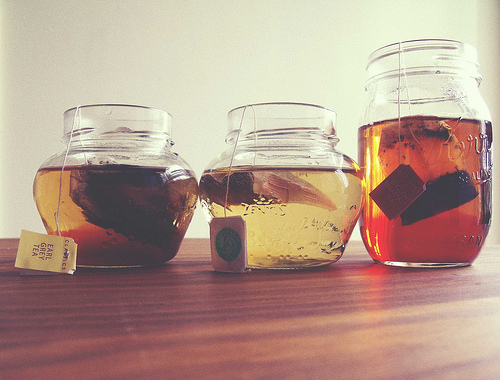
Okay, so you’ve selected your herbs.  Now place them in a glass jar, add sweetener if you wish, and fill the jar with water.  The ratio of herbs to water should be around 1 part herb, 4 parts water.  Since this concoction will probably be very yummy, you might want to use the biggest jar you have.

Tightly seal the jar, give it a good shake, place out in the sun, and come back in about 5 hours.

And here comes the eco-friendly part: you (well, actually the sun) is making herbal tea in a totally electricity-less way.  You’re not boiling all that water, the sun will do it for you.  Energy straight from the source.

Once the tea is brewed, if you’d rather have it cold you can either put in the fridge for a while (removing the herbs first), or add some ice cubes.

Got a recipe for delicious sun tea?  Please share below.

[image via: TheGirlCalledLaura]

Stew some more with these articles on herbs and tea::
6 Herbal Teas – A Natural Way to Cure What Ails You
The ABCs of Traditional Middle Eastern Spice Medicines (A-C)
Recipe: Reap Your Wild Oats to Make Nourishing Outstraw Tea

Karen Chernick
Karen Chernickhttps://www.greenprophet.com/
Much to the disappointment of her Moroccan grandmother, Karen became a vegetarian at the age of seven because of a heartfelt respect for other forms of life. She also began her journey to understand her surroundings and her impact on the environment. She even starting an elementary school Ecology Club and an environmental newsletter in the 3rd grade. (The proceeds of the newsletter went to non-profit environmental organizations, of course.) She now studies in New York. Karen can be reached at karen (at) greenprophet (dot) com.

Read More

TRENDING

5 Reasons Why You Should Save Seeds (and plant them)

Saving seeds from tomatoes, peppers, herbs and flowers helps preserve biodiversity, strengthen food security, and keep heirloom varieties alive. Even a small balcony garden can make a difference.

Make Guarapo De Piña (it’s fermented pineapple juice)

In Cuba, guarapo is simply freshly-pressed sugar cane juice, and is drunk on the spot, without waiting for it to ferment. But in Colombia, Venezuela, Peru and Mexico, they homebrew guarapo from pineapples or oranges, and the fragrant fluid sits on the kitchen counter top to ferment until it's bubbly.

Baby teeth read like tree rings paint a picture of toxins in early life

A new study from the Icahn School of Medicine at Mount Sinai in New York offers a striking insight into how the environments we are born into can quietly shape our brains years later. By analyzing naturally shed baby teeth, the ones tucked under pillows for the tooth fairy, researchers have reconstructed a detailed timeline of exposure to environmental metals during pregnancy and early infancy.

Poop in the East River shows the city’s rat problem and what people like to eat

New York ecology and health can be monitored by a jug of water a week.

Saving Gourmet Wild Plants For The Future

Think of truffles, a gourmet wild food. The European...

Yerukim Forms a New Green Economy Where the Money is Really Green

The Yerukim members who pick up the recyclables get to keep the monetary reward, the public earns "green" bills that can be used in shops, and business owners get to be associated with environmentalism.

Choosing Riyadh over Dubai? What Investors Should Know

Saudi Arabia is deploying capital at unmatched scale to catalyze tourism and advanced industry while rewiring its power-and-water backbone. The investable frontier is widening—especially in renewables, grid storage, water efficiency/desal retrofits, and hospitality operating platforms. Prudent investors will insist on phased delivery, enforceable KPIs (energy, water, biodiversity), and RHQ/zone compliance—while pricing political-economy and reputational risks alongside growth upside.

Sell your cooking oil for biodiesel money

Want to make money on old french fry oil? Sell it.

Qatar Alternative Energy Summit Pairs Investors And Innovators

Alternative energy investors and innovators can meet n' greet in Doha, Qatar March 16 and 17.

Here’s How To Implement The Four Pillars Of Employee Engagement

If you throw a party for your work team and they are vegans, don't make it a barbecue. Know the sustainability values of your team to boost moral and retain good people.

Locals From Rishon Fight IKEA

Big Box stores are a pretty new concept in Israel, and thank God that not every Israeli city wants them in their backyard. A word from someone who has see the beautiful farmland around her hometown Newmarket, Ontario stripped and converted into vulgar strip malls of big box shops: they have no place in a healthy and sustainable town or city.

The Jewish National Fund Meets An Inconvenient Truth

According to the JNF, it has transformed thousands of acres of barren land into green forests in Israel. They state that each person emits about 23 tons of carbon per year, estimating that each tree planted can absorb one ton of carbon in its lifetime. That's a whole lot of trees you'd need to be planting. Could so many fit in Israel?

How to quiet noise from construction in your office

Streets need to be resurfaced in New York but the humming and grinding noise is unsettling. Noise is environmental pollution. 

Popular Categories