
 Fair is foul, but foul is not fair. A new technique for cleaning water using UV light.
Does your drinking water smell foul, or are you worried that chemicals might be damaging your family’s health? Water treatment facilities currently use chlorine that produces carcinogenic by-products to keep your tapwater clean, but Tel Aviv University scientists have determined that ultra-violet (UV) light might be a better solution.
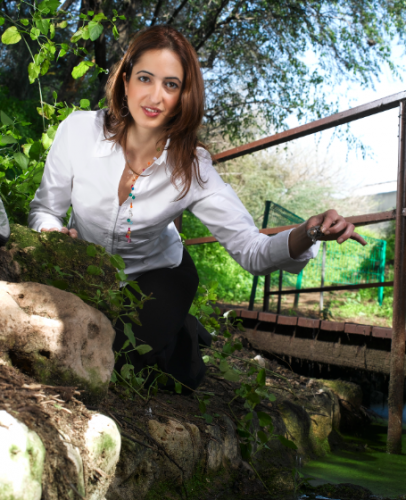
Dr. Hadas Mamane of Tel Aviv University’s Porter School of Environmental Science and Faculty of Engineering (pictured left), with Prof. Eliora Ron and their doctoral student Anat Lakretz of TAU’s School of Mechanical Engineering have recently determined the optimal UV wavelength for keeping water clean of microorganisms. Their approach could be used by water treatment plants as well as large-scale desalination facilities to destroy health-threatening microorganisms and make these facilities more efficient.
“UV light irradiation is being increasingly applied as a primary process for water disinfection,” says Lakretz. “In our recent study, we’ve shown how this treatment can be optimized to kill free-swimming bacteria in the water — the kinds that also stick inside water distribution pipes and clog filters in desalination plants by producing bacterial biofilms.”
This undesired “stickiness” of bacteria to surfaces is called “bio-fouling,” which costs taxpayers and governments billions of dollars each year. “No one should be drinking microorganisms in their water. In addition, when microorganisms get stuck in the pores of the membranes of filters, they create serious problems,” says Lakretz.
Not all UV light is created equal
Irradiation could be used as a pre-treatment to inactivate suspended microorganisms in water, with the secondary goal of preventing bio-fouling. In their study, reported in the journal Biofouling, the researchers looked at targeted UV light wavelengths on the bacteria Pseudomonas aeruginosa, commonly found in drinking water.
The TAU researchers investigated UV wavelengths within between the 220-280 nanometre (nm) scale, and found that any wavelength between 254 and 270 nm effectively cleaned the water. Those in the same region were also best for keeping membranes clear of bacterial build-up in desalination plants, they reported. Special lamps that emit a multi-wavelength UV spectrum — more advanced than the single-wavelength UV lamps found in home water systems — were used.
The UV “zap” also prevented bacterial re-growth in the water after UV inactivation. “The best way to control and kill these micro-organisms was to damage their DNA,” says Lakretz. “The damage that the UV light causes has no known negative effect on the water,” she adds.
In addition, the prevention of biofilm formation by bacteria was UV dose-dependent. The researchers reported less bio-fouling when a bigger dose of UV light was applied to the water around the film.
A light to save lives
The approach is even more helpful against parasites that aren’t adversely affected by chlorine treatment, such as Giarrdia and Cryptosporidium, two harmful parasites that cause severe diarrhea and can lead to death. Children, the elderly and those in developing nations are particularly vulnerable. “Sewage leakage into water supplies poses a big problem in terms of bacterial contamination, and is something UV light could remediate,” says Lakretz.
Small amounts of chorine or other oxidants will still be necessary to make sure that residual bacteria don’t enter the water further along the distribution pipeline. But Lakretz says this new approach to disinfecting water while controlling biofouling can also reduce the amount of carcinogenic by-products that chlorine produces.
The Tel Aviv University team is part of the MAGNET consortium, an Israeli research-oriented project aimed at researching and commercializing “clean” technologies.
::AFTAU