
Iraq Begs Dry Neighbors For Water

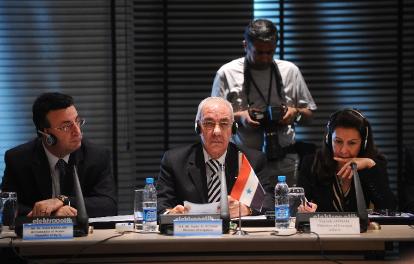
turkey-iraq-syria-waterWith the regional drought carrying on for its third year, Iraq is in a water bind as its rivers dry up. Turkey’s Hurriyet Daily News reports that Baghdad has urged Istanbul and Damascus to release water so that residents of southern Iraq don’t flee of thirst. The problem is that they are suffering from water problems of their own. Left, the three countries’ ministers meet in Ankara.

Iraq, once a food exporter, has to import 80 percent of its supply this year. The country has turned off the hydroelectric power plants over the Euphrates and Tigris Rivers to release dammed waters, but it hasn’t been enough. Now Iraq wants Syria and Turkey, both upstream, to release their own dams. In response, Turkey said they are trying, but global warming is decreasing the water supply there too:

“We even abnegated our electricity production in order to provide Iraq and Syria with more water,” said Environment and Forest Minister Veysel Eroğlu, who hosted the Ankara summit along with Energy and Natural Resources Minister Taner Yıldız.

Eroğlu said climate change was the main cause of the dried-up riverbeds.

“Turkey’s biggest dam, the Atatürk Dam, has been almost emptied. The water level decreased by 10 percent,” he said, confirming that his country had provided a flow of 500 cubic meters per second in line with its legal responsibilities.

Iraq’s water shortage is having disastrous effects. An area that used to be known as the Garden of Eden – 9,00 km. sq. of lush marshes – has shriveled into a parched pach of 760 km. sq.  The depopulated wasteland is becoming a haven for drug smugglers. In April Turkey announced it would release more water to revive the marshes, but apparently that effort hasn’t gotten too far.

But Syria and Turkey have their issues, as well. Climate change has emptied out 160 villages in the northern reaches of Syria, while lakes in Turkey have been drying up or turning into polluted salt water marshes thanks to warming and river diversion.

 

Daniella Cheslow
Daniella Cheslowhttp://www.greenprophet.com
Daniella Cheslow grew up in a car-dependent suburb in New Jersey, where she noticed strip malls and Wal-Marts slowly replacing farmland. Her introduction to nature came through hiking trips in Israel. As a counselor for a freshman backpacking program at Northwestern University, Daniella noticed that Americans outdoors seemed to need to arm themselves with performance clothing, specialized water bottles and sophisticated camping silverware. This made her think about how to interact with and enjoy nature simply. This year, Daniella is getting a Master’s in Geography from Ben Gurion University of the Negev. She also freelance writes, photographs and podcasts. In her free time, she takes day trips in the desert, drops off compost and cooks local foods like stuffed zucchini, kubbeh and majadara. Daniella gets her peak oil anxiety from James Howard Kunstler and her organic food dreams from Michael Pollan. Read more at her blog, TheTruthHerzl.com. Daniella can be reached at daniella (at) greenprophet (dot) com.

Read More

4 COMMENTS
  1. I think that Iraqis obviously can't help themselves so they need foreign help. But as long as this help is conditioned by certain things they should give back to those who give this help, then it's going to backfire against them. I remember when Tony Blair was giving his infamous blair rewards by which he was giving out to his political partners all kinds of small favors which threw him in a category of nepotists.

  2. I think that Iraqis obviously can't help themselves so they need foreign help. But as long as this help is conditioned by certain things they should give back to those who give this help, then it's going to backfire against them. I remember when Tony Blair was giving his infamous blair rewards by which he was giving out to his political partners all kinds of small favors which threw him in a category of nepotists.

  3. I think that Iraqis obviously can't help themselves so they need foreign help. But as long as this help is conditioned by certain things they should give back to those who give this help, then it's going to backfire against them. I remember when Tony Blair was giving his infamous blair rewards by which he was giving out to his political partners all kinds of small favors which threw him in a category of nepotists.

TRENDING

Understanding Food Production: Karl Studer on the Urban-Rural Knowledge Gap

Karl Studer occupies an unusual position in American business. As President of Quanta Services, he oversees electrical infrastructure operations across the United States, Canada, and Australia, managing thousands of employees and multibillion-dollar projects.

Tigris River oil spill highlights Iraq’s environmental oversight and our addiction to oil

A fresh oil spill in the Tigris River, filmed by an Iraqi university student, has reignited concern over Iraq's polluted waterways. From ancient Mesopotamia to modern Basra, the country's dependence on oil has come at a steep environmental and human cost, with activists warning that unchecked contamination is putting ecosystems and public health at risk.

Wave wind energy for Nvidia’s next AI energy boom?

As AI factories consume unprecedented amounts of electricity, NVIDIA is looking beyond chips and data centers to the ocean. The company recently spotlighted Israel's Eco Wave Power and its wave energy projects in Jaffa and Los Angeles, highlighting how AI, digital twins and renewable energy can work together to meet future power demands. The collaboration reflects a growing realization that the future of artificial intelligence may depend as much on clean energy infrastructure as it does on computing power.

5 Reasons Why You Should Save Seeds (and plant them)

Saving seeds from tomatoes, peppers, herbs and flowers helps preserve biodiversity, strengthen food security, and keep heirloom varieties alive. Even a small balcony garden can make a difference.

Weston Higginbotham found dead in a Kyoto forest: is climate anxiety part of the story?

In some ways, Weston has become a symbol of a generation wrestling with environmental and technological anxiety. Friends and family described him as deeply concerned about environmental issues. Reports also noted that he questioned the growing role of artificial intelligence in daily life, even reportedly disagreeing with his mother about her use of AI.

Yerukim Forms a New Green Economy Where the Money is Really Green

The Yerukim members who pick up the recyclables get to keep the monetary reward, the public earns "green" bills that can be used in shops, and business owners get to be associated with environmentalism.

Choosing Riyadh over Dubai? What Investors Should Know

Saudi Arabia is deploying capital at unmatched scale to catalyze tourism and advanced industry while rewiring its power-and-water backbone. The investable frontier is widening—especially in renewables, grid storage, water efficiency/desal retrofits, and hospitality operating platforms. Prudent investors will insist on phased delivery, enforceable KPIs (energy, water, biodiversity), and RHQ/zone compliance—while pricing political-economy and reputational risks alongside growth upside.

Sell your cooking oil for biodiesel money

Want to make money on old french fry oil? Sell it.

Qatar Alternative Energy Summit Pairs Investors And Innovators

Alternative energy investors and innovators can meet n' greet in Doha, Qatar March 16 and 17.

Here’s How To Implement The Four Pillars Of Employee Engagement

If you throw a party for your work team and they are vegans, don't make it a barbecue. Know the sustainability values of your team to boost moral and retain good people.

Locals From Rishon Fight IKEA

Big Box stores are a pretty new concept in Israel, and thank God that not every Israeli city wants them in their backyard. A word from someone who has see the beautiful farmland around her hometown Newmarket, Ontario stripped and converted into vulgar strip malls of big box shops: they have no place in a healthy and sustainable town or city.

The Jewish National Fund Meets An Inconvenient Truth

According to the JNF, it has transformed thousands of acres of barren land into green forests in Israel. They state that each person emits about 23 tons of carbon per year, estimating that each tree planted can absorb one ton of carbon in its lifetime. That's a whole lot of trees you'd need to be planting. Could so many fit in Israel?

How to quiet noise from construction in your office

Streets need to be resurfaced in New York but the humming and grinding noise is unsettling. Noise is environmental pollution. 

Popular Categories