
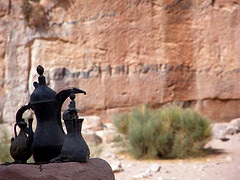
Anyone who has ever experienced Bedouin hospitality will know that the kettle is always on in a Bedouin home: brewing either the strong bitter coffee, or a special infusion of sweet tea, brewed with desert herbs.
If you delve a bit further, you will hear that although the Bedouin know all about life and survival in a hot arid desert, they know where to find water, and know how to treasure the small amount available in desert terrain. With this in mind, based on my researches amongst the Bedouin tribes of the Negev over the past few years (see an example in this green prophet video here), I joined Rabbis For Human Rights (RHR) on a solidarity convoy to the unrecognised Bedouin village of Tel Arad last week.
RHR was one part of a larger forum of groups taking part in the convoy, in order to draw attention to a lack of basic services (and in particular, a lack of water) that the Bedouin face. Some 50,000 Bedouin live in villages in the Negev that are not recognised by the State. Some of these villages existed pre-1948, and others were created by the Government as temporary dwelling areas between 1948 and 1951.
“Non-recognition deprives the villages of any possible official construction planning and elementary infrastructure – water, electricity, sanitation, transportation, education and health,”
– to quote from information supplied by Rabbis For Human Rights. Other Israeli NGO’s involved in the Bedouin struggle for water and fair rights include Physicians for Human Rights, and Bustan. Bustan is arranging a full study day this coming Thursday (the 24th of July), which will concentrate on the issue, and will take participants to un-recognised villages, with a range of speakers from farmers to academics.
This is a good opportunity for anyone who is interested in the many links between humans and the environment, and the politicization of natural resources, to delve deeper in the company of those who live the situation, and those who work in the field.
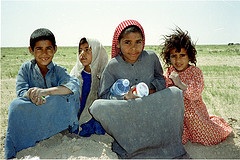
In Tel Arad, I heard villagers talk about their experience: they showed me the containers on trucks that they have to take several kilometres away to buy in water in bulk. This puts up the price of water (as a cubic metre) considerably, rather than the current cost of between 4 – 7 shekels for those of us who have it flowing through taps (and this despite the current crisis over water levels: see recent Green Prophet post on this here).
One villager, Ali Al Nebari, told us:”The Government forbids us to build homes and dig water wells. My house has a demolition order pending…. any solution for settling the Bedouin must consider their traditions and their special bond to nature. Bedouins born in nature blend with it. But the demolition of my family home turns me into a criminal, having committed no crime.”
There are no easy solutions to these issues, and politics and the wider picture of the Middle East muddy these turbulent waters further. But one thing is clear – that resources must be shared amongst all who need them, and using the traditional knowledge of formerly nomadic peoples alongside modern science and technology could be a step forward in solving the water crisis we are currently drowning in.
For further information about the Bustan study day, check out their website here.
Jerusalem-based Rabbis For Human Rights are here (and you don’t have to be rabbinical to be involved)…
More Green Prophet water posts are: ‘cleantech’ , ‘Red-Dead Sea Canal’ , and ‘Zalul & Lachish River’.



[…] Water and the Bedouin: Sharing the Resources AKPC_IDS += "65153,"; __spr_config = { pid: '4ef1a3d5396cef53f100007b', title: 'Proposal for Riyadh's Celebration Hall in Saudi Distorts Bedouin Values', ckw: 'architecture,Bedouin,design,green building,Indigenous culture,Riyadh,Riyahd,Unsustainable development', chan: 'architecture-urban', no_slide: '', slide_logo: false, pub: '2012-02-06 08:06:01', url: 'http%3A%2F%2Fwww.greenprophet.com%2F2012%2F02%2Fcelebration-hall-riyadh-bedouin-values%2F', header: 'RECOMMENDED FOR YOU' }; var content = document.getElementById('simplereach-slide-tag').parentNode, loc; if (content.className){ loc = '.' + content.className; } if (content.id){ loc = '#' + content.id; } __spr_config.loc = loc || content; (function(){ var s = document.createElement('script'); s.async = true; s.type = 'text/javascript'; s.src = document.location.protocol + '//d8rk54i4mohrb.cloudfront.net/js/slide.js'; __spr_config.css = 'document.location.protocol + '//d8rk54i4mohrb.cloudfront.net/css/p/4ef1a3d5396cef53f100007b.css'; var tg = document.getElementsByTagName('head')[0]; if (!tg) {tg = document.getElementsByTagName('body')[0];} if (tg) {tg.appendChild(s);} })(); […]
[…] Attir, would aim to emanate a village that combines traditional Bedouin values with complicated and sustainable tillage techniques and appetite solutions. Thanks to theRead More This entry was posted in Environment and tagged […]
[…] Attir, would aim to create a community that combines traditional Bedouin values with modern and sustainable farming techniques and energy solutions. Thanks to the recent commitment of approximately 10 million NIS from the […]