

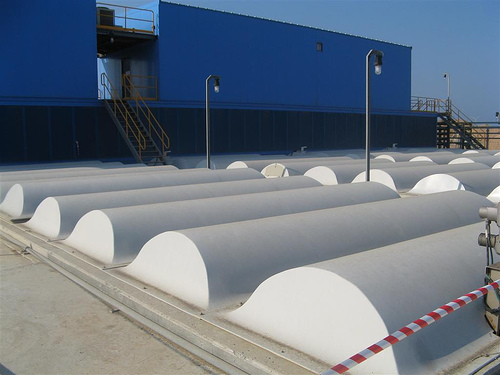
Desalination plant in Israel
Earlier this week, Michael Green wrote about Shimon Peres’ “Peace Valley” project, which will create a canal from the Red Sea to the Dead Sea, as well as a huge tourist complex in the Arava dubbed the “Las Vegas of the Middle East.” Although the Peace Valley is relatively new, plans to either build a channel between the Mediterranean and the Dead Sea or the Red Sea and the Dead Sea have been around for decades. These plans picked up steam at the World Summit in Johannesburg in 2002, where Israel and Jordan introduced the “Peace Conduit,” a Red-Dead canal. The Palestinian Authority subsequently gave its support for the plan. The plans for the Conduit have kept right on rolling within the last few months, as the World Bank began a two-year feasibility study on the project.
Many environmentalists are concerned that the Peace Conduit will have adverse environmental impacts. First of all, the system will require an enormous amount of energy. As water flows downward from the Gulf of Aqaba to the Dead Sea it will produce enough hydro-electricity to power the desalination plants that are to be built near the Dead Sea.
Eilat, however, is elevated, so the water will need to be pumped over Eilat before it can flow downwards toward the Dead Sea. Under the agreement, Jordan will receive the majority of the desalinated water; Amman’s elevation, however, is 1400 meters higher than that of the Dead Sea, so another massive quantity of input will be necessary to pump the water to Jordan. It is unclear where this energy will come from; potentially, Israel, Jordan, and Palestine are setting themselves up for a gross dependence on fossil fuels – with all of their ecological consequences – in order to power this project.
Secondly, although proponents of the project argue that it will “Save the Dead Sea,” it is entirely possible that the project will actually harm the rapidly-fading landmark. Initial scientific predictions reveal that the 2 billion cubic meters of water that will be pumped from the Red Sea every year will just sit on top of the Dead Sea – instead of mixing in – and will cause growth of algae and gypsum. Furthermore, it is unclear where the brine from the desalination plants will be dumped. If they are to be dumped in the Dead Sea, they could potentially alter the ecology of the water.
The Dead Sea is a huge tourist destination in both Israel and Jordan because of its therapeutic qualities, so if the Peace Conduit changes the composition of the water it could have disastrous results for the tourist industry. This is also extremely significant to the Palestinian Authority, who also control a portion of the Dead Sea, and who will need opportunities to improve their floundering economy as they build their future state.
Lastly, the Peace Conduit could be quite damaging for the Arava Valley. The valley contains underground aquifers. The pipe will run through the valley, so seawater from the Red Sea leaks out of the pipe, it could contaminate the aquifer, rendering it unusable. Additionally, the Arava Valley is located in the Great Seismic Valley. Earthquakes could greatly harm the Conduit, which poses another threat for contamination of groundwater. Since the Arava is a highly productive agricultural center, this is another risk that is both ecological and economic.
Although Jordan’s King Abdullah does not appear to be too pleased about Peres’ “Peace Valley” shenanigans, leaders from Jordan, Israel, and the Palestinian Authority are all in agreement on their support for the Peace Conduit, which could be equally as damaging. For now, we will have to wait for the World Bank feasibility results, and hope that our leaders do the same.
Image Credits: Sasyl and young_geologist
More politics and water from the Middle East:
Water Planning, Problems and Propositions For Palestinians
Study It Dead or Red, The Politics of Water
Help The Environment Ministry Collect Fines from Green Criminals
The Water Crisis and the Electric Car
Electric Vehicles: Good for Climate, Bad for Water?



Israel’s biggest engineering projects are largely funded by the sale of Israel Bonds at less than prime interest rates. The Bonds’ last big project when I began working for them was Ashdod Port, a multi-billion dollar task that was deemed a success. I was hired to write about the new winner, The Med-Dead Canal project. The goal was to raise half a billion dollars for it in the first year. So off I rode to the Tel Aviv Hilton to use my writing talent to raise some of the funds during its inaugural, kickoff convention.
The Dead Sea was drying up and fast. Dangerous sinkholes were appearing on the exposed shore. The Southern end had already been desiccated and water had to be pumped ten miles to keep the hotels relevant. The new scheme would use gravity to pump Mediterranean water 1300 ft below sea level to refill the Dead Sea. After the canal was built, a Red-Dead Canal would be built from Eilat to the Dead Sea for the same purpose. I was coached to write about the beautiful water parks, fishing holes and beaches along the routes of both canals.
So, on night one, I took all the literature and reports up to my room and prepared for my assignment. It was the section on environmental effects that ruined my night. The chemical compositions of both Med and Red water were so vastly different than the Dead Sea’s potassium, potash and magnesium mix, that the sea water wouldn’t mix with the Dead
Sea. The sea water would float on top of the Dead Sea creating a greenhouse effect that would boil the Dead Sea to Death. Before then, some Med chemicals would mix and create
a witch’s brew of “snowballs.” The greenhouse effect was so pronounced that one Ben Gurion University professor named Branover was actually running electric turbines on Dead Sea water covered with a layer of common seawater.
A Red-Dead Canal would be even worse. Not only would the same chemical effects take place, but leaks would eventually turn the saline Negev aquifer salty, ruining Israel’s natural desert water reserve supply.
In the morning I turned to my boss with all the environmental objections. He said, “Don’t worry. The canal is not going to ever be built. But we sunk too much into the project to stop selling it.”
“So I’m here to fool these delegates?” I asked.
“We’ll invest the money in better bonds and everyone will get their dividends. No one will complain.”
I cannot understand the resistance – specifically the idea that a “rapidly fading landmark” as the author calls it, will somehow be “ecologically” affected by the addition of seawater. Firstly – what ecology? The dead sea is indeed – dead. There is no life in it, and the addition of seawater, or brine for that matter will make it – salty? Probably less than it now is, regressing it some 200 years maybe? And how is that a problem?
There is a concern about the Red Sea, and that is valid. Though this is not an obstacle that cannot be overcome. Using many pumping locations further out in the sea maybe?
Why is it that human progress must always be pitted as totally damaging to nature in the minds of environmentalists? If we had not done all those things we did to get to where we are, we would not be able to exert the little control over our lives we do exert. Besides, we must come off of this idea that Nature is entirely positive, subject to some misterious order and totally benign.
Random events occur ALL the time in nature, they cause much damage – weather and climate are chaotic systems – but by and large, life adapts. That is the very nature(no pun intended) of life.
This canal idea scares the living daylights out of me. Look what happened after Suez — mollusks and jellyfish now overtake the Med Sea. I am sure there are other negative environmental consequences.
Another potential ecological concern is that water pumped from the gulf would increase the turbidity of the Red seawater. Consequently, the polyps that are already severely stressed because of agricultural and economic factors, will face another obstacle, lack of the clear water that sustains them. For the northernmost reef in the world to suffer for the sake of the “Taalat HaYamim” would be a travesty.