

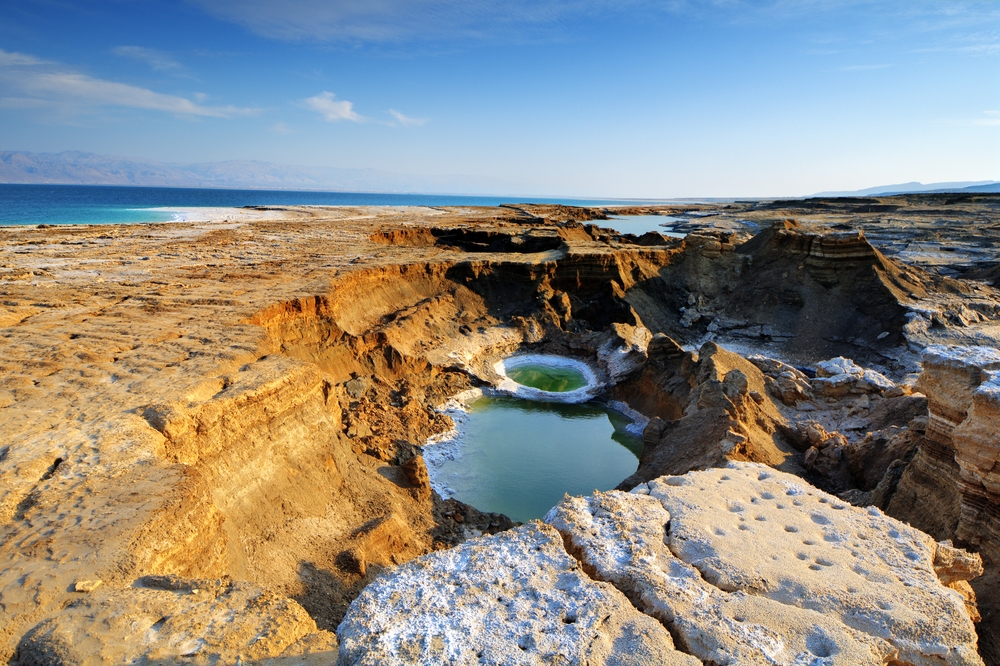
 Watch your step, kibbutzniks and spa-mavens! Diminishing water levels in the Dead Sea are causing changes to surrounding groundwater flows. Freshwater moves through the aquifer, dissolving subterranean salt deposits and creating underground voids, which cause surface collapse. Dramatic and unpredictable, sinkholes appear at the alarming rate of nearly one a day.
First observed around the Dead Sea in the 1980s, geologist Eli Raz estimates that today there are over 3,000 on the Israeli side alone. “Sinkholes are caused by human irresponsibility,” he told Slate Magazine, “For more than 30 years, I’ve been trying to warn everyone—especially government officials—that if we don’t do something about the situation in the Dead Sea, the sinkholes will swallow us up.”
The Dead Sea (which is technically a lake fed by the Jordan River) spans more than 60 miles. Its shorelines include Jordan, the West Bank, and Israel. Located 1,388 feet below sea level, it’s the lowest place on earth, and with no outlet for minerals deposited over millennia, its waters have become ten times saltier than the north Atlantic.
In the past half century, the populations of Jordan, Israel, and the Palestinian territories have ballooned from 5 million to over 20 million. Along with Syria and Lebanon, these thirsty nations pull water from the Jordan River and its tributaries, cutting flow to the Dead Sea to less than 26 billion gallons per year compared to 343 billion gallons a century back.
Next, factor in Dead Sea industries like the Israel Chemicals Company and the Jordanian Arab Potash Company. To support their mineral extraction processes, these companies extract enormous volumes of seawater, accounting for about 40% of the water level decrease.
As a result, the Dead Sea is shrinking over three feet a year and receding from the shore at an even greater clip. There are loads of videos to be found online showing the changes: the one below is short, vivid, and refreshingly void of conspiracy theories and New Age prophecy:
[youtube]http://youtu.be/3x2JlBctc7Y[/youtube]
Several nations have jurisdictions over the Sea, so remedies are fraught with international complexity. Ongoing debate undermines action. And doing nothing is the worst alternative of all.
Signs in Hebrew, English, and Arabic warn to beware of sinkholes. Raz laughs, “How can you be careful? No one knows where the next one will open up. It’s only a matter of time until we have to leave this entire area.”
To date, no one has yet died in an Israeli sinkhole, but there have been serious injuries. Sinkholes are a direct threat to agriculture and tourism, the main livelihoods of the kibbutzim and entire Dead Sea region. Jordan is also investing heavily in regional tourism, and the Palestinians plan to develop resorts in their future state.
The unique Dead Sea natural habitat is also at risk as the surrounding ecosystem includes spring-fed oases that support a rich range of plant and animal wildlife.
How can an environmental catastrophe be averted? One possibility is a World Bank plan to replenish the Dead Sea with water from the Red Sea. Environmentalists warn that the ecological effects of the long-touted Red-Dead project might drive the nail in the sea’s coffin.
Raz prefers to see the Dead Sea’s problems solved by rehabilitating the Jordan River and utilizing desalination to supply water to Israel’s densely populated Mediterranean coast. But something must be done, and done now.
“Water should not be a reason for conflict—there isn’t enough to argue about, certainly not in the Dead Sea basin. Water should be the reason for smart, regional cooperation.” says Raz, “There’s an expression from the army: ‘If we can’t hang onto each other, we’ll be hung next to each other.’ But no one seems to get it.”



[…] Mysterious Sinkholes Threaten to Sink the Dead Sea (greenprophet.com) […]
[…] Mysterious Sinkholes Threaten to Sink the Dead Sea […]
[…] Mysterious Sinkholes Threaten to Sink the Dead Sea (greenprophet.com) […]
[…] Mysterious Sinkholes Threaten to Sink the Dead Sea | Green Prophet. […]