

 An Israel Chemicals Dead Sea mining plant; Photo by Haaretz/Ofer Vaknin
Despite the recent heavy rains and flooding in Israel that helped replenish water in the Dead Sea, the salt lake in the ‘lowest point on earth ‘ is still suffering from a sharp decline in water levels due in part to the ongoing mineral harvesting activities by Israel and Jordanian chemical industries who cause the water to disappear further by evaporating it to extricate bromides and other chemicals for use in chemicals as well as in the fertilizer industry.
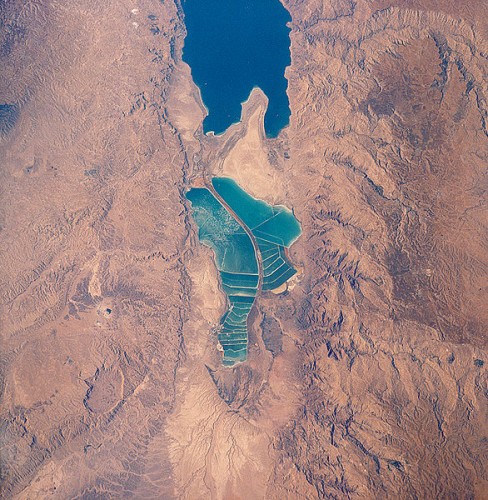
Aerial view of “divided Dead Sea” showing mining evaporation pans at the lower end of the Dead Sea
The future of one of the earth’s true natural wonders may be in even greater jeopardy if plans go through for Israel Chemicals (ICL), which is one of the largest Dead Sea mineral extractors, to be purchased by a large Canadian fertilizer producer, Potash Corporation of Saskatchewan.
The Canadian firm is determined to purchase Israel Chemicals, which itself has a market value of nearly $17 billion USD, despite local fears that this would accelerate the mining of Dead Sea minerals even further.
This fear was expressed recently by Israel’s outgoing Environmental Protection minister Gilad Erdan, who said that “Potash Corp holds a global monopoly in potash production and can influence the prices of potash internationally against the interests of the State of Israel by exploiting its resources.”
Erdan went on to say that Israel Chemicals should not be allowed to merge with the large Canadian firm as it would create a “real endangerment of economic, social and environmental interests of the highest priority.
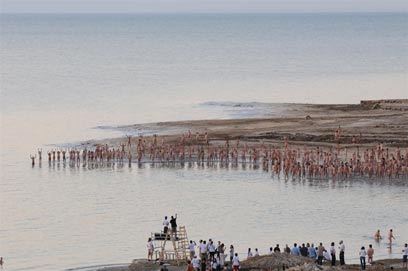
Spencer Tunick’s Naked Dead Sea photo shoot
Besides the issues involving the mineral mining industries at the Dead Sea, the salt lake also is a major tourism industry location for both Israel and Jordan. The activities of chemical companies like Dead Sea Chemicals has resulted in water levels in the areas of a number of Dead Sea hotels, beaches and health spas actually rising and threatening to flood these resort locations if measures are not taken to prevent this from occurring.
In order to bring more public attention to the lake’s plight, internationally renowned “nude art” photographer Spencer Tunick did a photo shot of 1,000 nude Israelis and tourists at the Dead Sea in September 2011. While this project did bring attention to plight of the area’s tourism industry, it apparently did not have any affect on the mining operations which still continue unabated to this day.
The large profits created by companies like ICL, which claims to be the largest employer in the Nevev region of Israel, has caused the Finance Ministry, how headed by former journalist and Yesh Atid centrist party leader Yair Lapid, to not interfere with the operations of company which contributes NIS 12 billion ($ 3.34 billion) to Israel’s annual GDP.
Lapid declined to “comment on the matter” in a Jerusalem Post article, and Potash Corporation (the company trying to purchase ICL) refused to comment as well. As a result, time may be definitely running out for a body of water that is predicted to run dry by the year 2050.
There is definitely ethical issues at stake when a country sells its natural resources to other countries. Concerned about the issue, we wrote to Daniel Orenstein, an outspoken environmentalist in Israel, who is also Assistant Professor at the Faculty of Architecture and Town Planning at the Technion – Israel Institute of Technology; and co-author/editor of the new book Between Ruin and Restoration.
He writes to Karin Kloosterman, Green Prophet’s editor:
“I think your concern is well placed. I am not a big fan of distancing the ownership of natural resources from the source. It doesn’t bode well for local concerns (workers rights, environmental protection) – that said I’m wondering if a Canadian company would have better/stronger principles than the Israeli company they would replace (an argument that always surfaced during the NAFTA debates vis-a-vis American companies relocating to Mexico).
“Sustainability principles usually emphasize local control and decision making with regarding to natural resources. And I think your question is an excellent one and needs to be addressed – what is going to assure that the largest chunk of profits of Israel’s resources go to its citizens and not to the shareholders of an international company? – for this we’d have to check the percentage of royalties going to the public, which has been historically ridiculously low in Israel.
“And, of course, what kind of social/economic/environmental obligations are written into the deal (but I’d probably need a team of international corporate lawyers to figure if that one works to our – local – benefit).”
These are all good points that we plan on following up on.
Meanwhile…
More articles on Dead Sea environmental issues:
Steep Decline of Dead Sea Levels Due to Fertilizer Industry
1,000 Israelis Strip Naked to Save the Dead Sea
As Israel Chemicals’ Profits Soar The Dead Sea Suffers
Time Running Out for Saving Dead Sea Hotels
Lower photos via ICL Dead Sea Works


Hi Maurice and Karin,
Here’s a [Hebrew] update just posted by the Green Movement (which joined Tzipi Livni’s “Tnua” Party prior to the last election). For non-Hebrew readers, it basically states that Israel Chemicals decided to scrap the deal in light of the public criticism and the belief that control of Israel’s natural resources should not be handed over to a foreign company.
For your consideration!
Daniel.
בוטלה עסקת המיזוג של כיל-פוטאש! החברה לישראל, בבעלות משפחת עופר, הוציאה הודעה דרמטית ועדכנה כי לאור הביקורת הציבורית הרחבה, הוחלט במשרדי החברה, לאחר דיונים מרתוניים לבטל את עיסקת מיזוג חברת כימיקלים לישראל עם ענקית האשלג הקנדית פוטאש.
ניר גלעד, מנכ”ל החברה: “לאחר שנבחנו כל ההיבטים ולאחר שהתגבשה ההבנה כי העסקה אף מנוגדת לתקנון חברת כיל – הגענו למסקנה המתבקשת כי יש לבטל את העסקה, בין השאר כי לא ניתן להתעלם מכך שאסור למכור את השימוש בים המלח, משאב טבע לאומי, לחברה זרה, חסרת זיקה וקשר למדינה”.
Great news. Thanks for sharing.