Blind Shrimp Spared from Extinction at Bible Zoo in Jerusalem

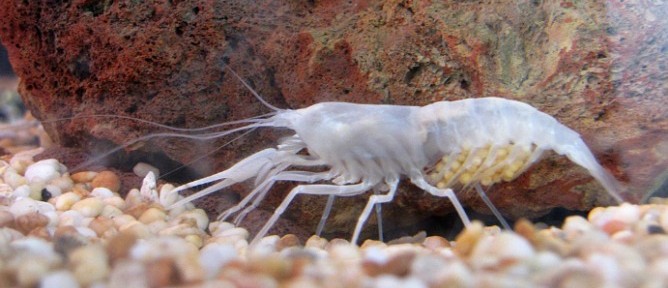
Typhlocaris Galilea, blind shrimpWhen Noah was told by God to load two of all animals onto a special hand-built ark, there was no mention of the blind shrimp species found only in Israel. There probably was no need to protect the small crustacean living happily underwater – until now.

Human development has put this blind shrimp, or prawn to be more precise (Typhlocaris Galilea), at severe risk of extinction.

The prawn is found in a remarkable habitat: It lives in one chamber of an ancient Roman cistern in a forgotten city on the north shore of the Sea of Galilee. Water from the chamber doesn’t flow in or out directly, but seeps through the clay bottom, and then into other sections.

There are others similar to these blind shrimp in cave systems around the world, including Mexico, but these shellfish “are really the last on earth,” says Nicole Wexler, development director for the Tisch Family Zoological Gardens, also known as the Jerusalem Biblical Zoo.

Habitat threatened as groundwater use changes

Described first in 1909, the blind prawns are now critically endangered because the only place they can live is in the En-Nur pool, where groundwater drilling and pumping has leaked foreign water into their environment, changing the composition and temperature.

The three-inch-long, transparent creatures aren’t especially cute.

The three-inch-long, transparent creatures may not be especially cute, nor do ecosystems depend on their survival. But the Israel Nature and Parks Authority approached the zoo to help keep the species alive through a dedicated behind-the-scenes breeding program.
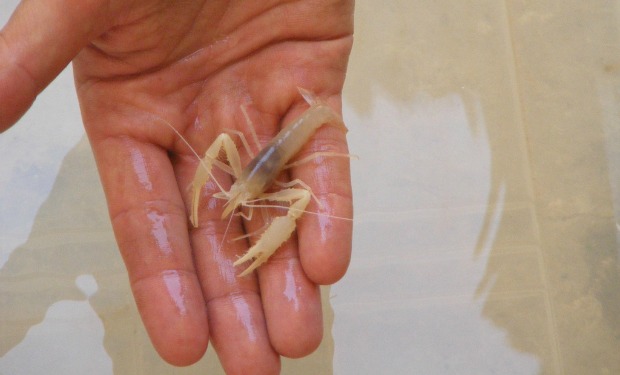
Typhlocaris Galilea, blind shrimp

This “genetic bank” — an ark of sorts, Wexler tells ISRAEL21c – is a little windowless hut to limit the prawns’ exposure to light, and the water is carefully balanced with just the right amount of salinity and dissolved gases they need in order to thrive. Someday they may be able to be returned to their native habitat.

“One of the functions of a modern zoo is to act as a genetic ark for critically endangered species — particularly where their natural environment is disappearing – to ensure that they do not become lost to us forever,” said Shai Doron, director of the Biblical Zoo.

Animals from Persia and Arab countries fill the ark

There are many other breeding and conservation efforts at the Jerusalem zoo. Zoologists there have done remarkable work with Persian fallow deer, believed to be extinct until the 1950s when a few were found in Iran and brought to Israel to be bred. Also once native to Israel, the deer decades later are now back in the wild in the north of Israel and in the Jerusalem hills.

The European otter, also a threatened species, has been bred successfully at the zoo as well as the sand cat, the Negev tortoise and the Griffon vulture, says Wexler.

The zoo was also the first in the world to breed captive Asian elephants using artificial insemination.

Recently, Israel’s nature authority and zoos have had to deal with an influx of gray wolves entering Israel from the north. It appears the animals are fleeing troubles in surrounding Arab countries, such as Lebanon.

“It’s so endangered and hunted so that’s why we are seeing an influx into Israel,” says Wexler.

Wolves, among them the gray wolves, will be part of a new exhibit opening at the zoo in the spring in June. “It will be stocked with wolves rescued from the wild and in time they will breed and then we’ll see what we can do for them next.”

Wexler argues that only zoos can accomplish this species rescue work.

“Today the world’s natural habitats are so threatened that without zoos these animals aren’t going to be preserved,” Wexler says. “We participate in both local and global programs to save animals and it’s important work as a whole.”

This story is reprinted from ISRAEL21c – www.israel21c.org

Karin Kloosterman
Karin Kloostermanhttp://www.greenprophet.com
Karin Kloosterman is an award-winning journalist, innovation strategist, and founder of Green Prophet, one of the Middle East’s pioneering sustainability platforms. She has ranked in the Top 10 of Verizon innovation competitions, participated in NASA-linked challenges, and spoken worldwide on climate, food security, and future resilience. With an IoT technology patent, features in Canada’s National Post, and leadership inside teams building next-generation agricultural and planetary systems — including Mars-farming concepts — Karin operates at the intersection of storytelling, science, and systems change. She doesn’t report on the future – she helps design it. Reach out directly to [email protected]

Read More

1 COMMENT

TRENDING

Dan Zaslavsky’s energy tower dream is rising again in Iran and China

The Energy Tower idea never made the leap from drawings and engineering studies to full-scale construction. But nearly two decades after most people stopped talking about it, the concept is quietly evolving in two unexpected places: China and Iran. The concept let dreamers dream and doers do - figuring out more pleasing designs and engineering.

A visit to Amirim, Israel’s first all-vegetarian village in the Galilee

Just 15 kilometers from Tzfat there is a moshav that was founded in the late 50s that was ideologically influenced by organic, vegetarian and vegan principles. My hostess at Ohn-Bar, the tzimmer where I stayed, explained that the people of Amirim were among the pioneers of Israel’s strong vegetarian movement.

Israeli Hydrogen Startup H2Pro Are Trying to Solve Clean Energy’s Hardest Problem

The company has attracted backing from major investors including Breakthrough Energy Ventures, the climate fund founded by Bill Gates, along with industrial partners such as Sumitomo, ArcelorMittal, and Temasek, a multi-billion dollar company that owns Singapore airlines. H2Pro has raised more than $100 million USD and is moving from pilot projects toward commercial-scale deployments.

I Went Looking for Jerusalem. I Found Oskar Schindler

  I did not go looking for Oskar Schindler. But...

Desalination experts debunk Aqua Solaire, the floating desalination barge

AI makes it easy to dream, develop, and create images of what could be world-changing ideas, until the reality sets in. A new project making the rounds is Aqua Solaire, an allged French concept for a solar-powered desalination vessel designed to bring drinking water to coastal communities facing drought, storms, and infrastructure failures.

Yerukim Forms a New Green Economy Where the Money is Really Green

The Yerukim members who pick up the recyclables get to keep the monetary reward, the public earns "green" bills that can be used in shops, and business owners get to be associated with environmentalism.

Choosing Riyadh over Dubai? What Investors Should Know

Saudi Arabia is deploying capital at unmatched scale to catalyze tourism and advanced industry while rewiring its power-and-water backbone. The investable frontier is widening—especially in renewables, grid storage, water efficiency/desal retrofits, and hospitality operating platforms. Prudent investors will insist on phased delivery, enforceable KPIs (energy, water, biodiversity), and RHQ/zone compliance—while pricing political-economy and reputational risks alongside growth upside.

Sell your cooking oil for biodiesel money

Want to make money on old french fry oil? Sell it.

Qatar Alternative Energy Summit Pairs Investors And Innovators

Alternative energy investors and innovators can meet n' greet in Doha, Qatar March 16 and 17.

Here’s How To Implement The Four Pillars Of Employee Engagement

If you throw a party for your work team and they are vegans, don't make it a barbecue. Know the sustainability values of your team to boost moral and retain good people.

Locals From Rishon Fight IKEA

Big Box stores are a pretty new concept in Israel, and thank God that not every Israeli city wants them in their backyard. A word from someone who has see the beautiful farmland around her hometown Newmarket, Ontario stripped and converted into vulgar strip malls of big box shops: they have no place in a healthy and sustainable town or city.

The Jewish National Fund Meets An Inconvenient Truth

According to the JNF, it has transformed thousands of acres of barren land into green forests in Israel. They state that each person emits about 23 tons of carbon per year, estimating that each tree planted can absorb one ton of carbon in its lifetime. That's a whole lot of trees you'd need to be planting. Could so many fit in Israel?

How to quiet noise from construction in your office

Streets need to be resurfaced in New York but the humming and grinding noise is unsettling. Noise is environmental pollution. 

Popular Categories