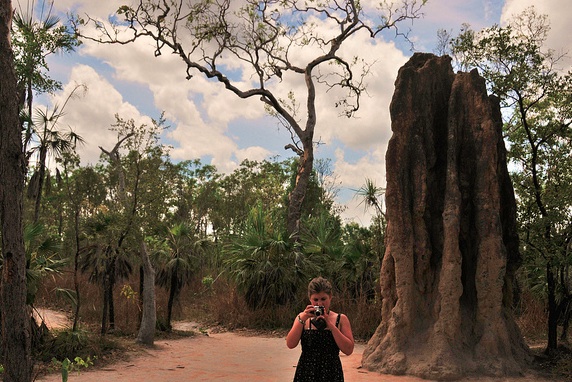
Termite Mounds Inspire Energy Neutral Buildings

termite mound, adelaide, biomimicryMr. Dubai, why not build your hotel like a termite would?

Green Prophet has written many articles on green building, and the revival of beautiful earth architecture in the Middle East. Earth architecture is certainly a more sustainable and interesting alternative solution – for those lucky enough to own some rural land, but can buildings made from earth be a viable solution for cities? Can earth architecture sustain the ever increasing urban population?

Personally I do not think so. If the entire population of New York, for example, were to live in earth buildings, the total surface area required to fit everyone would be huge. In the end the per capita carbon foot print may be even larger (more roads will be required and greater distances travelled which releases more CO2 for example).

Given that in 2008, for the first time in history, more than half of the human population lived in urban areas and that by 2030, especially in the developing world, towns and cities are expected to harbor up to 81% of the world population; how and what should sustainable architecture and living in urban areas look like?

One solution is to observe nature, and apply its solutions to “human problems”. Nature has had 3.8 billion years’ worth of evolution and trial and error to perfect solutions so that it can become self-sustaining, so learning from it seems like a clever idea.

Biomimicry essentially seeks inspiration from natures’ genius and creativity to improve efficiency and sustainability in the “human” world we have created.  A perfect example is how termite mounds have inspired clever ventilation systems in architecture that reduce energy usage and costs.

Natures’ solution:

Termites farm their own food source, a type of fungus, inside the 1 to 3 meter tall mounds they build from debris and soil. This fungus must be kept at exactly 30.5 °C, while temperatures outside range from 2 °C at night to 40 °C during the day.

Termites have devised (links to PDF) a system of vents and channels inside the mounds so that the temperature inside the mound can be maintained constant at 30.5 °C (side note: will global warming affect this? How will termites adapt? Will they adapt quick enough?).

Termites then open and close a series of vents throughout the mound so that air can circulates in a way that heats or cools the mounds.

Application to modern construction:

This “passive ventilation” system of adjusted convection currents has been applied by architects to design buildings like the Eastgate center in Zimbabwe. The Eastgate center is designed to draw outside air into the building’s floor and offices; the air is then warmed if the building mass is warmer than the air or cooled if the building mass is colder than the air before exiting via chimneys at the top (which are opened or closed depending on the required internal temperatures).

This system is so efficient that the Eastgate complex does not need to use air conditioning , as a result it has avoided $3.5 million in air conditioning equipment and uses only 35 % of the energy required for temperature regulation as a conventional building of similar size, with similar exterior temperatures.

These cost savings have translated into 20% lower rental rates than for tenants living in nearby buildings as well as a significant reduction in the buildings’ environmental impact.

Now, given that CO2 emissions are expected to double in the next 30 years in the Middle East, and emissions from air conditioning (especially in the Gulf states) also contributes to the regions’ carbon foot print ; self thermoregulating buildings in the Middle East could realistically accommodate increasing urban populations while reducing the carbon footprint from air conditioning.

Oil rich countries have the luxury of being a little more extravagant in their construction choices; why not build smartly like termites do? Mr Dubai, why not build your hotel like a termite would?

Image via 1234abcd

Linda Pappagallo
Linda Pappagallohttps://www.greenprophet.com/
Linda's love for nature started when at the age of eight she discovered, with her dog, a magical river in the valley of a mountainous region in Lebanon. For four years Linda and her dog explored along the river, until one day she saw construction scrapers pushing rock boulders down the valley to make way for new construction sites. The rubble came crashing into the river destroying her little paradise, and her pathetic reaction was to shout at the mechanic monsters. Of course that was not enough to stop the destructive processes. As she continued to observe severe environmental degradation across the different places she lived in the Middle East and Africa, these terrible images remained impressed in her mind. However, environmental issues where not her first love. Her initial academic and career choices veered towards sustainable economic development, with particular interest in savings led microfinance schemes. Nevertheless, through experience, she soon realized a seemingly obvious but undervalued concept. While humans can somewhat defend themselves from the greed of other humans, nature cannot. Also nature, the environment, is the main “system” that humans depend on, not economics. These conclusions changed her path and she is now studying a Masters in International Affairs with a concentration in Energy and the Environment in New York. Her interests lie on ecosystems management: that is how to preserve the integrity of an Ecosystem while allowing for sustainable economic development, in particular in the Middle East and Africa.

Read More

TRENDING

Etihad offers free travel insurance to any visitor to the UAE

Talk about a way to woo your visitors. Etihad, the UAE's national carrier has decided to offer free travel insurance to visitors heading to the UAE.

Bricks and Minifigs, and the Future of Circular Play

A second-hand LEGO marketplace keeps plastic bricks circulating for years instead of ending up forgotten in basements or discarded in landfills. It gives children access to building materials at lower prices. It extends the lifespan of a product that was originally designed to last generations.

Barnacle glue could fix coral reefs, inspire new advances in building and medicine

Aalto University researchers create a protein-based adhesive inspired by barnacles and mussels that works underwater and could aid coral reef restoration.

Why wombats have cubed poop – with photos

Why is wombat poop cubed? Plus great photos.

OPEC and energy stocks in the UAE – insight from eToro

Energy equities are responding unevenly to the evolving landscape. Companies with direct exposure to UAE production growth and infrastructure are benefiting from increased activity expectations, while global oil majors face a more mixed outlook.

Yerukim Forms a New Green Economy Where the Money is Really Green

The Yerukim members who pick up the recyclables get to keep the monetary reward, the public earns "green" bills that can be used in shops, and business owners get to be associated with environmentalism.

Choosing Riyadh over Dubai? What Investors Should Know

Saudi Arabia is deploying capital at unmatched scale to catalyze tourism and advanced industry while rewiring its power-and-water backbone. The investable frontier is widening—especially in renewables, grid storage, water efficiency/desal retrofits, and hospitality operating platforms. Prudent investors will insist on phased delivery, enforceable KPIs (energy, water, biodiversity), and RHQ/zone compliance—while pricing political-economy and reputational risks alongside growth upside.

Sell your cooking oil for biodiesel money

Want to make money on old french fry oil? Sell it.

Qatar Alternative Energy Summit Pairs Investors And Innovators

Alternative energy investors and innovators can meet n' greet in Doha, Qatar March 16 and 17.

Here’s How To Implement The Four Pillars Of Employee Engagement

If you throw a party for your work team and they are vegans, don't make it a barbecue. Know the sustainability values of your team to boost moral and retain good people.

Locals From Rishon Fight IKEA

Big Box stores are a pretty new concept in Israel, and thank God that not every Israeli city wants them in their backyard. A word from someone who has see the beautiful farmland around her hometown Newmarket, Ontario stripped and converted into vulgar strip malls of big box shops: they have no place in a healthy and sustainable town or city.

The Jewish National Fund Meets An Inconvenient Truth

According to the JNF, it has transformed thousands of acres of barren land into green forests in Israel. They state that each person emits about 23 tons of carbon per year, estimating that each tree planted can absorb one ton of carbon in its lifetime. That's a whole lot of trees you'd need to be planting. Could so many fit in Israel?

How to quiet noise from construction in your office

Streets need to be resurfaced in New York but the humming and grinding noise is unsettling. Noise is environmental pollution. 

Popular Categories