
Saudi’s Soaring Construction Industry Could Negate Costly Water Investments

saudi economic city construction

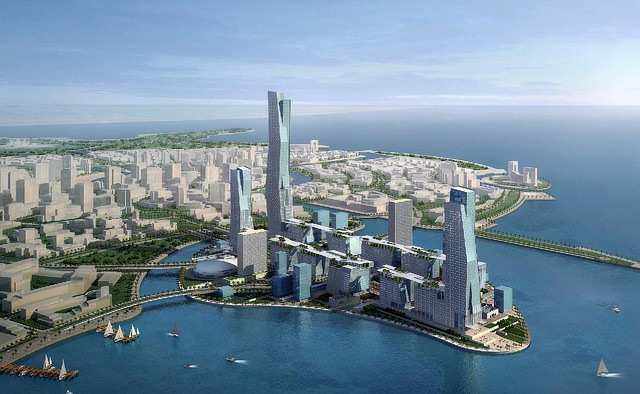
Saudi Arabia is investing huge sums to diversify its water supply, while at the same time fanning a booming construction industry. Will the latter negate the former?

Desertification, depletion of underground water sources, and lack of perennial rivers or permanent water bodies are among Saudia Arabia’s greatest environmental challenges. In part, these are being met by pouring money into energy-hungry desalination facilities.

With oil reserves overestimated by 40%, and peak oil on the horizon, the Royals are realizing the need to diversify. Construction Week reported that over the next 15 years, the Gulf country will invest $53 billion on water projects, 70% of which will be devoted to sewage and wastewater treatment plants.

Arabian Business recently reported that Saudi entered into water and sanitation contracts worth $130 million. These monies will benefit communities throughout the country, including Makkah, Madinah, Baha, the northern borders, the eastern province, Qassim, Najran and Tabuk.

Abdullah bin Abdulrahman Al-Hossein, the Minister of Water and Electricity, signed off on the deals that are aimed at developing new and improved sanitation systems, water pipelines and networks, dams, wells and reservoirs.

Despite its bevy of desalination plants, including the world’s largest, and 20% of the world’s oil reserves to help fuel them, Saudi has to diversify its water supply in order to supply a population of  26,131,703 and growing.

In the meantime, Saudi’s construction industry is growing. A boon to job creation, the construction industry nonetheless requires significant water investments.

A chart produced by UCL Department of Civil, Environmental & Geomatic Engineering demonstrates that in the UK alone, the steel industry requires 12.18 million cubic meters of water each year, aluminum requires 4.5 million cubic meters, and concrete uses slightly less at 1.56 million cubic meters of water each year.

The Soaring Saudi Building Construction Report – November 2010 released by Ventures Middle East shows that by 2012, construction contracts will amount to US$ 39,138 million. The report also projects a 12% annual growth rate in construction projects.

As Saudi invests money in desalination projects and water recycling, an important step towards reducing reliance on desalination, measures should be taken to ensure the construction industry does not cancel out hydrological gains.

More on Saudi Arabia and Desalination:

Saudi Arabia To Replace Oil With Sun Power For Desalination Plants

Saudi Arabia Investing In Nanotech For Desalination

Saudi Opens World’s Largest Desalination Plant

image via Marshall Strabala

Tafline Laylin
Tafline Laylinhttp://www.greenprophet.com
As a tour leader who led “eco-friendly” camping trips throughout North America, Tafline soon realized that she was instead leaving behind a trail of gas fumes, plastic bottles and Pringles. In fact, wherever she traveled – whether it was Viet Nam or South Africa or England – it became clear how inefficiently the mandate to re-think our consumer culture is reaching the general public. Born in Iran, raised in South Africa and the United States, she currently splits her time between Africa and the Middle East. Tafline can be reached at tafline (at) greenprophet (dot) com.

Read More

2 COMMENTS

TRENDING

Desalination experts debunk Aqua Solaire, the floating desalination barge

AI makes it easy to dream, develop, and create images of what could be world-changing ideas, until the reality sets in. A new project making the rounds is Aqua Solaire, an allged French concept for a solar-powered desalination vessel designed to bring drinking water to coastal communities facing drought, storms, and infrastructure failures.

Alcohol the night before work in the heat may raise inflammation, study finds

If you work as a roofer, landscaper, pool builder, or in construction, installing garden slabs or solar panels, building sheds, or working on outdoor home improvement projects, take note of new research that can help you protect your heart.

Jordan’s $6 Billion Aqaba–Amman Desalination Project from the Red Sea Moves Forward

In 2025, the Jordanian government signed agreements with a consortium led by Meridiam and SUEZ, alongside VINCI Construction and Orascom Construction. Under a 30-year concession agreement, the consortium will design, build, finance, operate, and maintain the system before transferring it back to the Jordanian government. The total investment is estimated at approximately $6 billion USD.

The Saudi Startup Turning Desalination’s Toxic Waste Into Its Own Disinfectant

For millennia, the Middle East's water crisis seemed an immutable fact of geography — a region defined as much by what it lacked as by what lay beneath its sands. Today, a convergence of plummeting solar costs, advancing membrane technology, and hard-won engineering expertise is rewriting that story.

10 Proven Israeli Technologies to Help Somaliland Build Food, Water, and Energy Security

Israel’s water and agricultural technologies didn’t emerge from ideal conditions. They were developed under pressure: low rainfall, saline water, political isolation, lack of energy resources, and the constant need to feed a growing population with limited land. Over the years, I’ve written about many of these companies not as miracle-makers, but as problem-solvers. That’s what makes them relevant to places like Somaliland. Israel was the first country in the world to recognize Somaliland as an independent state although Ethiopia has been treating the nation as such for decades.

Yerukim Forms a New Green Economy Where the Money is Really Green

The Yerukim members who pick up the recyclables get to keep the monetary reward, the public earns "green" bills that can be used in shops, and business owners get to be associated with environmentalism.

Choosing Riyadh over Dubai? What Investors Should Know

Saudi Arabia is deploying capital at unmatched scale to catalyze tourism and advanced industry while rewiring its power-and-water backbone. The investable frontier is widening—especially in renewables, grid storage, water efficiency/desal retrofits, and hospitality operating platforms. Prudent investors will insist on phased delivery, enforceable KPIs (energy, water, biodiversity), and RHQ/zone compliance—while pricing political-economy and reputational risks alongside growth upside.

Sell your cooking oil for biodiesel money

Want to make money on old french fry oil? Sell it.

Qatar Alternative Energy Summit Pairs Investors And Innovators

Alternative energy investors and innovators can meet n' greet in Doha, Qatar March 16 and 17.

Here’s How To Implement The Four Pillars Of Employee Engagement

If you throw a party for your work team and they are vegans, don't make it a barbecue. Know the sustainability values of your team to boost moral and retain good people.

Locals From Rishon Fight IKEA

Big Box stores are a pretty new concept in Israel, and thank God that not every Israeli city wants them in their backyard. A word from someone who has see the beautiful farmland around her hometown Newmarket, Ontario stripped and converted into vulgar strip malls of big box shops: they have no place in a healthy and sustainable town or city.

The Jewish National Fund Meets An Inconvenient Truth

According to the JNF, it has transformed thousands of acres of barren land into green forests in Israel. They state that each person emits about 23 tons of carbon per year, estimating that each tree planted can absorb one ton of carbon in its lifetime. That's a whole lot of trees you'd need to be planting. Could so many fit in Israel?

How to quiet noise from construction in your office

Streets need to be resurfaced in New York but the humming and grinding noise is unsettling. Noise is environmental pollution. 

Popular Categories