

A New Solar Energy Source from the Common Pea

pea pod solar energyAn Israeli scientist has found a way to pull solar energy from pea plants.

If harnessing the unlimited solar power of the sun were easy, we wouldn’t still have the greenhouse gas problem that results from the use of fossil fuel. And while solar energy systems work moderately well in hot desert climates, they are still inefficient and contribute only a small percentage of the general energy demand. A new solution may be coming from an unexpected source — a source that may be on your dinner plate tonight. Peas!

“Looking at the most complicated membrane structure found in a plant, we deciphered a complex membrane protein structure which is the core of our new proposed model for developing ‘green’ energy,” says structural biologist Prof. Nathan Nelson of Tel Aviv University’s Department of Biochemistry. Isolating the minute crystals of the PSI super complex from the pea plant, Prof. Nelson suggests these crystals can be illuminated and used as small battery chargers or form the core of more efficient man-made solar cells.

Nanoscience is the science of small particles of materials and is one of the most important research frontiers in modern technology. In nature, positioning of molecules with sub-nanometer precision is routine, and crucial to the operation of biological complexes such as photosynthetic complexes. Prof. Nelson’s research concentrates on this aspect.

The mighty PSI

To generate useful energy, plants have evolved very sophisticated “nano-machinery” which operates with light as its energy source and gives a perfect quantum yield of 100%. Called the Photosystem I (PSI) complex, this complex was isolated from pea leaves, crystalized and its crystal structure determined by Prof. Nelson to high resolution, which enabled him to describe in detail its intricate structure.

“My research aims to come close to achieving the energy production that plants can obtain when converting sun to sugars in their green leaves,” explains Prof. Nelson (below).
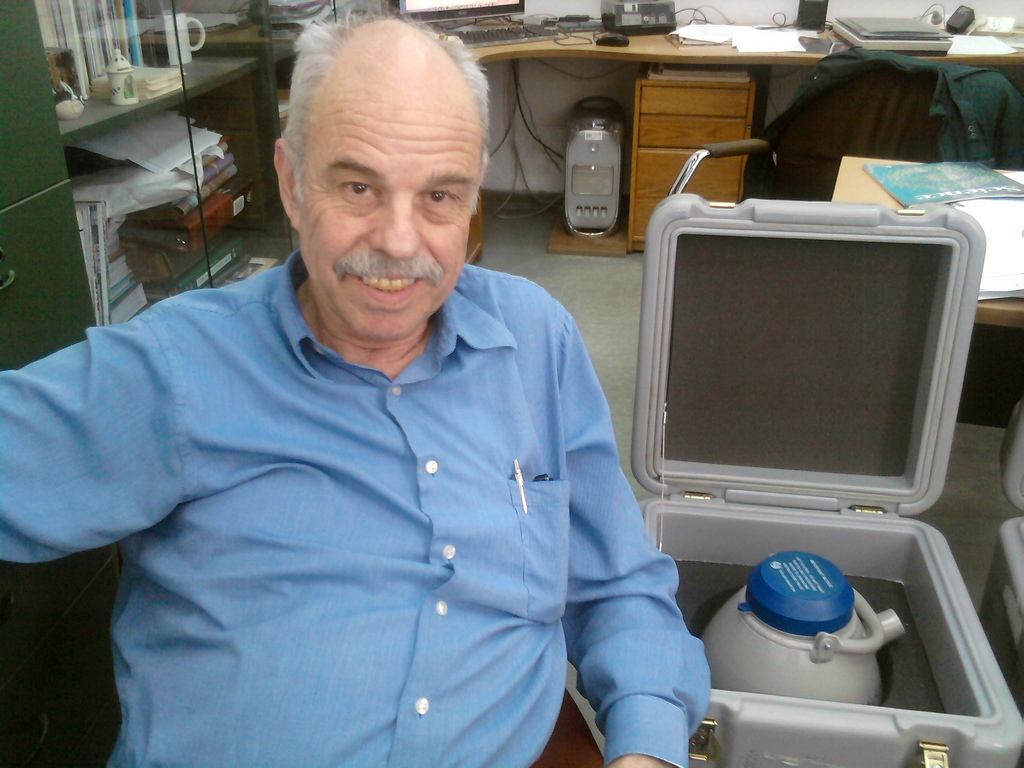
pea pod solar energy

Described in 1905 by Albert Einstein, quantum physics and photons explained the basic principles of how light energy works. Once light is absorbed in plant leaves, it energizes an electron which is subsequently used to support a biochemical reaction, like sugar production.

“If we could come even close to how plants are manufacturing their sugar energy, we’d have a breakthrough. It’s therefore important to solve the structure of this nano-machine to understand its function,” says Prof. Nelson, whose lab is laying the foundations for this possibility.

Since the PSI reaction center is a pigment-protein complex responsible for the photosynthetic conversion of light energy to another form of energy like chemical energy, these reaction centers, thousands of which are precisely packed in the crystals, may be used to convert light energy to electricity and serve as electronic components in a variety of different devices.

“One can imagine our amazement and joy when, upon illumination of those crystals placed on gold covered plates, we were able to generate a voltage of 10 volts. This won’t solve our world’s energy problem, but this could be assembled in power switches for low-power solar needs, for example,” he concludes.

Read More

1 COMMENT
  1. Kind of reminds me of the movie, Avatar, where plants created their own light and glowed at night. “Light without heat”.

Comments are closed.

TRENDING

Desalination experts debunk Aqua Solaire, the floating desalination barge

AI makes it easy to dream, develop, and create images of what could be world-changing ideas, until the reality sets in. A new project making the rounds is Aqua Solaire, an allged French concept for a solar-powered desalination vessel designed to bring drinking water to coastal communities facing drought, storms, and infrastructure failures.

24 7 renewable energy: how solar, wind, batteries and AI SaaS replace fossil fuels

A new report from the International Renewable Energy Agency based in Abu Dhabi makes something clear that many in the industry already suspected. When solar and wind are paired with battery storage, they can deliver reliable, round the clock electricity at costs that compete with, and often beat, fossil fuels.

Japan wants to build a solar panel ring around the moon

Unlike solar power on Earth, which is limited by night cycles, weather, and seasons, the Moon offers something close to uninterrupted exposure to the Sun. By placing solar infrastructure in orbit or along the lunar surface, engineers could generate continuous clean energy at a scale that may exceed global electricity demand,  the Japanese scientists say.

Batteries from salt? New grid projects suggest the idea is becoming real

Peak Energy makes storage batteries from salt making us one step closer to cleaner, endless energy from the wind and the sun

Eco organization offices destroyed by Iran missile

Tel Aviv's eco organization, the Heschel Center, was impacted by an Iranian missile.

How to quiet noise from construction in your office

Streets need to be resurfaced in New York but the humming and grinding noise is unsettling. Noise is environmental pollution. 

EarthX and a blueprint for sustainable investing

Trammell S. Crow, a Dallas-based businessman and father of four, is focusing his efforts on impact investing, and media that focuses on saving the planet through EarthX.

Mining Afghanistan’s Mineral Discoveries Similar to Avatar

Now that American forces in Afghanistan are commemorating the longest period of any war that America has been involved in, including the 1965-73 Vietnam War, the recent discoveries of large and extremely valuable mineral and metal deposits may finally bring to light a reason to continue the presence of US fighting forces in this war torn and backward country.

From Pilot Plant to Global Stage: How Aduro Clean Technologies’ 2026 Expansion Signals a Turning Point for Chemical Recycling Investors Like Yazan Al Homsi

The company's Next Generation Process (NGP) Pilot Plant in London, Ontario, has officially moved into initial operating campaigns, generating the kind of structured, repeatable data that separates laboratory promise from commercial viability.

Nobul’s Regan McGee on Shareholder Value: “Complacency Is the Silent Killer” 

Why the governance framework designed to protect shareholders so...

Should You Invest in the Private Market?

startustartup Unlike public stock exchanges, which offer daily trading, strict...

How to build a 100-year-company

Kongō Gumi is a Japanese construction company, purportedly founded in 578 A.D., making it the world's oldest documented company. What can we learn about building sustainable businesses from them?

How AI Helps SaaS Companies Reduce Repetitive Customer Support Work

SaaS products are designed for large numbers of users with different levels of experience, and also in renewable energy.

Popular Categories