“In the midst of uncertain time, renewable energy remains consistent and steadfast in its expansion,” said Francesco La Camera, IRENA’s Director-General. “A more decentralised energy system, with a growing share of renewables and more market players, is structurally more resilient.”
Health insurance is a regulated financial product. Insurers operate under binding contracts, overseen by state insurance commissioners, that legally obligate them to pay claims meeting policy terms. Policyholders who believe a covered claim was wrongfully denied have legal recourse through state regulatory channels.
The New Zealand Merino Company, now rebranded as Zentera, has quietly removed the phrase “world’s leading ethical wool brand” from its website, a notable change that comes after a disturbing investigation by PETA Asia-Pacific into the company’s ZQ-certified wool supply chain, PETA reports to Green Prophet.
Somehow vegetables with short seasons excite the imagination and appetite more sharply than produce that’s available all year around. Good Middle Eastern cooks have many recipes for delicate fava beans, and this turmeric-fragrant soup is one.
“In the midst of uncertain time, renewable energy remains consistent and steadfast in its expansion,” said Francesco La Camera, IRENA’s Director-General. “A more decentralised energy system, with a growing share of renewables and more market players, is structurally more resilient.”
Health insurance is a regulated financial product. Insurers operate under binding contracts, overseen by state insurance commissioners, that legally obligate them to pay claims meeting policy terms. Policyholders who believe a covered claim was wrongfully denied have legal recourse through state regulatory channels.
The New Zealand Merino Company, now rebranded as Zentera, has quietly removed the phrase “world’s leading ethical wool brand” from its website, a notable change that comes after a disturbing investigation by PETA Asia-Pacific into the company’s ZQ-certified wool supply chain, PETA reports to Green Prophet.
Somehow vegetables with short seasons excite the imagination and appetite more sharply than produce that’s available all year around. Good Middle Eastern cooks have many recipes for delicate fava beans, and this turmeric-fragrant soup is one.
“In the midst of uncertain time, renewable energy remains consistent and steadfast in its expansion,” said Francesco La Camera, IRENA’s Director-General. “A more decentralised energy system, with a growing share of renewables and more market players, is structurally more resilient.”
Health insurance is a regulated financial product. Insurers operate under binding contracts, overseen by state insurance commissioners, that legally obligate them to pay claims meeting policy terms. Policyholders who believe a covered claim was wrongfully denied have legal recourse through state regulatory channels.
The New Zealand Merino Company, now rebranded as Zentera, has quietly removed the phrase “world’s leading ethical wool brand” from its website, a notable change that comes after a disturbing investigation by PETA Asia-Pacific into the company’s ZQ-certified wool supply chain, PETA reports to Green Prophet.
Somehow vegetables with short seasons excite the imagination and appetite more sharply than produce that’s available all year around. Good Middle Eastern cooks have many recipes for delicate fava beans, and this turmeric-fragrant soup is one.
“In the midst of uncertain time, renewable energy remains consistent and steadfast in its expansion,” said Francesco La Camera, IRENA’s Director-General. “A more decentralised energy system, with a growing share of renewables and more market players, is structurally more resilient.”
Health insurance is a regulated financial product. Insurers operate under binding contracts, overseen by state insurance commissioners, that legally obligate them to pay claims meeting policy terms. Policyholders who believe a covered claim was wrongfully denied have legal recourse through state regulatory channels.
The New Zealand Merino Company, now rebranded as Zentera, has quietly removed the phrase “world’s leading ethical wool brand” from its website, a notable change that comes after a disturbing investigation by PETA Asia-Pacific into the company’s ZQ-certified wool supply chain, PETA reports to Green Prophet.
Somehow vegetables with short seasons excite the imagination and appetite more sharply than produce that’s available all year around. Good Middle Eastern cooks have many recipes for delicate fava beans, and this turmeric-fragrant soup is one.
“In the midst of uncertain time, renewable energy remains consistent and steadfast in its expansion,” said Francesco La Camera, IRENA’s Director-General. “A more decentralised energy system, with a growing share of renewables and more market players, is structurally more resilient.”
Health insurance is a regulated financial product. Insurers operate under binding contracts, overseen by state insurance commissioners, that legally obligate them to pay claims meeting policy terms. Policyholders who believe a covered claim was wrongfully denied have legal recourse through state regulatory channels.
The New Zealand Merino Company, now rebranded as Zentera, has quietly removed the phrase “world’s leading ethical wool brand” from its website, a notable change that comes after a disturbing investigation by PETA Asia-Pacific into the company’s ZQ-certified wool supply chain, PETA reports to Green Prophet.
Somehow vegetables with short seasons excite the imagination and appetite more sharply than produce that’s available all year around. Good Middle Eastern cooks have many recipes for delicate fava beans, and this turmeric-fragrant soup is one.
“In the midst of uncertain time, renewable energy remains consistent and steadfast in its expansion,” said Francesco La Camera, IRENA’s Director-General. “A more decentralised energy system, with a growing share of renewables and more market players, is structurally more resilient.”
Health insurance is a regulated financial product. Insurers operate under binding contracts, overseen by state insurance commissioners, that legally obligate them to pay claims meeting policy terms. Policyholders who believe a covered claim was wrongfully denied have legal recourse through state regulatory channels.
The New Zealand Merino Company, now rebranded as Zentera, has quietly removed the phrase “world’s leading ethical wool brand” from its website, a notable change that comes after a disturbing investigation by PETA Asia-Pacific into the company’s ZQ-certified wool supply chain, PETA reports to Green Prophet.
Somehow vegetables with short seasons excite the imagination and appetite more sharply than produce that’s available all year around. Good Middle Eastern cooks have many recipes for delicate fava beans, and this turmeric-fragrant soup is one.
“In the midst of uncertain time, renewable energy remains consistent and steadfast in its expansion,” said Francesco La Camera, IRENA’s Director-General. “A more decentralised energy system, with a growing share of renewables and more market players, is structurally more resilient.”
Health insurance is a regulated financial product. Insurers operate under binding contracts, overseen by state insurance commissioners, that legally obligate them to pay claims meeting policy terms. Policyholders who believe a covered claim was wrongfully denied have legal recourse through state regulatory channels.
The New Zealand Merino Company, now rebranded as Zentera, has quietly removed the phrase “world’s leading ethical wool brand” from its website, a notable change that comes after a disturbing investigation by PETA Asia-Pacific into the company’s ZQ-certified wool supply chain, PETA reports to Green Prophet.
Somehow vegetables with short seasons excite the imagination and appetite more sharply than produce that’s available all year around. Good Middle Eastern cooks have many recipes for delicate fava beans, and this turmeric-fragrant soup is one.
“In the midst of uncertain time, renewable energy remains consistent and steadfast in its expansion,” said Francesco La Camera, IRENA’s Director-General. “A more decentralised energy system, with a growing share of renewables and more market players, is structurally more resilient.”
Health insurance is a regulated financial product. Insurers operate under binding contracts, overseen by state insurance commissioners, that legally obligate them to pay claims meeting policy terms. Policyholders who believe a covered claim was wrongfully denied have legal recourse through state regulatory channels.
The New Zealand Merino Company, now rebranded as Zentera, has quietly removed the phrase “world’s leading ethical wool brand” from its website, a notable change that comes after a disturbing investigation by PETA Asia-Pacific into the company’s ZQ-certified wool supply chain, PETA reports to Green Prophet.
Somehow vegetables with short seasons excite the imagination and appetite more sharply than produce that’s available all year around. Good Middle Eastern cooks have many recipes for delicate fava beans, and this turmeric-fragrant soup is one.
After archaeological studies which included C14 dating of different samples of bones and textiles, the Salt Man was dated to about 1,700 years ago. By testing a sample of hair, the blood group B+ was determined.
In the winter of 1993, miners at the Chehrabad Salt Mine in Iran made a remarkable discovery while bulldozing for salt. They found a body with long hair, a beard, and several artifacts with it. Among the items found were a lower leg inside a leather boot (pictured below), three iron knives, a woolen half-trouser, a silver needle, a sling, parts of a leather rope, a grindstone, a walnut, pottery shards, fragments of patterned textiles, and broken bones.
The body was buried deep inside a tunnel about 40 yards long. Cause: the salt mines they were working in collapsed. Salt can be bought for a song and a dance today but once it was a much more valuable commodity. Read about the economic importance of salt in this feature article here.
The head of salt man
By 2010, the remains of six men had been discovered, and it is believed that most of them accidentally killed by the collapse of galleries in which they were working while they too were mining for salt. The head and left foot of Salt Man 1 are on display at the National Museum of Iran in Tehran.
In 2004, yet another salt man mummy was discovered just 50 feet away, followed by a third in 2005, and later that same year, the remains of a teenage boy.
These “salt men” are ancient corpses that were either killed or crushed in the cave and naturally mummified by the harsh, salty conditions. The dry salinity of the mine preserved hair, flesh, and bone but also internal organs, including stomachs and colons, in remarkable detail.
One salt man found to have the remains of a tapeworm in his gut at the time of death. Parasites lived with us then and they live with us today.
President Donald Trump was recently made aware that there was $50 million more taxpayer money being earmarked to send free condoms to Gaza. Like molotov cocktails, and water pipes turned into rockets, the condoms are used as improvised guerrilla warfare devices to install harm on people, forests and agriculture land in Israel. Special poems are written about this so Israeli children don’t touch balloons, balls and condoms they find on the street.
The incendiary device found in a community in the Shaar Hanegev Regional Council on June 21, 2018. (Israel Police)
White House press secretary Karoline Leavitt on Tuesday defended President Donald Trump’s order to freeze federal funding, claiming that $50 million had been earmarked for the distribution of condoms in the besieged Gaza Strip.
Leavitt briefed reporters that the newly-established Department of Government Efficiency (DOGE) and the White House Office for Management and Budget (OMB) found “that there was about to be $50 million taxpayer dollars that went out the door to fund condoms in Gaza”.
In 2023 USAID revealed that no condom money was sent to Gaza, however.
An exploding soccer ball meant to harm children who kick it, sent to Israel from Gaza. An explosives-laden soccer ball that was apparently flown from the Gaza Strip using balloons is seen in an open area of the Sha’ar Hanegev Regional Council on January 23, 2019. (Courtesy)
The only shipment to the Middle East that year was a $45,680 delivery to Jordan, which was noted as the first condom shipment to the region since 2019. Since news of the condom bombs in 2018, it is likely a government office in the US had the foresight to stop shipments.
Watch out for explosive condoms. Photos from 2018 in Israel.
The Department of Government Efficiency (DOGE) and the Office of Management and Budget (OMB) found “that there was about to be 50 million taxpayer dollars that went out the door to fund condoms in Gaza,” Leavitt told reporters during her first press conference. “That is a preposterous waste of taxpayer money.”
The Trump administration has frozen nearly all foreign assistance programs for at least 90 days, in an attempt to understand how the US is funding UN organizations such as the World Health Organization.The US is the largest source of international assistance out of all countries in the world.
A bundle of balloons attached to a model plane found near Neot Hovav on January 21, 2020. (Israel Police)
Over the years the Israeli public have taught their children to take care when they find balloons or balls, as they may be fitted with explosives. In 2020 the Israel Defense Forces’ Home Front Command on Friday released a poem for children warning them against the dangers of the balloon-borne bombs flown into southern Israel from the Gaza Strip.
Titled “What does the wind bring with it?”, the poem tells children to call an adult and run away if they see a suspicious object.
“Sometimes, the wind brings with it/dangerous things/which come from over the fence/they are not mine/and they’re not some friend’s,” wrote the poem’s author,Tali Versano-Eisman, the head of the Home Front Command’s child-outreach department.
A condom bomb poster handout
Are condoms permissible in Islam?
According to Islamqa, it is permissible to use condoms so long as this does not cause any harm and so long as both husband and wife consent to their use, because this is similar to ‘azl (coitus interruptus or “withdrawal”). But it reduces the sensation of pleasure, which is the right of both partners, and reduces the chance of conception, which is also the right of both partners. Neither one of them is allowed to deprive the other of these rights. (Related: read our article on female circumcision in Islam).
Red Sea helps farmers prosper near dead or dying aquifers
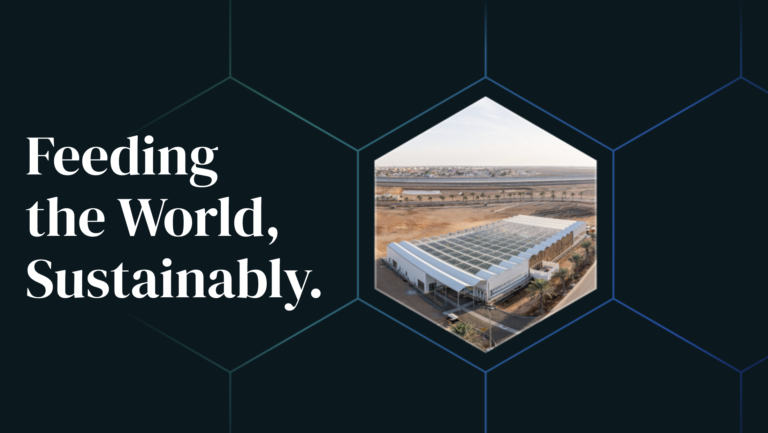
RedSea LLC, a company founded in the heat of Saudi Arabia has cracked the code for sustainably growing plants in high heat conditions. They offer the answer to increasing cultivation on dead and dying aquifers.
Growing food in greenhouses in a European winter makes sense. The Dutch invented the idea in the 1800s when botanist Charles Lucien Bonaparte wanted to grow medicinal plants in Leiden. These greenhouses retain heat in the enclosures, allowing cultivation even during the cold Northern European winter months.
Hydroponics –– or growing trees and plants in a water medium with nutrients –– is having a moment now but it started with a California botanist in the 1800s and was perfected in the 90s by cannabis growers in Canada. Hydroponics tech is now used for growing salads in food deserts everywhere. Hydro-grown has its challenges, and high costs, however.
Drip irrigation, designed to precisely control the delivery of scarce water and costly fertilizer directly to plant roots is credited to the Polish-Israeli agronomist Simcha Blass. This solution allowed cultivation in arid climates where the growing season was limited. More recently, American-Israeli Daniel Hillel received the World Food Prize for devising drip irrigation systems in the developing world and this technology, delivered by companies like Netafim and Rivulis, is now a multi-billion dollar global business.
Redsea grafts more desirable plants onto graft-stock which is saline resistant
Climate change and increasing world temperatures now presents additional challenges for agriculture –– especially where climates are becoming more hostile, and water less available. A growing world population, and concerns over food security in the hottest countries in the world has shifted the focus of innovators to ask the question of how to sustainably feed this growing population, and how to overcome the challenges of cultivating in increasingly arid climates.
RedSea LLC, a company founded in the heat of Saudi Arabia, has cracked the code for sustainably growing plants in high heat conditions and they offer the answer to increasing cultivation on dead and dying aquifers.
The founders include an Australian plant biologist Prof. Mark Tester, known as the Indiana Jones of the plant world, Prof. Derya Baran, a leading materials scientist and Dr. Ryan Lefers, an expert on water systems and water preservation in agriculture. The trio have built a platform of technologies that adapts the best of the innovative pioneers before them in materials, AI, hydroponics, smart farms, and drip irrigation and have applied know-how in materials, water and plant genetics to sustainably grow crops in hot and dry climates.
Founders Mark Tester, Ryan Lefers (right)Derya Baran, a RedSea founder
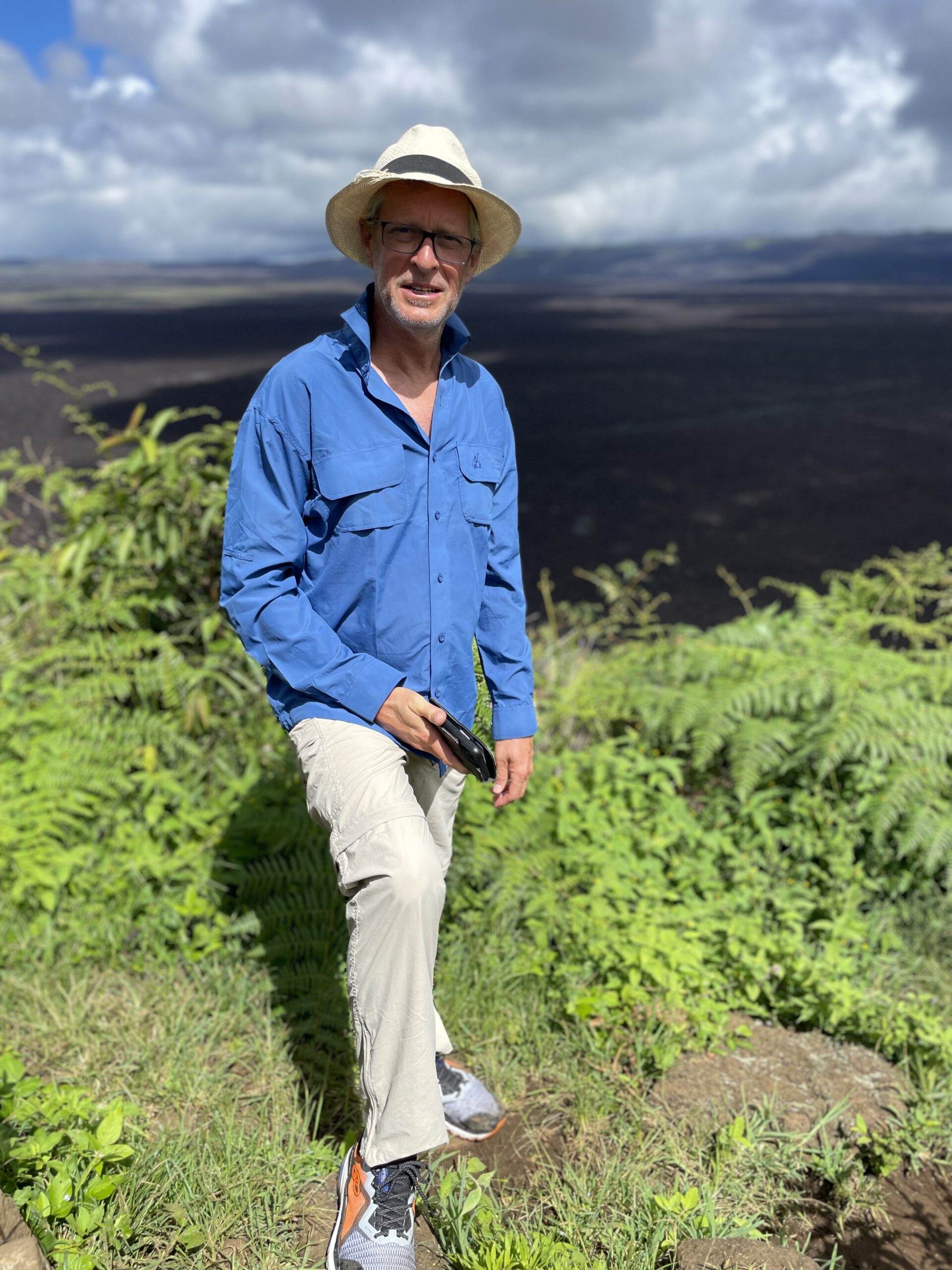
This starts with the water, as access to fresh water is an increasing challenge with agriculture currently using up to 70% of available fresh water to grow crops. The challenge was how to grow plants in increasingly arid conditions on dead or dying aquifers. Tester went to the Galapagos on a mission to figure it out and came home inspired by the tomato plants that he found there growing on rocks right next to the sea.
Darwin Lake in the Galapagos is twice as salty as the sea. Plants that grow there must be salt tolerant.
He tells Green Prophet that he questioned whether these tomato plants could handle the salt, and if so, could they be modified to be grown commercially while reducing the draw of fresh water resources? Brackish water is saltier than water that comes from the tap and plants don’t like it. It is the water found in estuaries where rivers meet the sea. It is also the water found in aquifers near the sea or in deserts –– or in areas where climate change, and overpopulation has depleted aquifers.
Mark Tester, Indiana Jones of the Plants on the Galapagos
In all parts of our drought-facing world, and especially in the dry Middle East and regions of California and Texas, brackish water in damaged and dead aquifers is common. Tester has made it his life mission, and with his co-founders established a successful company now scaling into new markets, to grow food on dead and dying aquifers.
“It really depends on the crop, but when our technologies are combined this means you can build greenhouses near dead or dying aquifers. In reality there are a lot of factors in play, but this is the idea,” says Tester, pointing to a suite of agri-climate technologies RedSea has built: “The fundamental idea to address is to reduce the use of freshwater for producing fresh food and if we can do that by using more saltwater, then that is definitely a useful contribution.”
Tester was educated in the UK at Cambridge. He is a research professor at KAUST, King Abdullah University of Science and Technology, Saudi Arabia.
But Tester’s background is in plant biology, not just tech, furthering the understanding of salt tolerance in plants for desert agriculture. He has developed methods for developing new types of seeds that are used as a hearty rootstock which can handle brackish water. Other plants, which are not as tough, but which are tasty can be then grafted onto these rootstocks.
“I am a plant guy and in this company I am delivering the fruits of my lifetime’s research which is fundamental science: how plants move solutes in and out of the plants, and applying it to salinity tolerance. With my co-founders Ryan Lefers and Derya Baran a suite of products was developed and commercialised that can leverage this research,” he tells Green Prophet.
Grafting is used with many varieties of plants, such as apples, cherries, roses, watermelons, nut trees, and tomato plants. Developing new types of rootstocks that can handle brackish water and other challenges such as heat and drought is the aim –– and “then we graft the edible bits on top,” says Tester.
In some cases, RedSea can graft across species, but only closely related ones: “We can graft a tomato onto a wild tomato, an eggplant onto a wild eggplant, and sometimes even a tomato onto a wild eggplant, but we can’t graft an orange onto an apple, for example. They have to be fairly closely related.”
The work of grafting also allows the farmer to extend the growing period of the plant, says Tester: “We can help tomatoes be economically productive for longer, such as from 10 months to 11 months in a greenhouse.”
The RedSea technology works on a soil-based substrate, hydroponics or on open fields in soil: “We are developing rootstocks for all of these conditions,” says Tester.
“In tomatoes, for instance, we are working with brackish water, which is more dilute than seawater but more salty that you and I can drink, is the reality is that in many places around around the world a lot of our food is grown using groundwater and every major aquifer is being depleted. As it gets depleted, it gets salty.
“We have few aquifers straight outside our university that have been abandoned because of that – now we can access water that’s currently not being used.”
Turning greenhouses inside out
Apart from the unique rootstocks that RedSea is providing, the company has a number of technologies now being sold in export markets. While greenhouses typically need to be heated in Holland or Canada, in the Middle East, the reverse is true. It gets too hot. So RedSea has also helped solve that problem.
They have developed a range of heat blocking greenhouse covers. These are based on additives that can be incorporated into any polymer based cover that blocks damaging heat from penetrating into the greenhouses –– a product called iyris SecondSky which incorporates a nanoparticle technology invented by Baran. “Derya developed a nanoparticle that when dispersed in plastics absorbs near infrared radiation – which in layman’s terms translates to heat. This absorption of the heat load that would otherwise be damaging to plant health delivers a huge reduction of the resources that are needed in such structures to control the climate and manage plant health in the greenhouse,” says Tester.
RedSea facilities in Saudi Arabia at KAUST
The technology can be easily Integrated into standard plastic greenhouse covers, be that polycarbonate, polyethylene or net, resulting in a product that is a one for one replacement of standard greenhouse covers – just better – because the heat blocking is already integrated into the plastic during the manufacturing process. This means that there is very little compromising impact on the PAR (photosynthetic active radiation) transmission through the cover compared to alternative heat blocking methods.
Alternative heat blocking solutions include additional reflective films, chalking or internal shade screens, which are, in the case of films, expensive, an operational nuisance and potentially degrading to the plastic. In the case of chalking and compromise the PAR transmission within the greenhouse. Results achieved with the use of SecondSky have been impressive, Tester reports.
Ryan Lefers, the CEO of RedSea explained more about the potential of how disruptive this integrated heat blocking can be within high heat regions: “Greenhouse technology has become highly developed in Northern European countries such as the Netherlands, offering a solution to keep heat in winter so that crops could be grown out of season, but here in the Middle East and over vast areas of the planet we need to keep the heat out in summer, so our thinking was to take the original greenhouse and turn it inside out,” he tells Green Prophet.
“Water scarcity is another major challenge, so finding ways to operate farms with a lower environmental impact, while empowering farmers to continue to farm without an expectation that they make fundamental changes in the way that they farm was a key driver for us.”
The saltwater greenhouse dream
In facilities where SecondSky is installed, farmers can save up to 30% on water and fertilizer use when compared to hydroponic systems and up to 90% compared to soil based cultivation. Many farms also use a reverse pressure pad and fan cooling system in the region to assist in coping with the extreme temperatures. Farmers can save up to an additional 32% in energy costs once a SecondSky cover is installed.
RedSea has developed an add-on to their technology suite that enables farmers to use brackish water in these cooling systems further reducing the environmental impact of farming in hot climates.
Kairos saltwater greenhouse cooling tech made by RedSea
RedSea was founded in 2018, and to date has raised a total of about $36.5 million USD. Saudi Arabia’s oil company Aramco through their investment fund Wa’ed is among the investors. A new Series A funding round will close shortly, adding investors and additional funds for the company’s planned expansion.
Rapid growth of sales and revenues is the company’s focus at the moment, with expansions into other countries. RedSea technology is being sold through manufacturers and distributors, but also directly to farms. There are installations in 16 countries to date and this number is growing.
But Tester, a plant guy at heart with a passion for the environment, has his eye on the bigger prize: “We wanted to have a company that is profitable and truly sustainable and highly impactful –– where we are across the world developing and selling technologies to reduce the environmental footprint of our food productions in both developed and developing countries.
“And that’s where we came from –– Ryan and me. We started with this idea of increasing sustainability in agriculture in developing countries –– that’s in the DNA of the company.”
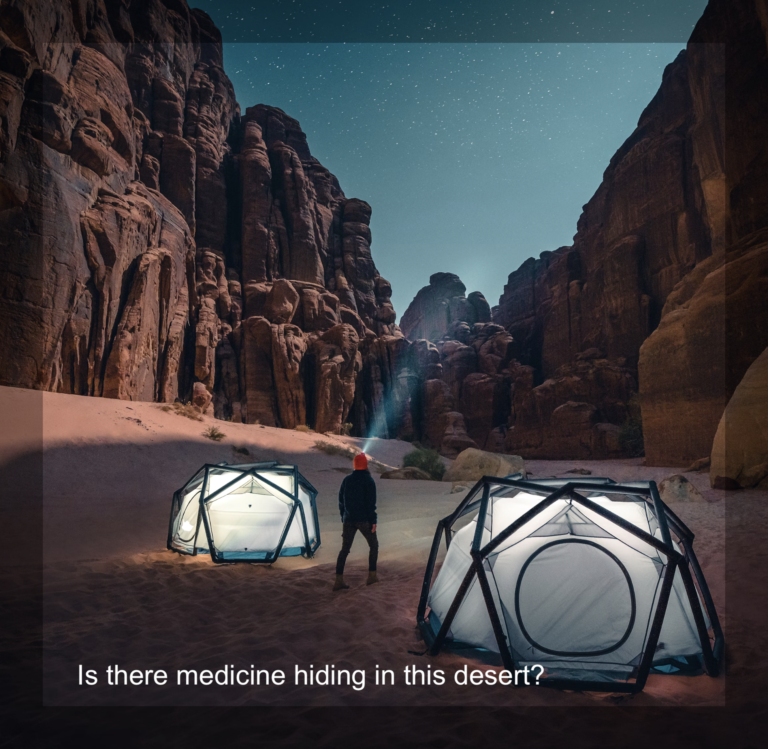
The National Center for Vegetation Cover Development and Combating Desertification (NCVC) has launched a project to catalog and analyze wild plants in Saudi Arabia with medicinal, aromatic, toxic, nutritional, and economic properties.
This initiative, in collaboration with the College of Pharmacy at King Saud University, aims to expand scientific knowledge of the Kingdom’s native plant species and provide research-based guides to support sustainable resource use and conservation. Such pharmacological data could lead to new discoveries in medicine.
The project will create detailed guides featuring scientific and geographical insights on wild plants with medicinal, aromatic, toxic, nutritional, and economic value. It will document key findings, map plant locations and characteristics, and benchmark them against the latest regional and global research. Additionally, the initiative includes the development of tailored media content and digital resources to raise awareness among all segments of society about the importance of native plants and their diverse applications.
This effort aligns with the NCVC’s mission and supports the goals of the Saudi Green Initiative and Vision 2030. It strengthens research partnerships among government agencies, academic institutions, and private sector stakeholders, fostering environmental and economic sustainability. By safeguarding the Kingdom’s plant resources, the project further underscores the NCVC’s role as a leading authority on vegetation cover and biodiversity conservation.
The NCVC remains committed to protecting and rehabilitating vegetation sites across Saudi Arabia, combating illegal logging, and managing rangelands, forests, and national parks. These efforts contribute to sustainable development and the preservation of the Kingdom’s natural heritage, in line with the objectives of the Saudi Green Initiative.
Here is a list of 10 unusual medicinal plants found in Saudi Arabia, along with their common names in Arabic and English, and their traditional uses:
Plant Name
Common Name (Arabic)
Common Name (English)
Traditional Use
Calotropis procera
العشار (Al-‘Ashar)
Apple of Sodom
Used for treating skin diseases and as an anti-inflammatory agent.
Ziziphus spina-christi
السدر (As-Sidr)
Christ’s Thorn Jujube
Employed to treat various ailments, including digestive disorders and infections.
Reichardia tingitana
الهندباء (Al-Hindiba)
Wild Chicory
Its leaves are used to treat constipation, colic, and inflamed eyes.
Ruellia tuberosa
غير متوفر
Minnieroot
Used as a diuretic, anti-diabetic, antipyretic, analgesic, antihypertensive, and to treat gonorrhea.
Rumex crispus
الحميض (Al-Humeidh)
Curly Dock
The root is used for treating anemia, skin conditions, respiratory issues, and enlarged lymph nodes.
Commiphora gileadensis
بلسان مكة (Balsan Makkah)
Balm of Gilead
Renowned for its aromatic resin used in perfumes and traditional medicine for its healing properties.
Soda rosmarinus
الأشنان (Al-Ushnan)
Saltwort
Historically used for producing potash and as a cleansing agent; also employed in traditional medicine for oral health.
Anethum graveolens
الشبت (Al-Shabat)
Dill
Commonly used to aid digestion and soothe upset stomachs.
Mentha longifolia
النعناع البري (Al-Na’na’ Al-Bari)
Wild Mint
Popular in teas, sauces, and desserts; also used for digestive comfort.
Peganum harmala
الحرمل (Al-Harmal)
Syrian Rue
Traditionally used for its analgesic and anti-inflammatory properties.
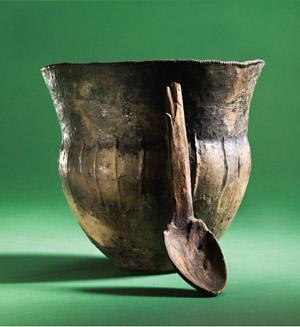
Does this look like a pot you’d cook in? Soup, possibly? This 6000 year old clay pot was recently retrieved from a bog in Denmark. A neolithic householder had cooked seafood in it, according to the analysis made of food residues scraped off from the inside. Cooking in clay has been around for a long, long time.
Porous clay retains and releases flavors. I imagine everything cooked in that pot 6000 years ago tasted like fish. I’d advise modern cooks to save one or two clay pots only for seafood. And keep your dessert ramekins for dessert only – you don’t want your creme brulee to taste like garlic custard.
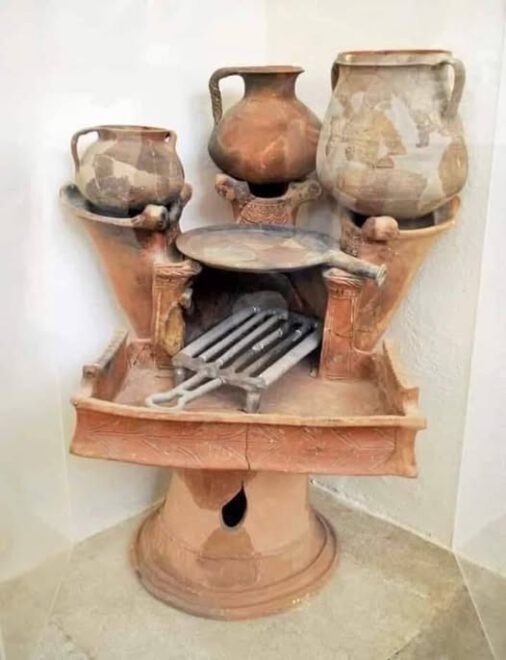
How about this ancient Greek setup? With the exceptions of the skillet and the grill, the whole stove and the pots are made of clay. Clay keeps a steady, slow heat going as long as the fuel lasts. The ancient Greek obviously expected to cook soup, stew, or pottage in the three pots poised on those funnel-like chimneys. I’ll bet the whole thing got hot enough to burn the hand. Since cooking in clay is a low and slow process, they must have started cooking early in the morning to be on time for lunch.
Dug out from the earth itself, clay needs patient processing to yield clean, malleable material. Most clay pots need a one-time preliminary seasoning in order to cook out the taste of raw clay. And they’re fragile. They must be protected from thermal shock to prevent cracks. Drying one isn’t a matter of wiping it out with a dish cloth; it has to be air-dried to prevent mold. And unless you’re lucky enough to live near a potter, you can expect to pay nicely for a beautifully-turned out tajine or Romertopf pot.
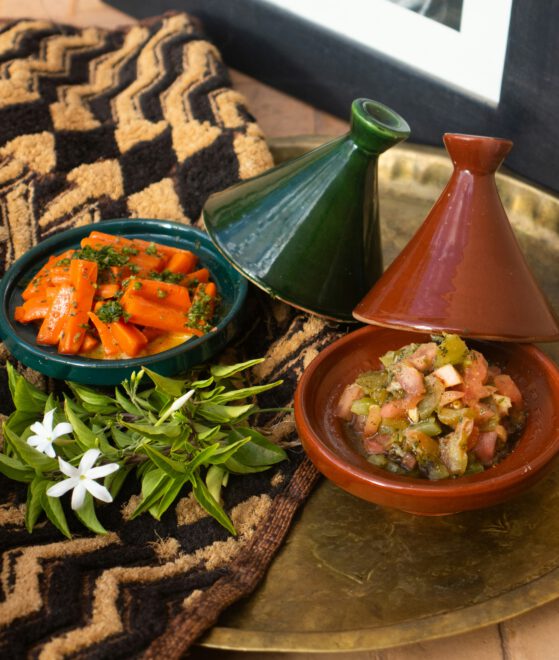
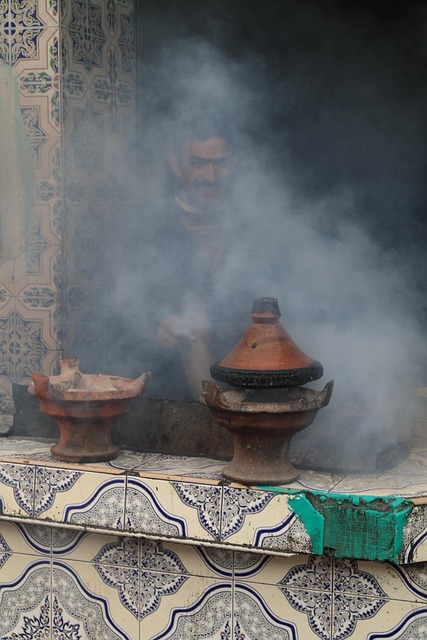
Unless you fly out to Morocco, where you can pick up a traditional tajine like this one in the souk:
So why bother to cook in clay when you can pick up all the metal cookware you need in your neighborhood supermarket?
First, flavor. Anything cooked in clay tastes better. If you appreciate traditional foods cooked low and slow, you’ll enjoy the deep flavors and textures that clay pots grant. Slow, even heat ensures that the ingredients’ flavors bloom and blend, and that foods requiring long cooking, like beans and tough cuts of meat, emerge from the pot tender and juicy.
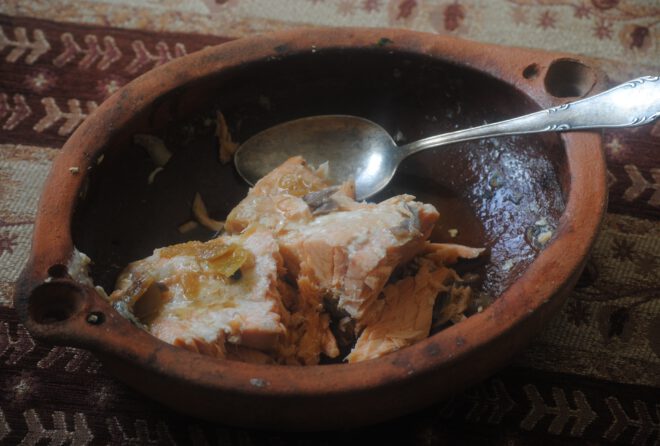
The more often you cook in a clay pot, the better the food from it tastes. To put it poetically, the clay retains some of the soul of the food – the flavors of spices and fats – which it releases to the next potful. A well-used and cared-for clay pot, even a simple tagra like the one below, becomes a treasure over time. (The photo shows slow-cooked salmon and lemons.)
Then there’s the satisfaction of handling a pot made from sustainable prime material; especially if the pot is beautiful.
Clay pot styles vary a lot. Tajines, for example, require very little or no liquid for stews or braised dishes. Cooking vapors condense inside their conical tops and drop back down on the food, resulting in foods with undiluted flavor.
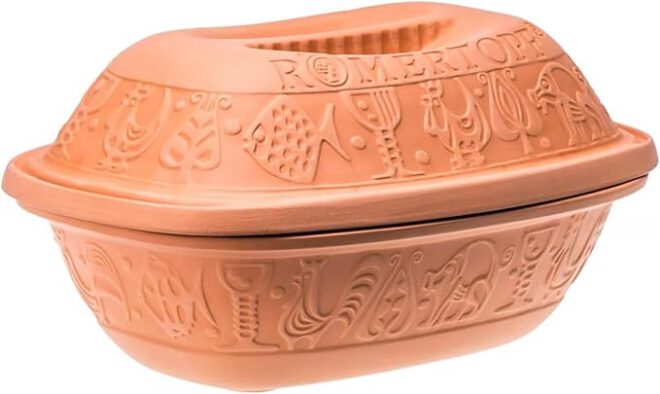
Romertopf pots are another specific type, with their glaze and two parts. Being soaked before cooking starts, the closed Romertopf releases steam around the food inside, producing deliciously roasted, juicy chicken and meat. (To create a golden, crisp crust, you remove the top and cook the dish a further 20 minutes.)
Cooking in clay takes longer, because you start with low heat and gradually increase it. But clay retains heat for a long time, which guarantees that the food stays hot for a long time after you take the pot off the stove or out of the oven.
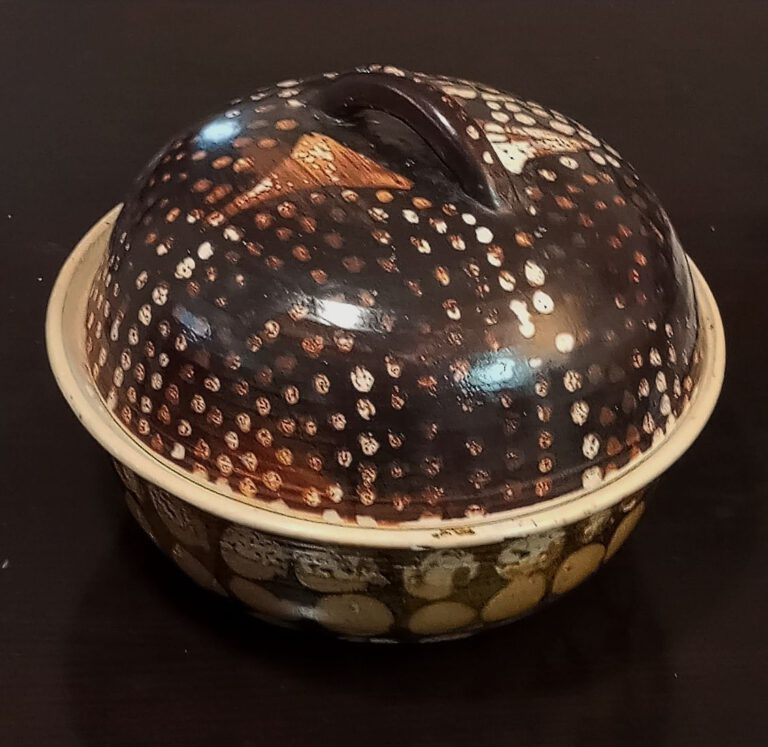
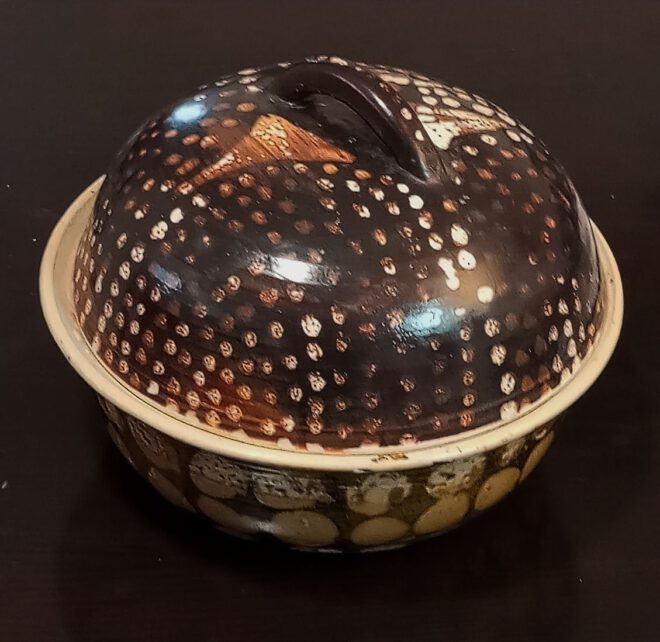
There are clay pots for every use. Stews, soups, and beans are the first foods that come to mind, but there are traditional clay vessels for casseroles, frittatas, baked potatoes, bread forms and even custard cups. I love the pot that Green Prophet’s founder Karin Kloosterman made in her own kiln.
It could make slow-cooked stew or soup, but I prefer to use it as a bread cloche. Here’s the bread:
If you live within reach of a potter, or travel to places where clay pots are made locally, buy them there. Where I live, there’s a warehouse that imports housewares from Morocco. I’ve bought tajines and tagras there. A heavy guvec stew pot on my shelf came from Turkey. I’ve also found clay cookware in a trendy shop in the local mall. Otherwise, you can order clay pots online via Amazon, Etsy, and similar sites.
You don’t need a exotic spices and herbs ordered online to make good use of clay pots. Below is a chicken tajine I cooked recently. Just chicken, veg, and the ground spices I keep around: cumin, turmeric and paprika. I could have substituted thyme, bay leaf, and a splash of white wine just as easily.
Regarding safety and fear of lead in glazed pots: all cooking pottery sold in the U.S. is regulated by the U.S. Food and Drug Administration. If you like to use a slow cooker on these cold winter days, remember that all the inserts of slow cookers are made of glazed clay, so you’ve been cooking perfectly safely with what’s basically a clay pot.
Unglazed pots are fine.
Don’t cook in antique pots you pick up in yard sales. Keep them for display. If you’re determined to cook in an old pot – unless it’s your Grandma’s familiar, treasured and well-used one – buy a lead test in your local hardware store and apply it to the pot.
For an authoritative book on cooking in clay, I recommend Paula Wolfert’s classic, Mediterranean Clay Pot Cooking. In it the most common types of clay pots are detailed, with valuable tips on handling clay pots, cooking different types of foods, and incidental recipes like preserved lemons and tomato paste. The book includes lists of food sources and clay pot sources. The bibliography is worth going through. The recipes largely reflect the foods of Morocco, Turkey, France, and Italy.
Follow Green Prophet for delicious recipes cooked in clay (or other) pots:
“The problem is bigger than just the smoke we’re inhaling.”
WVU toxicologist Timothy Nurkiewicz said the January fires burning in the Los Angeles area will create air pollution that can reach hundreds of miles in distance.
As the deadly California fires persisted into a second week, a West Virginia University air quality expert said people within hundreds of miles may experience the effects.
Timothy Nurkiewicz, professor of the physiology, pharmacology and toxicology in the WVU School of Medicine, said he also believes that — beyond any immediate health concerns — a swift, thorough cleanup must occur to prevent lingering effects in the environment.
“The folks within a 10-mile radius are in the greatest peril. With extremely high air pollution resulting from the fires, even a healthy person may have irritation of the eyes and complications breathing. What we’re seeing in hospitals are people with asthmatic events and bronchitis.
Timothy Nurkiewicz, professor, Department of Physiology, Pharmacology and Toxicology, WVU School of Medicine
“For those with pre-existing conditions, cardiovascular diseases can be exacerbated after inhalation exposure to this smoke. That could mean symptoms such as elevated blood pressure and chest pain.
“What we’re seeing in Los Angeles is called a ‘wildland urban interface fire.’ This is different from a typical wildfire. In a wildland urban interface fire, you have housing and urban environments built up against and in the wildlands.
“Now we’re getting two different profiles of toxicants — one from the wildlands and one from the urban environment and its building materials. The frequency and intensity of these fires will continue to increase with ongoing development and building into the wildlands.
Nurkiewicz directs the Center for Inhalation Toxicology, a research hub for investigators to measure, identify and discover how air particles affect human health.
“It’s fair to estimate that the smoke will travel hundreds of miles away. But the smoke will be diluted down by the time it reaches mid-America,” he warns.
How can authorities and people help slow the damage?
“While everyone’s focused on the immediate effects, as they should be, there must be cleanup after the fire, says Nurkiewicz. “A smoke plume is going to cover a tremendous area and that smoke will settle into the environment we’re interacting with. It’s like cigarette smoke. If someone’s sitting in a room smoking cigarettes, it will settle onto surfaces. It’s the same thing with these fires. You can’t just leave all these ashes around and not have some sort of exposure.
“The problem is bigger than just the smoke we’re inhaling.”
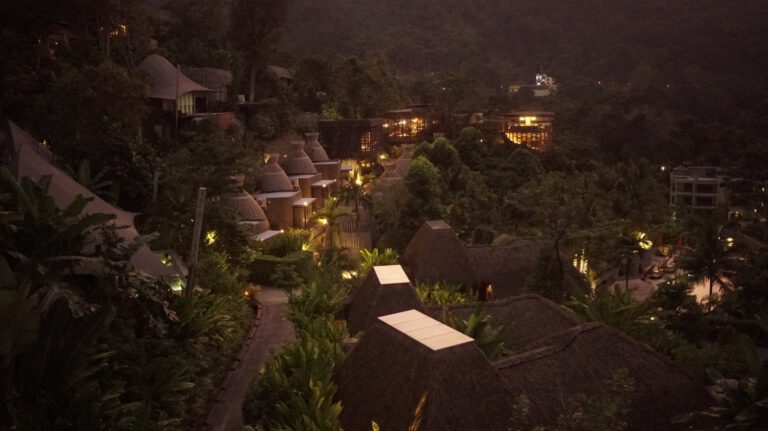
How do eco resorts like Keemalah get noticed? You can’t find them in the jungle but you can see this 5 star eco resort on social media. Image by Green Prophet
What do you use social media for? To chat with friends, share interesting facts, or read the news? Great, but these powered resources offer far more opportunities than just entertainment and casual interactions. These platforms have become essential tools for developing professional pages, expanding businesses, and generating new orders. Having a strong presence is no longer optional for companies—it’s mandatory. Your clients are already online, scrolling through their feeds, searching for solutions, and engaging with brands.
But not every brand succeeds in standing out. Some struggle to attract buyers, some fail to compete effectively, and others simply don’t know how to interact with their subs. While the reasons for failure may vary, one thing is clear: achieving success requires a solid strategy. Whether through creative content, audience connecting, or leveraging services like Viplikesto purchase important interactions such as followers or comments, you can position your eco-business for growth. In this article, we’ll explore one paid and two free methods to make your eco-brand flourish.
Content Optimization (Free)
Creating amazing content is essential, but it’s wasted effort if users don’t see it. That’s where optimization comes in. Hashtags are one of the simplest tools you can use to make your posts discoverable by your target audience. However, using too many hashtags can backfire, making your content look spammy or desperate.
The key is to focus on quality over quantity. Choose 2–3 highly relevant hashtags for each post, ensuring they align with your audience’s interests and your niche. For example, if your company focuses on sustainable packaging, hashtags like #Sustainability, #EcoFriendly, and #GreenLiving can be effective.
To maximize results, conduct research to identify the hashtags that resonate best with your audience. Test different combinations, track their performance, and refine a strategy over time.
Connect with Users (Free)
Sites thrive on interaction. Entrepreneurs that actively engage with potential buyers build stronger relationships, foster trust, and generate loyalty. Start by responding to comments on your posts, thanking users for mentioning your brand, and answering their questions. These small actions show that you value your audience’s input and care about their opinions.
Additionally, take the initiative to engage on other profiles. For example, if someone posts, “Does anyone know a good eco-friendly product brand?” don’t hesitate to join the conversation. Share your expertise, suggest your brand, and connect with clients.
Investing in Your Page (Paid)
The rapid growth of marketing has given rise to various services designed to help succeed online. One of the most working strategies for accelerating your growth is using sites to purchase targeted boosts for the company’s page.
For instance, if you frequently post links to your website or products, buying instant link clicks can significantly increase traffic. Similarly, you can purchase subs, likes, comments, and shares to enhance your profile’s credibility. These metrics make your page look more established and trustworthy, encouraging organic subs to interact with your posts.
In 2025, investing in such services is a cost-effective way to stay ahead of the competition. Even a modest advertising budget can yield substantial results. For eco-businesses, where building trust and showcasing authenticity are crucial, these paid boosts can provide the foundation for long-term success. By using Viplikes, you can focus on creating meaningful content while letting strategic investments handle the initial growth phase.
Brilliant engagement isn’t just about replying to comments—it’s about creating a community around your brand. Encourage your potential clients to share their stories, post testimonials, and participate in challenges or giveaways. This organic interaction not only strengthens your online presence but also amplifies your reach through word-of-mouth marketing.
When it comes to travel and holidays many people today focus on sustainability. This has become a new norm for travellers who care about the planet and want to make sure that they can reduce their carbon footprint. Various countries today are equally committed to this cause and want to provide travellers with better sustainable options.
Southeast Asia offers a wide range of beautiful landscapes, vibrant cultures, and unparalleled hospitality. However, many countries have risen to the occasion blending eco-conscious practices with luxury and charm. Today you will find a variety of destinations in Southeast Asia that offer eco-resorts and other sustainable practices for eco-conscious travelers.
With Experience Travel Group you can tour some of the leading destinations in Southeast Asia that follow sustainability practices and offer you the best eco-friendly accommodations.
Bali, Indonesia
One of the top destinations leading sustainability practices in Southeast Asia is Bali, Indonesia. Hence, if you are an eco-conscious traveller you would want to look out for the best eco-resorts in Bali that can offer you amazing holiday experiences.
Bali’s natural beauty and spiritual culture ensure that you can make the most of the moments even when you are staying in these eco-friendly accommodations. Various luxury and affordable hotels and resorts in Bali make use of renewable materials and support local artisans to thrive in the local economy.
Also, travellers can look out for a range of outdoor activities like trekking Mount Agung in Bali which ensures you can focus on environment-friendly activities. Bali is also committed to banning single-use plastics and has introduced concepts like zero-waste restaurants that help keep the environment clean.
Chiang Mai, Thailand
When you are thinking of holidays in Southeast Asia, Thailand is one of the top choices known for its pristine beaches and sumptuous cuisine. However, Thailand’s Chiang Mai has now become a hub for sustainable tourism.
This small town known for its serene temples and vibrant markets has attracted travellers from around the world for its sustainability practices. There are plenty of things to do in Chiang Mai that would keep you busy and offer the best experiences.
The city heavily promotes eco-friendly initiatives that also prioritize animal welfare. With a lot of focus on organic cafes, diners and support for local artisans, Chiang Mai is one of the leading cities in Thailand that is making genuine efforts to reduce its environmental footprint.
Luang Prabang, Laos
Over the years, Laos has become one of the popular destinations in Southeast Asia for those who want to relax and unwind. With its laidback vibe and serene temples, Luang Prabang has become one of the top spots for sustainable tourism in Southeast Asia.
Nestled between lush mountains and the Mekong River, Luang Prabang is a UNESCO World Heritage site attracting travellers from all over the world. However, the city has made further strides by introducing more eco-friendly lodges that make use of renewable and natural materials.
This blends perfectly with the natural landscape the city has to offer. Visitors can enjoy various walking tours, bicycle tours and even sustainable river cruises that allow them to explore the natural landscape of the city. The city has also been striving to promote local artisans through vibrant night markets.
Singapore
If you are looking for a luxurious urban escape, Singapore is a great choice, especially in the Southeast Asia region. The city-state is known for its cutting-edge architecture that blends itself into the lush green landscape.
Although Singapore is a bustling metropolis it is also a model for sustainable urban living and has green spaces like Gardens by the Bay and Marina Barrage that are made with the environment in mind. Apart from these, various must-see attractions in Singapore run on solar energy.
While you are in Singapore you can choose to stay at various eco-certified hotels, you can enjoy dining experiences that prioritize locally sourced ingredients and allow you to enjoy all the luxuries without harming Mother Nature.
Hoi An, Vietnam
Vietnam has quickly become one of the popular destinations in Southeast Asia. While the charming lantern-lit streets of Hoi An offer a sustainable touch to this place, there are many ways in which Hoi An promotes eco-tourism attracting more tourists from all over the world.
As more environment-conscious travellers travel to Hoi An, the popularity of this place has been increasing. To promote sustainable tourism, Hoi An is pushing initiatives like organic farming tours, bicycle tours, and walking tours.
Various hotels and resorts today make use of renewable and natural materials that attract eco-friendly travellers. Also, these resorts promote workshops on traditional crafts that support local livelihoods.
Ubud, Indonesia
Known as Bali’s cultural heart, Ubud is ideal for those who love lush greenery and a quiet environment. Overlooking the rice fields, visitors can stay in bamboo villas and resorts that replicate nature’s designs.
Visitors can also interact with local artisans at sustainable markets and indulge in organic meals made from locally sourced ingredients. The town is also known for its eco-friendly cafes where travellers can unwind and make the most of their time. With plenty of nature and sustainable practices, Ubud is a holistic destination in Southeast Asia.
Phnom Penh, Cambodia
With its rich history and plenty of ancient sites to discover, Cambodia is a hot favourite with history buffs and those who prefer eco-friendly destinations in Southeast Asia. With plenty of eco-friendly lodges in Phnom Penh, travellers can make the most of their holidays in Cambodia.
The city has also been promoting local workshops and activities that support local communities. Visitors can also enjoy cultural tours that focus on Khmer traditions, dine at restaurants that train underprivileged youth and shop at various markets that support local sustainable products. Travelers can also explore various parts of the city with walking and bicycle tours.
Koh Samui, Thailand
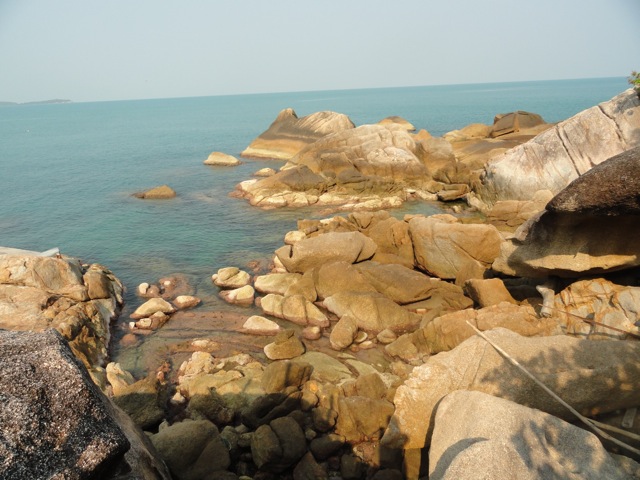
Kala Beach on Koh Samui
While Koh Samui is known as a luxury destination in Thailand it also attracts travelers who prefer sustainable tourism. The island has been promoting green initiatives like the use of renewable energy and materials in various resorts and hotels.
This attracts people from various corners of the globe who prefer eco-friendly tourism. Travelers can participate in various coral restoration projects, and ethical diving practices and enjoy locally-sourced cuisine.
With a growing demand for sustainable tourism and destinations, Koh Samui has become one of the top choices in Southeast Asia.
Siargao, Philippines
If you are a surfing enthusiast, Siargao in the Philippines is a haven for eco-tourism. The island has been promoting sustainable tourism via various green initiatives like waste reduction and the protection of natural resources.
The island has also been promoting hotels and resorts that make use of renewable energy and materials. Various projects include mangrove reforestation and farm-to-table meals for travelers making it one of the destinations in Southeast Asia for sustainable tourism.
In November 2024, with the festive spirit on the horizon, Tempest Photography collected additional funds for its charity partner Raise Your Hands. The photography leader worked with local businesses in Cornwall, collecting prizes for a grand raffle and bake sale.
Tempest Photography’s Partnership With Raise Your Hands
Tempest Photography partnered with Raise Your Hands in 2024, offering to donate 5% of all monies when families purchase a charity photo pack. This product has proved popular with customers, whose orders are helping the photography experts support the philanthropic initiative.
In the 2024 holiday season, Tempest was keen to go the extra mile to support Raise Your Hands. It launched the raffle and bake sale, which raised £750. The raffle offered high-value prizes like hotel stays, afternoon cream teas, escape room experiences, and treat-packed hampers. Numerous people got involved, and the winners were delighted with their prizes.
About Raise Your Hands
Raise Your Hands provides essential financial support and advice to 16 small children’s charities. As the biggest 5% of charities receive 88% of funding, the non-profit organisation ensures that smaller charities also receive the funds they need to achieve their missions.
Whether they work to reduce HIV or suicide, these charities are experts in their niches. They have the ability to transform and save lives. Raise Your Hands recognises that, in many cases, smaller charities are better placed to address specific challenges than bigger charities. This is because they are often specialists.
Tempest Photography in Conversation With Raise Your Hands
Tempest Photography has interviewed Raise Your Hands’ Partnerships Manager Madelaine Jones on the charity’s essential work.
Jones explained that great ideas only tend to receive backing in the corporate world. In the philanthropy space, this is typically only the case for well-known charities with big budgets. Even when small charities have the most effective ideas, they don’t usually have the marketing budget to reach lots of people.
That’s why Raise Your Hands provides long-term funding for small charities supporting children. Over the past decade, it has raised more than £2 million for these organisations. The donations are unrestricted, which means the charities can pour the funding into the resources they know they need most.
When Tempest asked about the challenges Raise Your Hands faces, Jones explained that the difficult economic climate can make it difficult for companies to back the organisation. However, plenty of companies looking to support young people do get involved and help the organisation with its critical work.
As a result, in 2023, Raise Your Hands’ charities’ income climbed by 17%. Their staff teams grew by 12%. And the number of children they supported rose by 25%. This is a fantastic milestone given that the number of young people in the UK needing support is higher than ever.
Thanks to Raise Your Hands’ support, various charities — like Football Beyond Borders — have grown so much they’ve passed the £2 million threshold the organisation uses to define a small charity.
About Tempest Photography
Tempest Photography sits at the forefront of the UK’s photographic industry. Since Horace Tempest founded the company over eight decades ago, it has supported schools, nurseries, and universities all over the UK with its classic and fun portraits, group photos, and ceremony shots. Since then, Tempest has added military and travel photography to its services, not to mention yearbooks, hoodies, and visual marketing.
Photography aside, Tempest is committed to creating social impact. The company is proud to support Raise Your Hands and hopes its customers will continue purchasing charity packs to support the organisation.
The Californian fires are devastating and no doubt families will want to rebuild what was lost. There is a lot of talk on social media platforms, like by investor Bill Ackman who is looking to invest in AI technologies to predict and help drones stop fires. But sometimes, vernacular building and sound ecological practices can save the day before technology, in a space called low-tech.
Fire hydrants and water packed drones might put out a fire if caught in time, but disaster-proofing your future might be a sound and sustainable move. Hemp blocks, also known as hempcrete are already on the market and are eco-friendly and sustainable construction materials composed of hemp, lime, and water.
What is hemp concrete?
Hempcrete or hemplime is biocomposite material, a mixture of hemp hurds (shives) and lime, sand, or pozzolans, which is used as a material for construction and insulation. It is marketed under names like Hempcrete, Canobiote, Canosmose, Isochanvre, and IsoHemp.I
In a recent study scientists look at the fire behaviour and structural performance of hemp-based materials in varying formats. They tested raw hemp shives, hemp blocks, and non-load-bearing hemp block walls.
Testing hemp concrete with fire
Researchers tested how various kinds of hemp reacted in fire safety and strength tests.
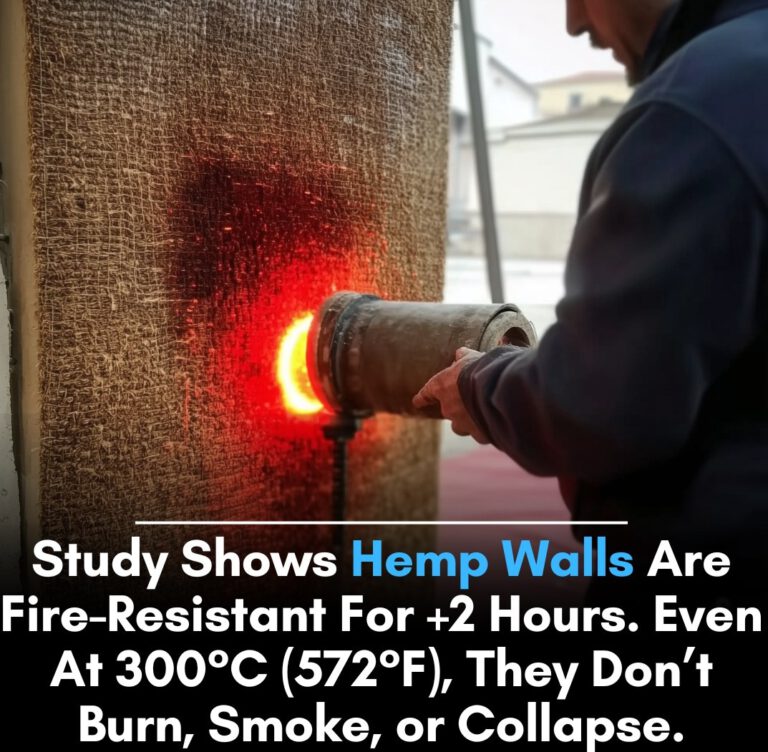
The study found that hemp blocks don’t catch fire with open flames but rather just smolder slowly, producing very little smoke. In fact, walls made of hemp blocks stayed structurally intact for 2 hours during fire tests.
Tests conducted include cone calorimeter, bomb calorimeter, standard furnace, heat-transfer rating inducing system (H-TRIS), and small-scale elevated temperature material tests. Hemp shives exhibit ignition with sustained flaming, a relatively high heat release rate (HRR), and a relatively low critical heat flux (CHF).
However, the hemp blocks exhibited no flaming ignition, only smouldering combustion, and an HRR an order of magnitude lower. Hemp blocks and hemp shives produced minimal smoke. Hemp blocks charred, and associated discoloration zones have been documented. Tests indicate that limited structural capacity is lost up until 200 °C, whereas at 300 °C, the residual material strength is almost negligible.
Their conclusions were that the hemp block walls maintained their structural stability and integrity for 2 hours of standard fire testing. The ambient-temperature compressive strength of the hemp blocks was determined to be 1.0 MPa. This work is the first comprehensive study on the fire behaviour of hemp blocks and highlights their good performance, whereby they are likely to have a limited impact on fire risk in buildings.
The research was led by Yohannes WerkinaShewalul and Richard Walls from Stellenbosch University, South Africa.
Hemp, or industrial hemp, is a plant in the botanical class of Cannabis sativa cultivars grown specifically for industrial and consumable use. It can be used to make a wide range of products. Along with bamboo, hemp is among the fastest growing plants on Earth which makes a great, hearty, sustainable fiber. It has taken nations years to recognize hemp as a viable building and material alternative because tiny amounts of the active ingredient of THC can be found in hemp.
Companies producing hemp blocks:
Hemp and Block
Colorado. The company offers made-in-USA hempcrete, hemp blocks, pre-cast hemp-lime products, and hempcrete binder, sourcing materials domestically to support the American economy.
Builds with and supplies natural high-performance building materials, including HempLime (hempcrete), to create healthy buildings and retrofit structures.
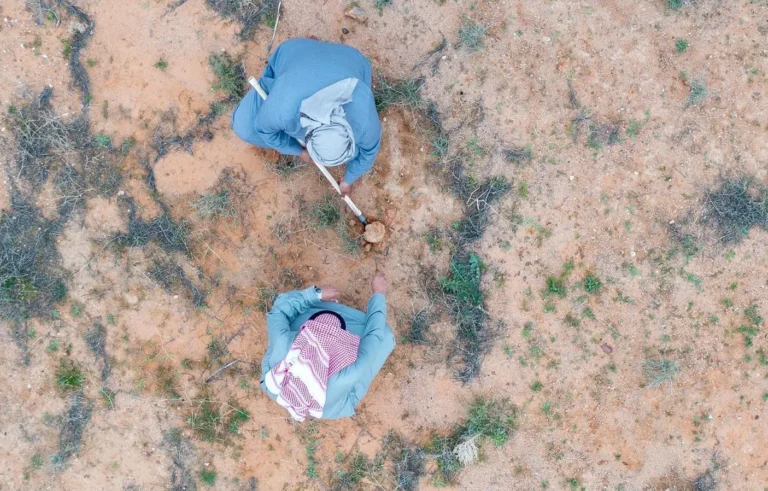
Saudi Arabian framers finding truffles without a pig. Handout the Saudi Arabia Press Agency.
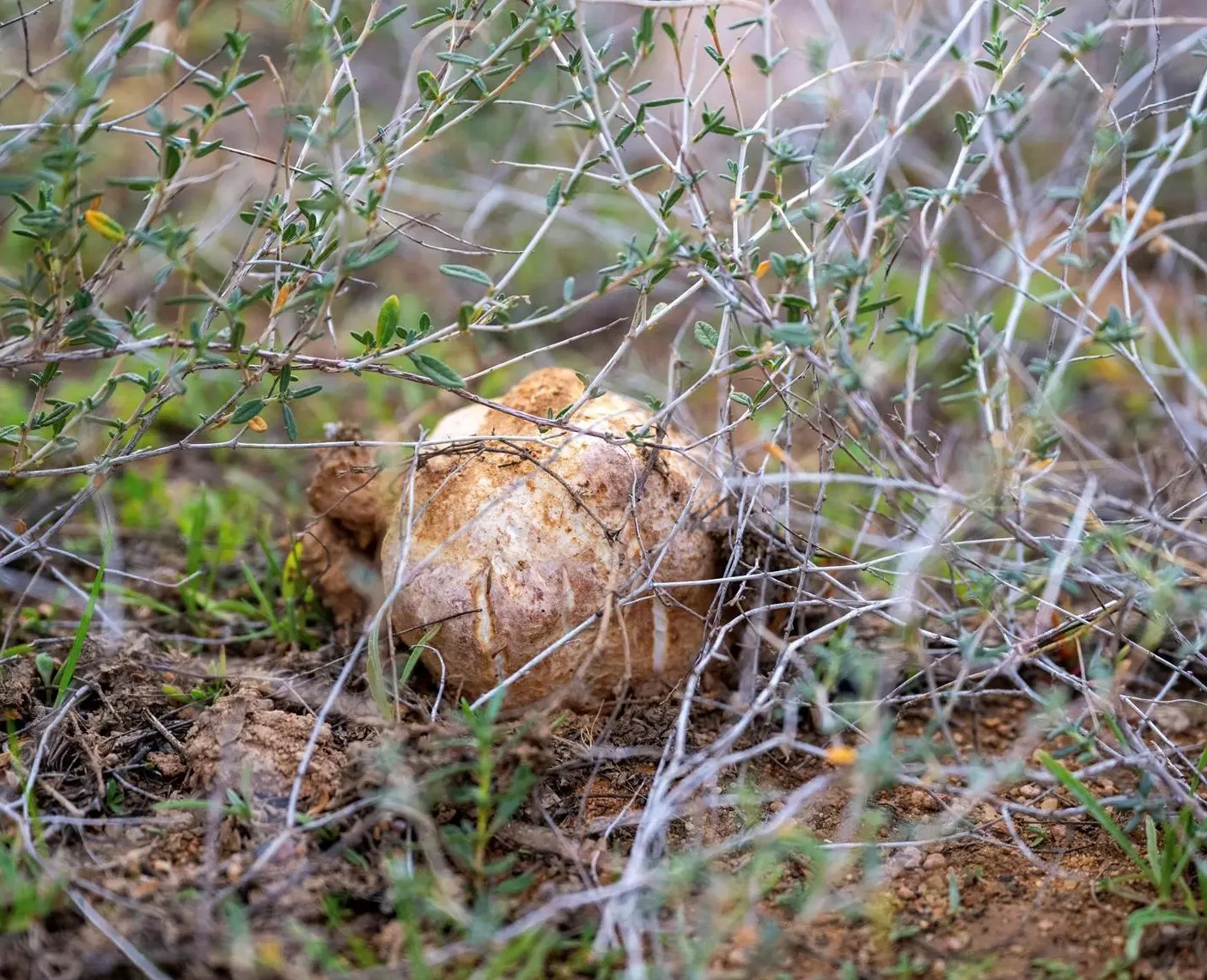
Desert truffles can grow in the sand in dry conditions and they have high nutritional value. Find them growing wild in the Mediterranean basin and Western Asia. Many studies have looked at the nutrition in desert truffles, including their phytochemical composition as potential anti-cancer therapies but a study led by a researcher from Amman, Jordan, looked specifically at the anticancer effects of Terfezia boudieri, a delicious desert truffle.
The researchers applied different solvent extracts from the truffle and the researchers tested these chemical properties against different kinds of cancers in the lab. assay was used to measure their anticancer activity against cancer cell lines.
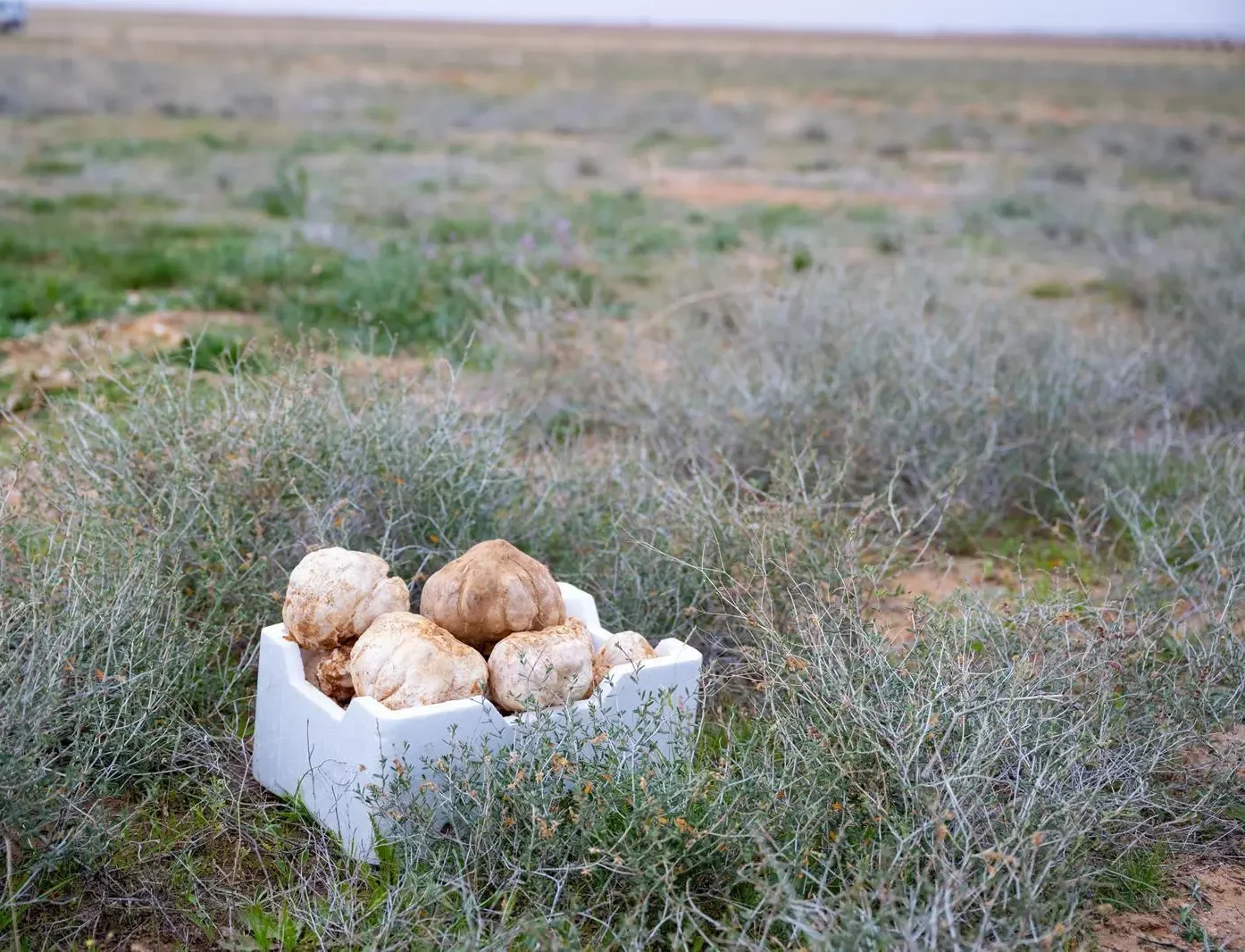
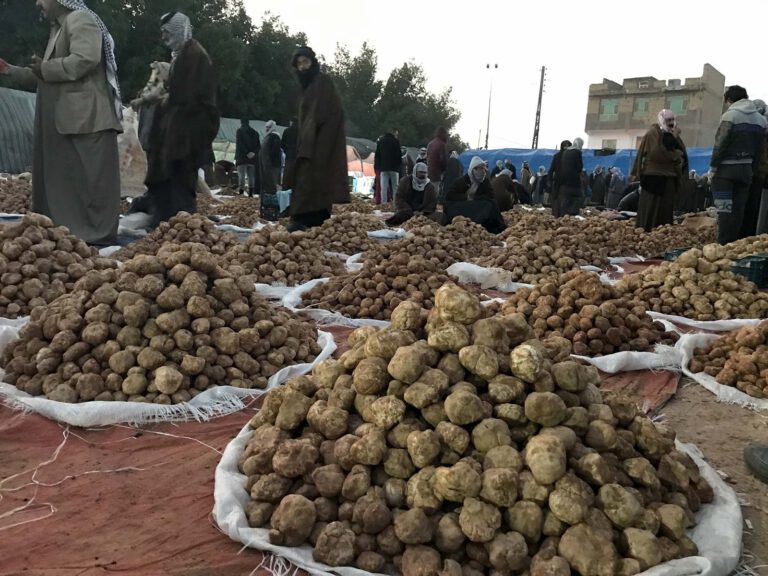
Truffles in the Middle East. Handout the Saudi Arabia Press Agency.
The scientists found that the growth of cancer cell lines was inhibited by the desert truffle extracts in a dose dependent manner which the chemical N-hexane extracted from the truffle as being the most potent against most cancers as part of the study. The researchers concluded that the use of T. boudieri provides variable health benefits and specifically the extracts N-hexane, ethyl acetate, and aqueous/methanol extracts exhibited anticancer activities and are potent stimulators of both innate and acquired immunity.
Saudi Arabia is home to desert truffles.
The researchers were from the Applied Science Private University, Amman, Jordan, the Pharmacy Department, AlNoor University College, Mosul, Iraq and the Department of Health Sciences, College of Natural and Health Sciences, Zayed University, Abu Dhabi, United Arab Emirates.
Further testing is needed to identify the biologically active compounds and detect them quantitatively using scientific methods. A new door of research for scientists in the Mediterranean?
When I think of truffles, I imagine hunters tromping through a dark Provencal forest and a trained pig snuffling around damp leaves. The joyful surprise of the huntsman when it uncovers a truffle! The fragrant black prize so carefully cherished, like a pot of gold! Because the black and white truffles of Europe are like gold to everyone who trades in them.
But the sands of Middle Eastern and North African deserts also yield truffles. They’re known as zubaidi,fagaa, terfez, kamaa (or kima), depending on the country they come from. The botanical name is Terfezia Leonis. And now, with winter in the Middle East drawing on, it’s prime time for a desert truffle safari. Well, if you have an experienced Beduin guide. See what else is in season now here.
Desert truffles have been known and valued as a delicacy since antiquity. The Roman poet Juvenal disdained bread and meat, if only he could dine off imported desert truffles. “Keep your grain, O Libya, and unyoke your oxen, if only you send truffles!” he wrote.
A Jewish legend claims that truffles were the original manna that fed the Hebrews during their 40 years’ wandering in the desert. Reasonable to think so, as they have a wealth of protein and antioxidant properties.
The huntsmen who find and sell desert truffles today are the Beduin. They wouldn’t dream of using a pig or a dog to find the fungus. They locate it by noticing where the yellow-flowered “Rock Rose” plant grows (Helianthemum sessiliflorum). This shrub enjoys a symbiotic relationship with the truffle, who transfers phosphorus to its roots. In return the truffle receives photosynthesized nutrients from the Rock Rose. Win-win for plant and fungus, and for the forager, a flag indicating that truffles are nearby.
That’s the prosaic explanation. Much more fun is the legend that claims truffles grow where lightning strikes the sand. This is because there’s a forked crack on the ground where the truffle struggles to emerge. Desert foragers know that under that crack is a truffle.
It’s true that lightning causes changes in the atmosphere where nitrogen is released and washed onto the ground by rain, which fertilizes plants. And it’s true that winter rains favor a larger truffle harvest. But alas for the romantics among us, truffles aren’t born of lightning strikes. Like all mushrooms, they grow from humble spores.
Desert truffles have been an important seasonal source of protein for the Beduin populations; less so today as they become scarce due to scanty winter rains and current geopolitical issues.
When available, they’re grilled over fire, boiled and marinated as salad and stewed with meat. Modern cooks may use them as the common supermarket mushroom (only far, far more expensive) – sauteed in butter with garlic and spices. It’s said that sliced thinly and sprinkled with salt, they’re delicious raw.
Beduin folk medicine uses desert truffles to cure eye infections and skin rashes.
The fungus’s looks aren’t especially appealing, most being a sandy beige with a knobbly skin. There are regional differences in their color; in Turkey, for example, you may find dark-blue desert truffles.
Their flavor depends on where they come from: Kuwaiti truffles are said to be blandly earthy, while Turkish truffles are supposed to have a fine, almost nutty taste. None have the pungent, decadent aroma and flavor of their European counterparts. In any case, desert truffles are full of sand in all their cracks and crevices, and need a lot of careful scrubbing before they’re fit to cook.
The Ben-Gurion University of the Negev tried to cultivate them as a possible sustainable crop, but apparently to no avail, as the only, rare, desert truffles seen in Israel have been brought from the Negev by Beduin. Under all their Arabic names, desert truffles command high prices and are eagerly sought in the markets of MENA countries at this time of year.
Ask any driver of a Tesla and you will find a happy customer. The cars look good, drive incredibly fast quickly, they cost a quarter of the price of petrol to run, and they have a fart cushion feature that makes every kid laugh.
With electric mobility continuing to gather pace especially in urban environments, recycling high-voltage batteries is increasingly under the spotlight. This is where urban miners, and companies that can recycle batteries and parts after a product’s first life is over.
Raw materials pulled from a BMW electric car battery.
After successfully launching a closed-loop recycling system for the reuse of raw materials from high-voltage batteries thanks to the BMW Brilliance Automotive Joint Venture in China in 2022, BMW has now hit another milestone on its journey to make cleaner, greener electric cars.
This past November, BMW launched a pan-European partnership with SK tes, a company that can mine valuable minerals such as cobalt, nickel and lithium from used batteries before returning them to the value chain to make new batteries.
BMW to recycle rare minerals from its electric car batteries with the company SK tes. Images supplied by BMW
This closed-loop system is set to expand to the car markets in the US-Mexico-Canada regions as early as 2026.
Its long-term partnership with SK tes sees the BMW Group directly involved in the practical recycling processes, allowing it to feed back valuable insights to the development departments: high-voltage batteries from BMW Group development, production and markets in Europe that are no longer fit for use are to be delivered to SK tes in what is the first step towards an effective and sustainable circular economy for batteries.
SK tes then converts the old batteries into high-quality metals that can be reintroduced to battery production. The latter process sees the batteries mechanically shredded, during which the metals are concentrated to leave a material called black mass.
The valuable materials, namely nickel, lithium and cobalt, are then recovered in a highly effective chemical process called hydrometallurgy. Among other things, these secondary raw materials will be used for the new GEN 6 drive train. Government groups like the Department of Energy are actively funding the development of mineral recovery technologies –– we recently reported on more than $20 million USD going toward funding the recycling of decommissioned wind turbines.
“Partnerships like this increase our efficiency in terms of the circular economy. In the closed-loop process, all partners mutually benefit from their experiences,” says Jörg Lederbauer, Vice President Circular Economy, Spare Parts Supply High Voltage Battery and Electric Powertrain at BMW AG.
We interviewed Regenx on its business model. And how lucrative upcycling minerals can be as the world looks to dangerous alternatives such as deep sea mining to develop new sources of minerals like lithium which exist waiting to be pulled from existing end-of-life products.
“The promotion of circular economy is an important strategic topic for the BMW Group. The development of recyclable products, the increase of secondary materials in our components, and the closing of loops play an equally important role,” says Nadine Philipp, Vice President Sustainability Supplier Network at BMW AG. “And by the means of circular economy we are also increasing our resilience in the supply chains.”
The BMW Group follows the principles of Re:Think, Re:Duce, Re:Use, and Re:Cycle in the sense of a conservation of resources when it comes to circular economy.
From vehicle design and production to recycling and reuse: everything is geared towards ensuring BMW vehicles become a raw materials source for new cars once they reach the end of their useful life. One such example is the BMW Group’s Recycling and Dismantling Centre.
Over a period of 30 years now, the centre has developed processes and put them into practice, making key progress in parts and materials recycling.
Michael Pollan, in Defence of Food, once called Americans “corn people” for the amount of corn products in their diet. As the world fights to find viable alternatives to plastics, the people may have found the best bio-polymer, made from… corn.
Michael Pollan
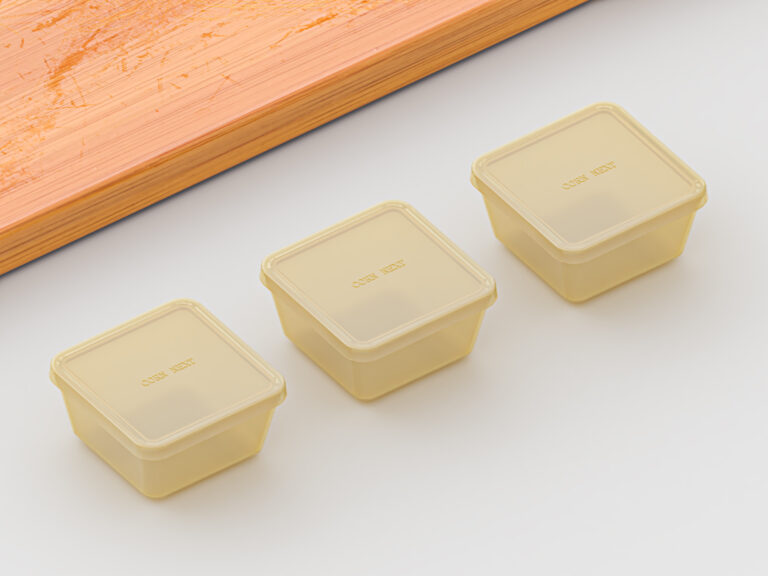
Corn Next has officially launched CornNext-17, a game-changing bio-based material designed to combat the global plastic pollution crisis. CornNext-17 says it can replace traditional plastics. Derived from renewable corn starch, CornNext-17 utilizes a patented fermentation-based process to create a fully biodegradable material with superior versatility and performance.
Unlike traditional plastics and bio-plastics such as PLA and PHA, CornNext-17 retains its natural polysaccharide structure, enabling rapid decomposition within 30 days in natural environments while maintaining the mechanical properties necessary for diverse applications. We all know that most plastics are never really recycled and when they are the process is toxic. The only solution to the plastic problem is a bio-based plastic. One that can fully decompose and degrade, not just break down into littler bits of plastic.
“CornNext-17 represents a significant leap forward in sustainable materials,” said Randy Yongzhong Zhang, Founder and CEO of Corn Next. “We are proud to offer a solution that addresses the urgent need for environmentally friendly alternatives to conventional plastics. The development of CornNext-17 is guided by our vision to revolutionize how materials are used and discarded. As a fully natural biodegradable innovation, it marks not just a breakthrough in material science, but a significant milestone in humanity’s pursuit of a greener, more sustainable future.”
Key Features of CornNext-17
Fully Biodegradable: Decomposes naturally within 30 days, leaving no harmful residues.
Versatile: Suitable for a wide range of applications, including packaging, consumer goods, and industrial components.
Cost-Effective: Produced through an efficient manufacturing process, offering competitive pricing.
High Performance: Exhibits excellent mechanical properties, including strength, flexibility, and heat resistance.
Eco-Friendly: Derived from renewable corn starch and produced without harmful chemicals.
Market Potential and Industrial Applications
CornNext-17 has the potential to transform multiple industries by replacing traditional plastics with a sustainable alternative:
Consumer Goods: CornNext-17 is ideal for creating compostable tableware, single-use products, food containers, and eco-friendly packaging solutions that cater to environmentally conscious consumers.
Packaging Industry: The material’s strength, flexibility, and resistance to heat and moisture make it a superior choice for biodegradable packaging, including retail, food, and industrial applications.
Agriculture: CornNext-17 can be used to manufacture biodegradable mulch films, seedling trays, and irrigation components, reducing waste and enhancing soil health.
Medical and Healthcare: With its ability to decompose fully, CornNext-17 is well-suited for disposable medical supplies such as gloves, syringes, and packaging, ensuring environmental safety.
Automotive: Lightweight and durable, CornNext-17 can be utilized in creating automotive components such as panels, trim, and interior parts, contributing to vehicle sustainability and fuel efficiency.
Electronics: As a biodegradable alternative, CornNext-17 can replace certain plastic components in electronics, helping reduce electronic waste.
The global push for environmentally sustainable materials positions CornNext-17 to capitalize on increasing regulatory support and consumer demand for green products. Its adaptability, cost-effectiveness, and eco-friendly properties provide a competitive edge in addressing the growing plastic pollution crisis.
Corn Next (or Y & J World Inc.) is a biotech company based in Irvine, California and is dedicated to eliminating plastic pollution. Their bio-based material CornNext-17 is a patented, 100% natural, biodegradable material derived from renewable corn starch.
Unlike traditional plastics, CornNext-17 fully decomposes within 30 days without leaving toxins or requiring costly recycling. After eight years of R&D, the company transformed CornNext-17 into a granular form, securing our proprietary technology and expanding its applications. This innovation led to the world’s first corn-based drinking straw, protein spoon, dinner knife, and forks, with future uses in utensils, dental floss, packaging and more
Corn-based plastics for packaging is a market which reached a market size valued at USD 0.56 Billion in 2022 and is projected to reach USD 1.20 Billion by 2030.
A Stella McCartney decomposing shoe
Bioplastics are derived from renewable biomass sources such as vegetable fats and oils, corn starch, straw, woodchips, sawdust, algae and recycled food waste. Fashion designers like Stella McCartney use bioplastics in fashion, thanks to companies like Balena, which develop a bio-based raw material that looks and acts like rubber but which decomposes at the end of its life.
We Used to Be Seaweed creates a dialogue between historical and contemporary perspectives of the Aral Sea. Once the world’s fourth-largest lake, the Aral Sea has been depleted to an eighth of its size due to large-scale irrigation projects.
Hosted at the Savitsky Museum, this exhibition recontextualizes the museum’s famous collection of Soviet avant-garde and Turkestan modernism to open new conversations about identity, environment, and transformation.
The exhibition brings together contemporary artists whose works address the ecological, cultural, and historical transformations of the Aral Sea region.
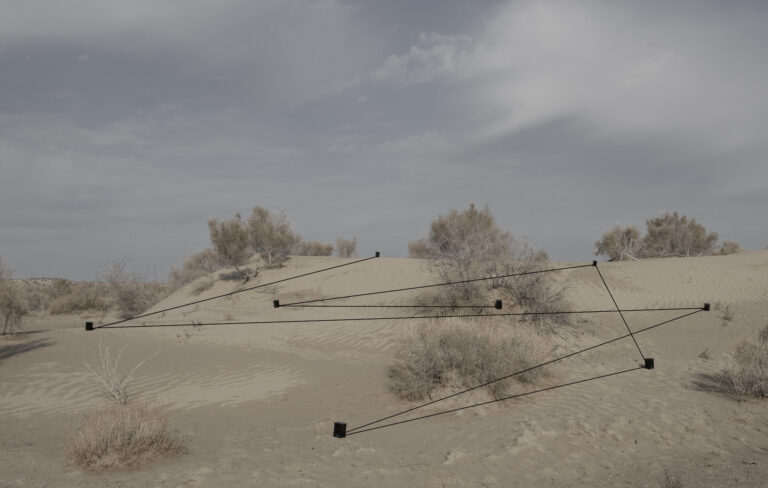
Alexander Ugay deconstructs the sea’s vanished horizon through his cameraless photographic work. Saodat Ismailova’s videos examine the extinction of the Turan tiger and the lives of three generations of Aral fishermen.
Saodat IsmailovaSaodat Ismailova. 18,000 Worlds, January 21 – June 4, 2023, Eye Filmmuseum, Amsterdam. Exhibition view of Zukhra, 2013. HD video installation, 30 min., colour, stereo. Image courtesy Eye Filmmuseum. Photograph by Studio Hans Wilschut.
The2vvo contributes a sound sculpture combining found sounds, underwater and field recordings, and testimonies, exploring the interconnectedness of human and non-human life in the area.
the2vvo
Lilia Bakanova presents a textile installation about imaginary life in the Aral Sea, created from raw silk and cotton—materials produced with water that was redirected away from the Aral Sea.
Lilia Bakanova
In conversation with selected works from the museum’s collection, these pieces reflect on the region’s histories, shared water resources, and the intertwined relationships between culture, nature, and memory.
What happened to the Aral Sea through an artist’s lens:
Imagine a journey that starts with a long train ride followed by an off-road drive through the desert, ending at what used to be the Aral Sea. Once the world’s fourth-largest lake, it has reduced to an eighth of its size since the 1950s due to water being diverted for cotton farming.
This made a drastic impact on the climate and life in Central Asia, mainly in Kazakhstan and Uzbekistan.
Against expectations, this landscape reveals striking beauty rather than depression: the desert blooms with a poignant tenderness; colors are muted by a superfine sandy powder, creating a velvety touch; unknown grass smells of chemically flavored lollipops.
Now imagine that in this remote town with no tourists where you hired the car, there is a world-class collection of Russian and Central Asian avant-garde. This is Savitsky museum, named after an artist who rescued paintings discarded by museums across the USSR in the 1960-70s. This town, Nukus, was so far from the Soviet government, that the collection survived. It not only educated and inspired local artists but also includes their works, many depicting the Aral Sea throughout the 20th century.
This exhibition will create a dialog between historical and contemporary perspectives of the Aral Sea and the life around it. The Museum provides a perfect backdrop for the exhibition, given its history of resilience and collection of paintings depicting the region’s transformations.
Featured contemporary works will include:
– A Kazakh-Korean artist explores the Aral area through imaginary history. Using AI, he reconstructs his family’s archive lost during deportation of Koreans from the Soviet Far East to Kazakhstan in 1937. The work will invite the viewers to consider a link between the erasure of culture and landscape, between identity and displacement.
– An Uzbek video artist connecting inadequate exploitation of shared water resources and female labour in Central Asia.
– An installation that will engage with the visitors through imaginary textures, sounds and smells, making the invisible resilience of Aral visible. This artist’s projects are focused on accessibility to diverse audience. To build on this inclusive effort, she will create t touchable versions of the paintings featured in our exhibition. This will complement the museum’s wheelchair access by introducing a wider range of sensory experiences.
– A photographic project by a Kazakh photographer will bridge the Kazakh and Uzbek regions of the Aral, fostering understanding and sensitivity between communities by offering glimpses into each other’s lives and shared water challenges.Beyond looking, touching, smelling and listening, the gallery is inviting people to get involved.
“Visitors can help plant seeds that they can take home and later return to the desert as seedlings for the local biostation. We’ll also teach them how to make biodegradable containers for holding water for these plants. This is about more than just raising awareness; it’s about small collective actions and new connections,” announce the artists.
February 13 to March 12; Savitsky Nukus Museum of Art Rsaev Str., Nukus 23100, Republic of Karakalpakstan, Uzbekistan
Artists:
Saodat Ismailova
Lena Pozdnyakova and Eldar Tagi
Alexander Ugay
Lilia Bakanova