
Cool, fresh drinking water. Westerners turn the faucet on and take it for granted that good water will flow out, but in many countries fresh water is a treasure, gained by hard work. In rural villages all over the globe, people – usually women and children – fill buckets and jerry cans from a communal faucet or from a natural source that may be over an hour’s walk away.
But the water obtained may not be safe to drink. According to UNICEF and the World Health Organization’s 2009 report, diarrhoea, due in large part to the lack of safe drinking water, kills nearly 9 million children under age 5 every year. Poor sanitation and hygiene play important roles in this figure as well.

“According to the latest available figures, an estimated 2.5 billion people lack improved sanitation facilities, and nearly one billion people do not have access to safe drinking water.” (WHO 2009)
Here we discuss filtering water through ceramic vessels for safe drinking. Clay jugs for filtering and cooling water have been used for centuries in India, Africa, the Mediterranean, and Central and South America. Some companies like Mayu were inspired by ways of the ancients and built a new solution.
Water poured out of traditional unglazed clay jugs tastes cool and sweet. Now let’s see how effectively clay jugs filter out disease-bearing particles.
The clay pot filter designed by Dr. Fernando Mazariego in Guatemla, 1981, is the model for the most successful modern clay filter system. Potters for Peace, a non-profit based in the USA, has been supplying the Mazariego filters and teaching villagers how to use and maintain them since 1986. Originally based in Nicaragua, the project has expanded to other underdeveloped countries. Other researchers have adopted the clay jug model. In over 20 countries, people are drinking safe water filtered through these clay jugs, and avoiding the catastrophic diarrheal diseases that kill adults and children within days.
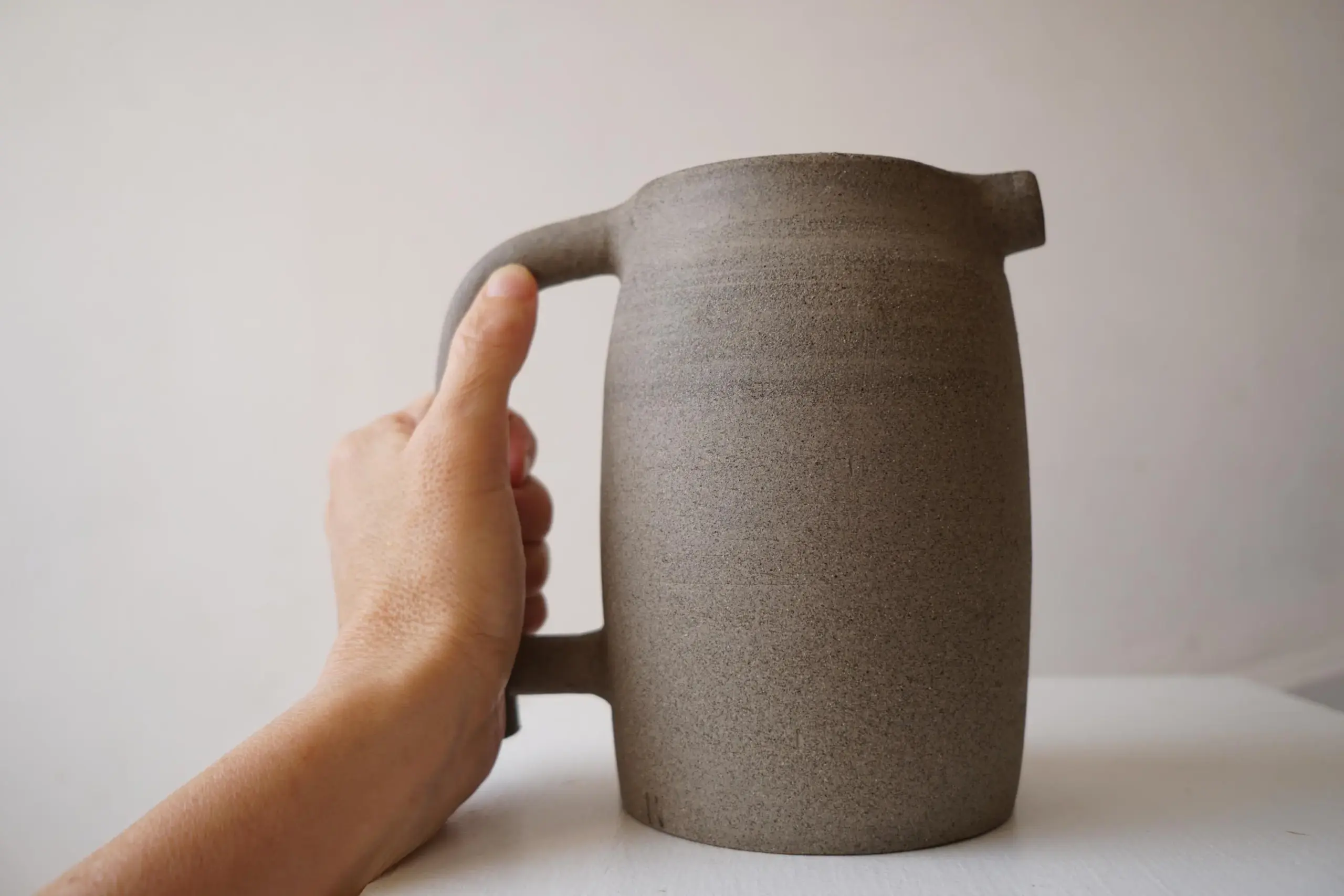
To be effective, the jugs must be made of local clay with mixed with ground, sieved sawdust or other combustible material. When the pots are fired, the clay incorporates the sawdust (or corn or rice husks). It remains porous, but its micro-texture blocks contaminants in the water filtering through and dripping downward into the storage vessel.
Learn how to throw your own clay pot here:
Still, some pathogens are small enough to pass through the clay pores. To remove deadly micro-organisms and prevent mold from growing inside the filters, a layer of colloidal silver is applied to their interiors. Tests prove that these colloidal silver-coated jugs eliminate 99.88% of toxins found in raw water. Introducing copper to the jug, instead of silver, has also proved to be effective.
Some commercial clay water jugs are quite handsome.
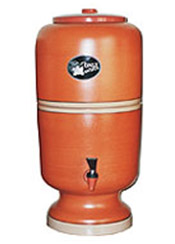
The filters based on the Potters for Peace model are less so, but just as effective. They hold 8-10 liters of water and are placed snugly over a storage vessel, which could be a bucket, or another clay pot. The filter on top is filled with water, which drips down into the storage vessel. A spigot attached to the receiving vessel allows access to the now-pure water. This is achieved by drilling a hole in the bucket or jerry can in order to insert a tap, or in the case of a clay storage vessel, having it made with a spigot. It’s important to prevent people from dipping their hands or cups inside the storage vessel, to prevent cross-contamination.

These clay filters are a cheap, locally-made and effective device for turning contaminated water into safe water. Studies show that where people use them, there is a 60-70% reduction in diarrheal disease. But there are two caveats: while many contaminants stay behind, viruses slip through; and where the jugs are poorly made, or cracked, or not regularly cleaned out, bacteria will accumulate inside them. Care and maintenance of the filter and the water storage vessel are an important part of education in clay filter use. They should be washed with hot water, soap, and a soft brush regularly, and immediately after filtering especially turbid water.
The Centers for Disease Control and Prevention of lists the following advantages and disadvantages of the clay water filter system:
- The benefits of ceramic filtration are:Proven reduction of bacteria and protozoa in water
- Simplicity of use and acceptability
- Proven reduction of diarrheal disease incidence for users
- Long life if the filter remains unbroken
- A low one-time cost
Drawbacks of clay filtration
- Not as effective against viruses
- No chlorine residual protection – can lead to recontamination
- Variable quality control for locally produced filters
- Filters can break over time – need for spare parts
- A low flow rate of 1-3 liters per hour for non-turbid waters
- Filters and receptacles must be cleaned regularly, especially after filtering turbid water
- Ceramic filtration is most appropriate in areas where there is capacity for quality ceramics filter production, a distribution network for replacement of broken parts, and user training on how to correctly maintain and use the filter.
The “raw water” trend that has taken hold of some American’s imaginations is an open invitation for toxins like runoff water pesticides, birth control hormones and fecal matter to invade and wreak havoc. Raw water is after all, responsible for the cholera epidemics that swept Europe and still claim victims around the world. Far better, if a person insists on drinking water in its most natural state, to invest in a clay water filtration system – and to boil the purified water before drinking it or brushing their teeth with it.
:: CDC Centers for Disease Control and Prevention
Drawing of clay water filter system via designindaba.com