Earth. Energy. Everything next.

Protest Against Nuclear Power In Jordan

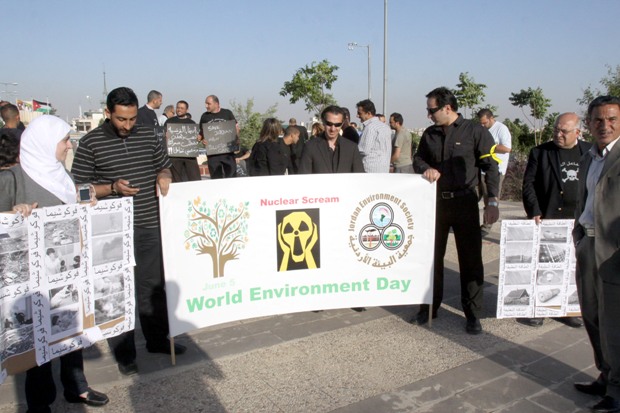
Protesters in Jordan are campaigning against the country’s plans to build a nuclear reactor which they state carries more risks than positive impacts

Despite the disaster at Japan’s Fukushima nuclear station and Germany’s bold move to shut down all nuclear reactors by 2020, it seems the Middle East is still set on a nuclear future. Israel has hinted that it may build a ‘safe nuclear station’, Turkey is pushing on with its nuclear ambitions and Jordan recently announced that it is forging ahead with plans to build its first nuclear power plant despite local resistance and regional instability.

This Tuesday, around 40 anti-nuclear campaigners gathered in Amman to ask the Jordanian government to re-think its plans to build a 1,000 megawatt nuclear reactor by the end of the next decade. According to The Jordan Times, they wore black t-shirts reading ‘no to a nuclear reactor’ and expressed concerns about the effects of nuclear power and uranium mining on the public health and environment.

Jordan is heavily reliant on imported energy – it currently imports 96% of its energy – and the government has claimed that the nuclear reactor will help the country become more self-sufficient. The country has massive uranium reserves that are estimated to be worth around $7 billion which could be utilized in nuclear power stations.

However, the protesters noted that other renewable sources of energy hadn’t been properly assessed and also any benefits from nuclear energy are far outweighed by the risks such as those demonstrated by the meltdown of the Fukushima nuclear station in Japan.

Basil Burgan, an anti-nuclear activist who heads a coalition of 16 NGOs and organised the event told the Jordan Times, “We have came to a point where nuclear power has begun to take priority over solar and wind energy and we want to say that a small desert county like Jordan has no need for a nuclear power programme.”

Another criticism leveled at the Jordanian government is the fact that country, much like Turkey, sits on a fault line making it vulnerable to earthquakes. As a water scare country, Jordan is also badly placed to provide the copious amounts of water that are needed to cool a nuclear reactor. Despite these obstacles, Jordan is pushing on with its nuclear plans and expects bids from private investors to help finance the reactor in the coming month.

::Jordan Times

:: Image via Batir Wardem

For more on Jordan and nuclear power see:

Jordan Explores The Nuclear Option

Shams Ma’an Solar Plant for South Jordan

Jordanian Uranium Discoveries Could Devastate Fragile Ecosystems
Arwa Aburawa
Arwa Aburawahttp://www.greenprophet.com
Arwa is a Muslim freelance writer who is interested in everything climate change related and how Islam can inspire more people to care for their planet and take active steps to save it while we can. She is endlessly suspicious of all politicians and their ceaseless meetings, especially as they make normal people believe that they are not part of the solution when they are the ONLY solution. Her Indian auntie is her model eco-warrier, and when Arwa is not busy helping out in the neighborhood alleyway garden, swap shopping or attempting fusion vegetarian dishes- with mixed success, she’d like to add- she can be found sipping on foraged nettle tea.

Read More

TRENDING

Petra by Night returns as Jordan tries brings tourists back to Wadi Rum

The Nabataeans understood that prosperity in the desert depended on respecting environmental limits. Two thousand years later, Petra's greatest attraction may still be the wisdom of the people who learned to live within them.

The pulsing planet and the earthquakes that shape our world

One of the most persistent questions in seismology concerns whether scientists will eventually be able to predict major earthquakes before they happen.

Amman’s traffic crisis is about more than cars. It’s about how we think

I believe Jordan needs a cultural transformation alongside its infrastructure investments. We must begin by redefining social prestige. Why should ownership of an expensive car be considered a greater achievement than making an environmentally responsible transportation choice? Why should travelling by bus carry a social stigma?

Why water-starved Amman keeps flooding and how underground rain tanks could help

Jordan's capital faces a troubling paradox: chronic water shortages and destructive winter floods. Hydrogeological expert Dr. Osama MN Gazal explains how underground rainwater tanks and green infrastructure could help Amman capture precious rainfall, reduce flooding and build a more water-secure future.

Can Amman become a walkable city? C40 is turning hot asphalt into green public spaces

Amman has never been an easy city to explore on foot. Now, C40 Cities and Community Jameel are reimagining Jordan's capital with cooler streets, shaded playgrounds and greener neighbourhoods. Could this sprawling city finally become more walkable?

Why Bronwyn Finnegan Chose the Nonprofit Sector Over Politics or Corporate Life

Bronwyn Finnegan could have pursued a career in politics or corporate leadership. Instead, she chose the nonprofit sector, where she focuses on financial sustainability, governance and helping mission-driven organizations build the capacity to survive and grow.

Scientists make lead-free perovskite solar cells that can weather the elements

Scientists have developed a “raincoat” for lead-free tin perovskite solar cells, helping them withstand air, moisture and heat while maintaining high efficiency.

The Essential Guide To Sustainability in Project Management

Sustainability is an approach where businesses and individuals balance the environmental, social, and economic aspects of a project such that current and future stakeholders are not overburdened with the impacts of the project in future.

Yerukim Forms a New Green Economy Where the Money is Really Green

The Yerukim members who pick up the recyclables get to keep the monetary reward, the public earns "green" bills that can be used in shops, and business owners get to be associated with environmentalism.

Choosing Riyadh over Dubai? What Investors Should Know

Saudi Arabia is deploying capital at unmatched scale to catalyze tourism and advanced industry while rewiring its power-and-water backbone. The investable frontier is widening—especially in renewables, grid storage, water efficiency/desal retrofits, and hospitality operating platforms. Prudent investors will insist on phased delivery, enforceable KPIs (energy, water, biodiversity), and RHQ/zone compliance—while pricing political-economy and reputational risks alongside growth upside.

Sell your cooking oil for biodiesel money

Want to make money on old french fry oil? Sell it.

Qatar Alternative Energy Summit Pairs Investors And Innovators

Alternative energy investors and innovators can meet n' greet in Doha, Qatar March 16 and 17.

Here’s How To Implement The Four Pillars Of Employee Engagement

If you throw a party for your work team and they are vegans, don't make it a barbecue. Know the sustainability values of your team to boost moral and retain good people.

Popular Categories