


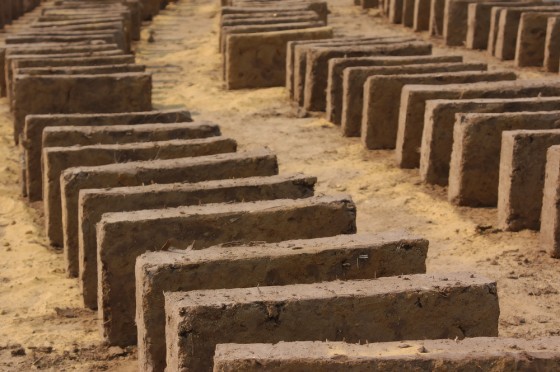
 Turn to the ancients for a green building technique that lets you play like a child. Mesopotamian mud bricks still do the job, for free.
Mesopotamia was the ancient collective of settlements tracing the Tigris–Euphrates river basin. It spanned modern Iraq, northeastern Syria, southeastern Turkey and smaller parts of Iran. Modern school kids learn this was “the Cradle of Civilization” and part of that education usually involves making Mesopotamian mud bricks. Clay was Mesopotamia’s most important raw material: most of their structures were made of clay bricks, clay cities which were encircled with massive fortifications made of more earthen bricks. Here’s a short guide on making your own. A great way to build your own compost bin.
Helping with a child’s brick making assignment, I had a brainstorm. I’ve wanted to start a small compost operation in the garden of my rented house to manage the shockingly large volume of organic waste my household generates, and I wanted to do it on the cheap.
Could I create a composting center that was non-intrusive to the owner’s property, easy to build, and fully biodegradable? It hit me – like a mud brick to the head – I could make one with adobe.
I’d form a compost “containment island” by digging deep into the soil and use the excavated dirt to build a low wall along its perimeter. That wall would enclose the compost and also support a lid to retain heat and keep out the armies of Ammanian stray cats. Why not form the wall with clay bricks?
My tiny helper and I cranked up some ancient Commodores tunes as inspirational backbeat and dug in. A few minutes online found us a simple brick recipe:
1. Collect cardboard shoe boxes (or similar boxy container) for your mold.
2. Mix different combinations of dirt, sand, clay, grass, weeds, straw, and water.
3. Pack the mixture tightly into your mold.
4. Allow your brick to dry in a sunny place for several days.
5. Remove the dried brick from the box. If the brick is still damp, set it in a dry, sunny spot to fully harden..

We improvised and used Teflon-coated cake pans. A week of steady rainfall had loosened up the hardpacked soil, making “excavation” and mix-up a breeze. Our dirt is largely red clay, extremely sticky. We added handfuls of dried pine needles (available in the garden) and just enough water to make the mix pliable.

The first attempts were laughable: the mud glued to our fingernails and added 2 inches to the soles of our shoes. So we modified our technique: less water, and lined the form with dry pine needles to allow damp bricks to slide readily out of the upturned pan.
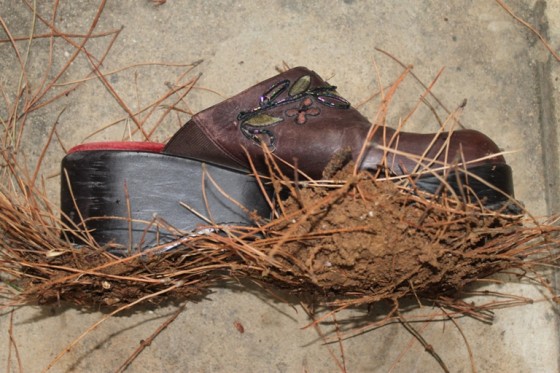
We laid the wet bricks – about 24 in all – along the perimeter of the patch I planned to excavate, approximately the size of a sheet of plywood, which will ultimately form the unit’s lid. Got the last “foundation” brick in place just as the skies opened up again. Phase one of our project completed.
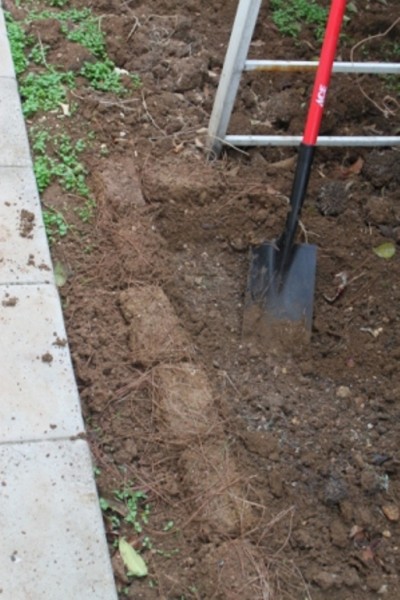 As with gardening, it’s a visceral pleasure to work the soil. Think of how versatile these bricks can be: edge a garden or a path, build an enclosure to hide ugly recycling bins. Make smaller containers to use as planters instead of clay pots. And redecorating is a cinch – knock it down and return the materials to the soil.
So, next I’ll dig the pit, taking advantage of the rain-loosened dirt. We’ll continue to stockpile raw bricks as free time allows, and leave them under a tarp to properly dry. Probably a project to be undertaken in the dry Amman summertime. But when inspiration strikes, it’s best to ride the wave.
Top image of bricks in rows by Shutterstock



How would we, say, seal these together to build a small structure? I teach children with autism, often using natural materials.
This is an excellent idea and works good.
I am working all greenways for life. I am working on pesticides/ chemicals pollution reduction and regulations for developing countries.