

 Composting with your teens in an educational family project.
Waste not, want not is something that can be taught by making compost. I’ve confess I’ve never much cared whether my vegetables are organic or bought at the neighborhood supermarket. I’ve always thought that the term “organic” is just a marketing ploy targeting a particular group of consumers to whom I do not belong. They are worried about pesticide residues; I’m more concerned with taste.
That’s because I’m a foodie. Taste and texture are all-important. I can take up to 15 minutes at the supermarket feeling each avocado on display to make sure I get the ripest, most perfect avocados on offer. To that end, the first time I had access to a patch of land, I became enamored with the idea of growing heirloom vegetables: huge imperfect Brandywine tomatoes cracking open to reveal sweet red flesh and Country Gentleman corn, white as snow and bursting forth with buttery corn flavor.
I pored over seed catalogues and gardening books and then threw myself into the process of gardening. To my delight, my children shared my interest in all things related to dirt, seeds, flowers, and vegetables. There’s something godlike about growing things.
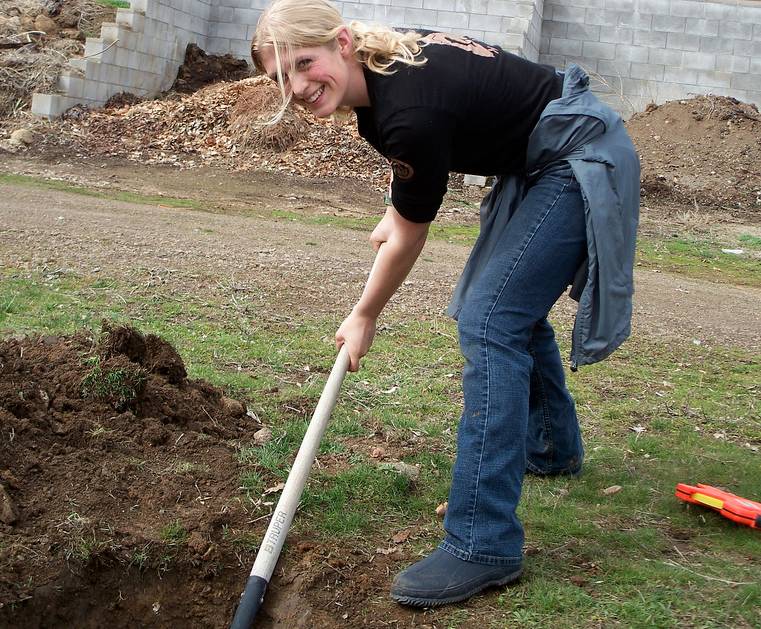
Like James, I decided to make a compost pile. The teens did the heavy labor and dug a deep hole not too close to the house.
This way, the wind wouldn’t waft composting smells and flies into our open windows. The kids took turns schlepping kitchen detritus out to the compost pile, building up layers of vegetable peels, coffee grounds, and dirt.
Here and there, a kid would turn the soil with a shovel. They were fascinated to see and touch the rich results of this experiment: dark, almost black compost you just knew would make a terrific growing medium.
Watching what we’d always thought of as garbage turning into soil made us understand the preciousness of potato peels and egg shells. Even after we moved to an urban apartment and had no land to speak of, throwing vegetable peels away felt like a criminal act.
Composting is a lesson in recycling resources your children (and you) will never forget.
More How-To articles on composting:
Mulch, Rot and Invigorate the Compost Heap (Part 1)
A Half Empty Bin and Some Worms (Part 2)
Make Your Own Vegetable Composter for Under $10



For those of you interested in the topic, check out the book, “Last Child in the Woods.” It’s by Richard Louv, and an excellent read about the relationship of kids to nature.
On an entirely different note, how do we get municipalities to include composting as part of recycling programs? This is particularly important for those of us in cities (like me, in Tel Aviv).
Write a letter to the municipality. All these issues are handled by the city, although the government can make recommendations.
For some teens, recycling and other “green” activities may seem like burdensome chores. Also, teens are by nature, kind of narcissistic–it’s not that they don’t give a darn about the planet, it’s that it doesn’t occur to them to care about anything outside of their own narrow teenaged worlds.
But you never know when some new activity will pique a teen’s interest to the point where s/he will be willing to learn something new. If they catch the excitement of (in this case) growing things, they may be able to step outside of their own self-concerns to see their relationship to planet as well as to see the planet as a whole.
Wow. Scary stuff, Steve. Next they’ll think they were brought by the stork 😉
It’s incredibly important for teens not only to learn how to live “close to the earth” (as my Grandfather used to call it), but to get a realistic idea of how food is made. I wonder how many teens today labor under the misapprehension that eggs in the supermarket come from “the egg fairy,” and how many believe carrots grow on trees?
Usually by the time our kids are teens we can assume they’ve learned all they’ll want about the environment before then. But it is never too late to teach your kids about composting, respecting the planet…
Thanks, Tina 🙂
Yeah. I think it did kind of have a trickle-down greening effect. One of the kids that helped me was studying engineering, but just wasn’t happy, even though he was pulling down good grades. After taking an aptitude test, he now studies green agricultural techniques at Weizman Institute!
My mom used to get my sister to do this sort of work for her. It paid off – she’s also green inclined. Nice.