There was a time when fashion changed and we changed or reshaped our clothes. I remember tightening in the legs of my jeans in the late 80s, and a year later chopping them up and adding colorful extensions turning them into bellbottoms, Grateful Dead style. I was working on a budget, so when the fashion changed, I just changed what I own. Fast fashion decades later has changed that. So has ozempic which is turning overweight people into skinny ones. How does that impact fashion? And sustainable fashion and circular fashion?

That is the strange place we have arrived at with Ozempic, Wegovy, Mounjaro and other GLP-1 weight-loss drugs. These medicines were developed to treat diabetes and obesity, but their influence is spilling far outside the doctor’s office. They are changing what people eat, what they drink, how they shop, what size clothes stores stock and, perhaps most uncomfortably, what kind of body fashion considers desirable.
I started thinking about this after sending some questions to Katie Baker Jones, Ph.D., an associate professor and program coordinator in Fashion Design & Merchandising at West Virginia University. Jones studies fashion media and the stories the industry tells us about our bodies.
Her research on weight loss drugs and fashion led me to write about how Ozempic and GLP-1 weight loss could reshape fashion, food consumption, waste and even the environmental footprint of transportation. If millions of people become smaller, I wondered, do the physical things surrounding us eventually become smaller too?
It’s the kind of rabbit hole we like to jump into over here at Green Prophet. A pharmaceutical drug changes an appetite. An appetite changes a supermarket basket, a smaller body changes a wardrobe and a wardrobe changes textile demand. Multiply those choices by millions of people and suddenly a medical breakthrough for weight loss starts looking like an environmental force.
We are seeing similarly unexpected connections elsewhere in medicine. New research into psilocybin and chemotherapy-induced peripheral neuropathy, for example, suggests that a compound better known for its psychedelic effects may protect sensory nerves by preserving the movement of energy-producing mitochondria. In both cases, drugs are doing things, biologically and culturally, that extend far beyond the reason most of us first heard about them.
But after my first GLP-1 story, I wanted to come back to the people inside this enormous experiment. Are fashion companies actually changing what they manufacture? Will smaller bodies mean fewer textiles? Will people simply throw away their old wardrobes and buy new ones? And after a decade of Americans talking and pushing for body positivity in advertising and sizing options, is fashion quietly deciding that thin is fashionable again?
I sent Jones five questions. Her answers were thoughtful, cautious and considerably more complicated than the simple narrative that everybody is suddenly becoming skinny.
Katie Baker Jones on GLP-1 drugs, fashion and the return of thin
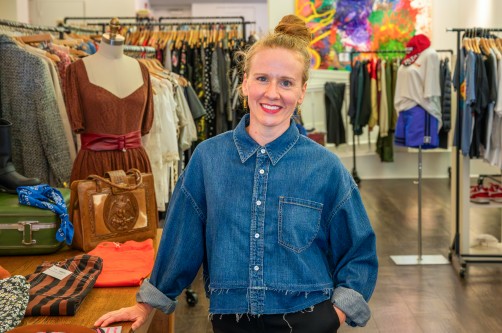
Green Prophet: Are fashion buyers actually changing size orders yet because of GLP-1 use, or is this still mostly discussion and anticipation?
Katie Baker Jones: Yes, there is documented evidence that brands are offering fewer options in the upper size range. From a Guardian article: “The research firm Edited, which tracks items as they launch on retailers’ websites, analysed H&M’s offerings for spring/summer 2026, recording all new women’s dresses landing on the site from January to May and compared it with the same period in 2025. Last year, 3XL and 4XL made up 2% of the new inventory.
This year those sizes were entirely absent. Other large sizes fell too: XXL, which had accounted for 13.3% of inventory in 2025, was down 3 percentage points, while XL was down 2 percentage points, and smaller sizes, XS to large, rose by 3 percentage points on average.” The article offers other examples of mass market brands decreasing or eliminating altogether their upper size ranges.
Even though Gallup reports that only 11% of the American population is currently taking a GLP-1, the fashion press continues to discuss GLP-1 adoption as inevitable/universal and appears to be making buying decisions based on that logic.
Green Prophet: Could widespread weight loss ultimately reduce the amount of textile used by the fashion industry, or do you think people changing sizes and replacing wardrobes could actually increase clothing consumption?
Katie Baker Jones: A decrease in textile usage is possible, but not necessarily from fewer plus size garments being made. Though only mentioned in a few of the trade press articles I read for my study, the industry does have some inkling that GLP-1s could reduce general demand for clothing since, at least for some users, it does seem to reduce overall desire and compulsive behavior and it’s being used to treat addictive behaviors (whether eating, shopping, or controlled substances).
Yes, some folks may need to replace their wardrobes as they lose weight, but it’s probably too early to tell how consumption will be reshaped by broader GLP-1 adoption.
As with most aspects of the fashion industry, reporting tends to focus on what is happening in Western and middle-to-upper class consumer economy – wealthy people have access to these drugs, poorer folks do not or it’s limited to what their insurance will cover. Obesity rates are rising in developing economies, so if we take the global view, the demand for textiles due to shifting body sizes is much more complicated.
That last point is important. The environmental equation isn’t as simple as smaller bodies requiring less fabric. A person losing weight may replace an entire wardrobe. Someone else may buy less of everything. And the changes happening among wealthy consumers in North America and Europe are not necessarily happening elsewhere in the world.
Green Prophet: Are brands beginning to think about the “GLP-1 consumer” as a distinct market — not only in sizing, but in style, identity and purchasing behavior?
Katie Baker Jones: Yes, most of the fashion trade press are focusing on the “Ozempic Economy” – the growth opportunities in wellness, beauty, and apparel that the drug has had or may have in the future. Business of Fashion reports that some brands are actively taking “size volatility” into account in their designs and policies (as has been widely reported, most people who stop using GLP-1s gain back most, if not more, of the weight they lost).
For example, it mentions David’s Bridal has clocked that brides are shopping closer to their wedding date since they may be using GLP-1s to reach an ideal size for their wedding, meaning things like alterations and fit sessions are going to happen on a shorter timeline. This will put pressure on factories and alterations workers to speed up their timelines as well. That same article talked about Soma developing their Bodify bra to better accommodate all the ways breasts may change, whether from giving birth, menopause, but also including for those who have lost breast fullness due to rapid weight loss.
WWD has published several reports on the growth of supplements and fitness regimes specifically aimed at GLP-1 users.
Green Prophet: Do you see a danger that fashion will abandon the body-positivity and size-inclusivity gains of the last decade if smaller bodies become dominant again?
Katie Baker Jones: The abandonment of size inclusivity on runways and in advertising is probably the most visible and rapid impact the spread of GLP-1s has had. Multiple outlets have reported on the noticeable loss of size-diverse models on the most recent runways. There are of course brands that have remained committed to size inclusivity including Christian Siriano and Karoline Vitto, but as with previous “thin is in” eras, the press frames them as anomalies not as bellwethers (and maybe also as a salve to women who still seek larger sizes AND fashionability).
I would argue the marquee luxury fashion houses were always reluctant participants in the body inclusivity movements; even when they did employ mid- and plus-size models for fashion week, the actual product available to consumers was limited at best.
The industry has never been very good at pretending that it aspires to dress every body type; excuses such as the ‘difficulty’ of designing for larger bodies or the economic infeasibility of expanding size runs have served as cover since at least the 1910s when mass manufacture of women’s apparel really started to take off. The work of Carmen Keist and Lauren Downing Peters offer some great historical and contemporary analysis of this issue.
Green Prophet: And the bigger question I became fascinated by: if millions of people eat less, weigh less and potentially consume differently, do you think GLP-1s could become a cultural and economic force far beyond medicine and fashion?
Katie Baker Jones: I am pretty cautious here since this comes back to the “universal and inevitable” issue. I don’t doubt that as weight loss drugs become more widely available, we will continue to see impacts both predictable (the fashion industry abandoning size inclusivity campaigns) and less predictable (the documented reduction in alcohol consumption). But, access to the drugs remains heavily limited and we still don’t have a really clear picture of the longterm implications of GLP-1 use.
One impact I do hope to see is fashion journalism learning from health journalism in terms of its ethical obligations in reporting. As these fields start overlapping more (the fashionable reshaping of bodies through medical intervention), the fashion press will need to keep the overall health of their readers more firmly in mind.
I do hope the fashion press learned at least a few lessons from the late 1990s and early 2000s, when it actively refused to acknowledge it played any role in promoting “thin as the default’ body standard.
I’ve attached an article I have students read published in Vogue in 1996 that drives this point home (link to the PDF –> Johnson_The body myth_1996). My research suggests that there has been some progress on this issue – there is more dialogue on the pros and cons of shifting body sizes and there is more inclusion of divergent voices, including women who identify as “plus size”, writing these pieces.
In an ideal world, the fashion press would truly operate like fashion’s “fourth estate” – holding it to account on issues like diversity in the C suites, size inclusivity, promoting overconsumption, its environmental impacts, worker exploitation, etc. – but we have a long way to go on that front.
—
For years we’ve talked about sustainable fashion as a problem of materials: organic cotton, recycled fibers, water, dyes, carbon emissions and clothing that shouldn’t be thrown into landfill after being worn three times. But perhaps there is another kind of sustainability involved here.

A sustainable fashion industry should be able to accommodate that reality without asking us to dispose of everything in our closets every time our waist changes.
GLP-1 drugs may ultimately reduce some forms of consumption. They may reduce food waste, alcohol consumption or compulsive shopping. They may also generate enormous new markets in clothing, beauty, supplements and wellness. We simply don’t know yet. What Jones reminds us is that we should be cautious about treating any of this as universal or inevitable.
Not everybody will take Ozempic. Not everybody can afford it. GLP-1 drugs are showing us however, something similar on a much larger cultural scale that cannabis and magic mushrooms are doing to managing cancer therapies: a medicine can escape the boundaries of medicine and begin reshaping behavior, business and even our ideas about beauty.
Want to be featured on Green Prophet? Pitch us at [email protected]