
“We need prospective evidence showing that AI actually changes patient outcomes.”
Artificial intelligence may help radiologists identify subtle signs of breast cancers that are missed during routine mammograms, and some AI systems may even identify patterns associated with an increased risk of cancer before it becomes visible on a mammogram, but there are still many significant limitations, according to a review led by investigators at the UCLA Health Jonsson Comprehensive Cancer Center.
The review, published in the Journal of Breast Imaging, examines the current landscape of commercially available AI tools used to assist with the interpretation of screening mammograms and summarizes research on their potential to detect and predict interval breast cancers.
Interval cancers are breast cancers diagnosed after a negative screening mammogram but before a woman’s next scheduled screening. They are an important measure of how well a mammography screening program is working and are often more aggressive than cancers detected through routine screening.
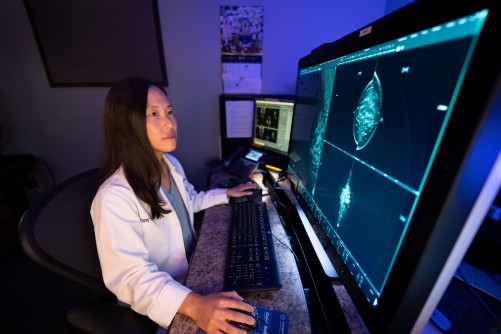
“The ultimate goal of screening mammography is to eliminate these interval cancers and catch as many of them as we can earlier, at the point of screening,” said Tiffany Yu, MD, assistant professor of radiology at the David Geffen School of Medicine at UCLA and senior author of the paper. She is featured in the image above.
“As AI tools become increasingly commercially available, we wanted to provide readers with a timely overview and foundational understanding of interval cancers and potential ways AI can help detect them, because ensuring these tools are safe and clinically effective is paramount.”
Some interval cancers develop rapidly and are not visible on the previous mammogram. Others, however, leave subtle signs that were present on the earlier mammogram but were not recognized at the time of screening. The latter group may represent an opportunity for AI to help radiologists identify cancers earlier.
Related: Can this smart bra replace mammograms
The researchers reviewed studies evaluating two potential applications of AI. The first was whether AI could identify interval cancers that were retrospectively visible on a previous mammogram. The second was whether AI could identify subtle patterns on a mammogram that appeared normal but were associated with an increased risk of developing breast cancer in the future.

Across retrospective studies, AI was able to identify a substantial proportion of interval cancers that had subtle signs visible on the prior mammogram. Estimates varied widely, ranging from about 5% to 78%, depending on the study, AI system and methodology.
However, the researchers emphasize that these findings represent potential detection, not proven reductions in interval cancer rates. Most of the studies were retrospective, meaning researchers went back to previously collected mammograms from women who were later diagnosed with breast cancer and determined whether AI could have identified signs of the cancer.
“Finding a cancer retrospectively is very different from demonstrating that using AI during routine screening would have led to an earlier diagnosis,” said Hannah Milch, MD, associate professor of radiology at the David Geffen School of Medicine at UCLA and co-author of the study. “We need prospective evidence showing that AI actually changes patient outcomes.”
Some studies also suggest AI may be able to identify women at increased risk of developing breast cancer even when the mammogram appears normal. In one study, AI assigned its highest risk scores to 23.1% of women who later developed an interval cancer three screening rounds before diagnosis, increasing to 39.4% on the mammogram immediately preceding diagnosis.
While these findings raise the possibility that AI could provide an early warning signal before a cancer becomes apparent, it is not yet clear how clinicians should respond to a high AI risk score when no abnormality is visible on the mammogram. Additional imaging could potentially identify cancer earlier, but it could also result in false positives, unnecessary procedures and overdiagnosis.
The review also highlights a large 2026 prospective randomized controlled trial involving more than 105,000 women that compared AI-supported screening with standard double reading, a routine practice commonly performed in Europe where two radiologists interpret a single mammogram. The interval cancer rate was 1.55 per 1,000 women in the AI-supported group compared with 1.76 per 1,000 in the standard screening group. AI-supported screening also had higher sensitivity, 80.5% compared with 73.8%, while specificity was the same at 98.5%.
The AI-supported approach reduced screening workload by 44.3% without reducing the overall cancer detection rate.
The authors say the trial provides some of the strongest prospective evidence to date for AI-assisted mammography, but caution that it was designed to assess non-inferiority rather than definitively demonstrate a reduction in interval cancer rates. The screening setting also differed from many U.S. programs, including the use of 2D mammography, longer screening intervals and double reading.
More broadly, the researchers found substantial differences among studies evaluating AI and interval cancers. Studies use different definitions of interval cancer and different screening technologies, intervals and radiologist workflows. Most research also evaluates a limited number of AI algorithms, making it difficult to determine whether findings from one system apply to others.
“These differences make it difficult to directly compare results because of international screening program differences, and the lack of studies applicable to U.S. programs,” said Yu. “This also highlights important areas where more research is needed before these tools can be fully integrated into everyday care.”
The researchers say future studies should follow patients prospectively and evaluate whether AI-assisted screening reduces interval cancer rates, as well as recall rates, false positives, radiologist workload and downstream testing. Long-term patient outcomes and post-market surveillance of commercially available AI systems will also be important to determine their safety and effectiveness.