Earth. Energy. Everything next.

City garden project pays you to compost and earn coupons for food

Tel Aviv green city award
Lira Shapira is a city farm in Tel Aviv

Tel Aviv one of 7 cities to win a world Green City Awards 2024

Tel Aviv has won Future Green City award for the Tel Chubez Agricultural Farm and the Lira Shapira initiative in Tel Aviv. The award was made at the Future Green City World Congress held in Utrecht, Netherlands. (In other news Tel Aviv gets an A- for sustainability).

The project was selected alongside six other cities for its unique model that bridges urban sustainability with community engagement that encourages a sustainable urban lifestyle.

Lira Shapira

Lira Shapira is a green local currency that rewards residents for separating organic waste for compost to enrich the farm’s crops. For every kilogram of organic waste separated and processed, residents receive one Lira, which can be spent at local businesses—thus not only protecting the environment but also strengthening the local economy and community.

Lira Shapira

Lira, the name for the old form of currency in Israel, can be spent on buying food from the garden.

The initiative is operated by local residents from the Shapira neighborhood in collaboration with the Tel Aviv-Yafo Municipality’s Environmental and Sustainability Authority.

Ruth Molcho, represented Lira Shapira at the congress: “Receiving this award was especially moving, as we realized that our small initiative at the Shapira neighborhood was gaining global recognition.”

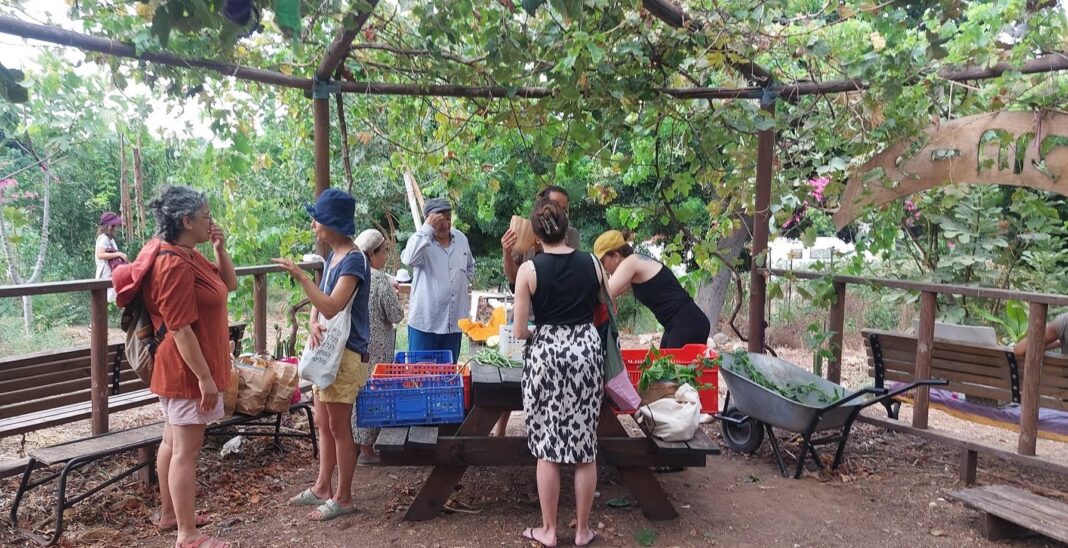
Tel Chubez is an urban agricultural farm located in the Shapira operating on principles of a circular economy. This vacant city land was transformed three years ago into a farm, providing residents with a green, productive space within the City, increasing wellness and access to fresh and healthy food while strengthening community resilience and increasing biodiversity.

Related: Fugee Fridays 

Tel Aviv–Yafo is constantly growing with massive construction and infrastructure projects. Preserving urban nature and connecting residents to it, maintaining and increasing the quality of life in this intense urban growth are significant challenges. Shapira neighborhood is located in the southern part of the City. In addition to the urban renewal phases, it has been identified as a vulnerable neighborhood in the climate change era dealing with more extreme heat waves and potential floods.

hydroponics urban farming tel aviv
Refugees from Sudan learn how to be modern farmers on a roof in South Tel Aviv. This is a project from 8 years ago to show how hydroponics can feed people in dense urban environments.

The farm, occupying four dunams, is being maintained by city employees, Lira Shapira NGO and volunteers. The cultivation method incorporates principles from permaculture and Biodynamics without any pesticides, focusing on growing local species following the seasons and a variety of over 60 fruit trees and local wildflowers that create an ecological system and habitat for birds and insects. The farm includes workshop plots where courses and training sessions are held to transfer the practices to participants’ yards to improve biodiversity and attract butterflies and honeybees.

Tel Chubez was included in the City Urban Nature Sites Index, together with 100 more sites. It is on the infrastructure layer, and future planning will have to avoid violating the area, as it has become an anchor for future urban green belts.

Tel Chubez became a green anchor for residents, plants and animals within a relatively short time. A model for collaboration internally in the municipality and externally with non-profits and businesses working together to build a new nature-based platform where environmental, social, economic and health positively impact.


Read More

TRENDING

From carpets to lampshades, Arudeko turns waste wool into beautiful new material

Design studio Arudeko is turning discarded wool into an innovative paper-like material for lamps and decorative objects. The project offers a creative solution to textile waste while exploring new possibilities for sustainable design and circular materials.

Brevel and India’s Wave Group turn sugar waste into food ingredients

Brevel and India's Wave Group partner on a $15 million biomanufacturing venture to turn sugar industry waste into sustainable microalgae, nutraceuticals and alternative proteins.

Bricks and Minifigs, and the Future of Circular Play

A second-hand LEGO marketplace keeps plastic bricks circulating for years instead of ending up forgotten in basements or discarded in landfills. It gives children access to building materials at lower prices. It extends the lifespan of a product that was originally designed to last generations.

Sports equipment is entering the bioplastics era

Breaking into the sports industry with a product that’s both high-performance and fully circular is a proud moment for us at Balena. This frisbee, made from our bacteria-fermented bioplastic, is proof that sustainable materials can go beyond concepts and prototypes, they can play, perform, and inspire” — David Roubach, Founder & CEO, Balena

A Brief History of Basil From India to Italy

Beloved, fortunate, sweet, and royal; an herb with a long and storied history in Asia and across the world. Called by many names, basil has featured in previous Green Prophet articles, so enjoy another serving, a brief history of basil.

Why Bronwyn Finnegan Chose the Nonprofit Sector Over Politics or Corporate Life

Bronwyn Finnegan could have pursued a career in politics or corporate leadership. Instead, she chose the nonprofit sector, where she focuses on financial sustainability, governance and helping mission-driven organizations build the capacity to survive and grow.

Scientists make lead-free perovskite solar cells that can weather the elements

Scientists have developed a “raincoat” for lead-free tin perovskite solar cells, helping them withstand air, moisture and heat while maintaining high efficiency.

The Essential Guide To Sustainability in Project Management

Sustainability is an approach where businesses and individuals balance the environmental, social, and economic aspects of a project such that current and future stakeholders are not overburdened with the impacts of the project in future.

Yerukim Forms a New Green Economy Where the Money is Really Green

The Yerukim members who pick up the recyclables get to keep the monetary reward, the public earns "green" bills that can be used in shops, and business owners get to be associated with environmentalism.

Choosing Riyadh over Dubai? What Investors Should Know

Saudi Arabia is deploying capital at unmatched scale to catalyze tourism and advanced industry while rewiring its power-and-water backbone. The investable frontier is widening—especially in renewables, grid storage, water efficiency/desal retrofits, and hospitality operating platforms. Prudent investors will insist on phased delivery, enforceable KPIs (energy, water, biodiversity), and RHQ/zone compliance—while pricing political-economy and reputational risks alongside growth upside.

Sell your cooking oil for biodiesel money

Want to make money on old french fry oil? Sell it.

Qatar Alternative Energy Summit Pairs Investors And Innovators

Alternative energy investors and innovators can meet n' greet in Doha, Qatar March 16 and 17.

Here’s How To Implement The Four Pillars Of Employee Engagement

If you throw a party for your work team and they are vegans, don't make it a barbecue. Know the sustainability values of your team to boost moral and retain good people.

Popular Categories