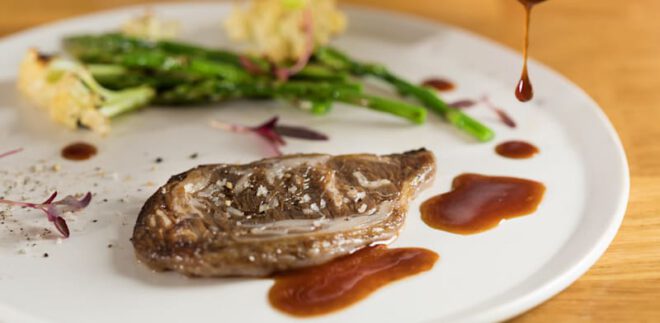
Slaughter free ribeye steak meat grown in a lab

rib eye steak aleph farms

Aleph Farms and its research partner at the Technion – Israel Institute of Technology, have successfully cultivated the world’s first slaughter-free ribeye steak, using three-dimensional (3D) bioprinting technology and natural building blocks of meat – real cow cells, without genetic engineering and immortalization.

Aleph now has the ability to produce any type of steak and plans to expand its portfolio of quality meat products.

Unlike 3D printing technology, Aleph Farms’ 3D bioprinting technology is the printing of actual living cells that are then incubated to grow, differentiate, and interact, in order to acquire the texture and qualities of a real steak.

A proprietary system, similar to the vascularization that occurs naturally in tissues, enables the perfusion of nutrients across the thicker tissue and grants the steak with the similar shape and structure of its native form as found in livestock before and during cooking.

Are steak growers on Mars out to lunch?

“This breakthrough reflects an artistic expression of the scientific expertise of our team,” said Didier Toubia, Co-Founder and CEO of Aleph Farms. “Additional meat designs will drive a larger impact in the mid and long term. This milestone for me marks a major leap in fulfilling our vision of leading a global food system transition toward a more sustainable, equitable and secure world.”

The cultivated ribeye steak is a thicker cut than the company’s first product – a thin-cut steak. It incorporates muscle and fat similar to its slaughtered counterpart and boasts the same organoleptic attributes of a delicious tender, juicy ribeye steak you’d buy from the butcher.

Bibi Netanyahu lab steak, aleph farms
Bibi Netanyahu tastes some Aleph lab steak

“With the realization of this milestone, we have broken the barriers to introducing new levels of variety into the cultivated meat cuts we can now produce.

“As we look into the future of 3D bioprinting, the opportunities are endless,” says Technion Professor Shulamit Levenberg, Aleph’s Co-Founder, Chief Scientific Advisor and a major brainpower behind the company’s IP. Levenberg is considered a global leader in tissue engineering and has amassed over two decades of research in the field at the Massachusetts Institute of Technology (MIT), in the United States and at the Technion, in Israel. Levenberg is also the former Dean of the Biomedical Engineering Faculty at the Technion.
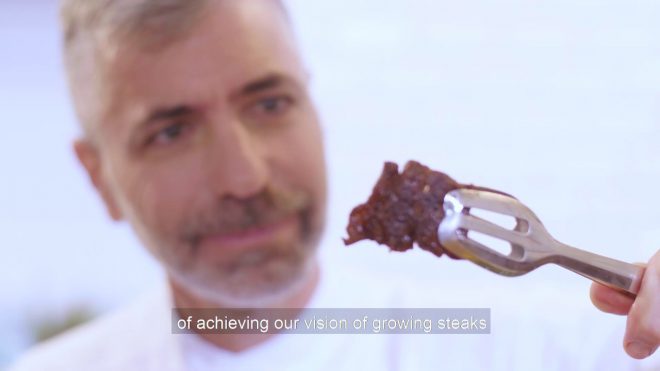
aleph farms engineered slaughter free meat, man looking at a piece of it

Aleph Farms’ zealous plans to diversify its offering align with its mission to create a global platform for local production, leveraging a highly scalable technology to create culinary experiences that can be adapted for the different food cultures around the world.

With the advent of synthetic milk or meat- or animal-free products cultivated in the lab, or alternatives to honey grown in an engineered bee stomach (another Israeli invention) –– some people think all this “progress” in the lab is really people out to lunch. Read our story about engineered honey for some alternative points of view to animal substitutes and our farming story on high tech hydroponic solutions that also may be out to lunch. The big solution may be simpler – regenerative agriculture. That what Woody Harrelson says, cow farts and all. 

Karin Kloosterman
Karin Kloostermanhttp://www.greenprophet.com
Karin Kloosterman is an award-winning journalist, innovation strategist, and founder of Green Prophet, one of the Middle East’s pioneering sustainability platforms. She has ranked in the Top 10 of Verizon innovation competitions, participated in NASA-linked challenges, and spoken worldwide on climate, food security, and future resilience. With an IoT technology patent, features in Canada’s National Post, and leadership inside teams building next-generation agricultural and planetary systems — including Mars-farming concepts — Karin operates at the intersection of storytelling, science, and systems change. She doesn’t report on the future – she helps design it. Reach out directly to [email protected]

Read More

LEAVE A REPLY

Please enter your comment!
Please enter your name here

TRENDING

Desalination experts debunk Aqua Solaire, the floating desalination barge

AI makes it easy to dream, develop, and create images of what could be world-changing ideas, until the reality sets in. A new project making the rounds is Aqua Solaire, an allged French concept for a solar-powered desalination vessel designed to bring drinking water to coastal communities facing drought, storms, and infrastructure failures.

Eco organization offices destroyed by Iran missile

Tel Aviv's eco organization, the Heschel Center, was impacted by an Iranian missile.

What are AWG air-water generators, and why they aren’t a golden-bullet solution (yet)

Atmospheric water generators (AWGs) sound like magic: machines that can pull drinking water out of air. The idea is mentioned in the Bible, where the elders would pray for water collected as dew on plants and the catch on turning this into a machine is in the physics. To turn invisible vapor into liquid, you must remove heat, especially the latent heat of condensation.

Jordan’s $6 Billion Aqaba–Amman Desalination Project from the Red Sea Moves Forward

In 2025, the Jordanian government signed agreements with a consortium led by Meridiam and SUEZ, alongside VINCI Construction and Orascom Construction. Under a 30-year concession agreement, the consortium will design, build, finance, operate, and maintain the system before transferring it back to the Jordanian government. The total investment is estimated at approximately $6 billion USD.

The Saudi Startup Turning Desalination’s Toxic Waste Into Its Own Disinfectant

For millennia, the Middle East's water crisis seemed an immutable fact of geography — a region defined as much by what it lacked as by what lay beneath its sands. Today, a convergence of plummeting solar costs, advancing membrane technology, and hard-won engineering expertise is rewriting that story.

How to quiet noise from construction in your office

Streets need to be resurfaced in New York but the humming and grinding noise is unsettling. Noise is environmental pollution. 

EarthX and a blueprint for sustainable investing

Trammell S. Crow, a Dallas-based businessman and father of four, is focusing his efforts on impact investing, and media that focuses on saving the planet through EarthX.

Mining Afghanistan’s Mineral Discoveries Similar to Avatar

Now that American forces in Afghanistan are commemorating the longest period of any war that America has been involved in, including the 1965-73 Vietnam War, the recent discoveries of large and extremely valuable mineral and metal deposits may finally bring to light a reason to continue the presence of US fighting forces in this war torn and backward country.

From Pilot Plant to Global Stage: How Aduro Clean Technologies’ 2026 Expansion Signals a Turning Point for Chemical Recycling Investors Like Yazan Al Homsi

The company's Next Generation Process (NGP) Pilot Plant in London, Ontario, has officially moved into initial operating campaigns, generating the kind of structured, repeatable data that separates laboratory promise from commercial viability.

Nobul’s Regan McGee on Shareholder Value: “Complacency Is the Silent Killer” 

Why the governance framework designed to protect shareholders so...

Should You Invest in the Private Market?

startustartup Unlike public stock exchanges, which offer daily trading, strict...

How to build a 100-year-company

Kongō Gumi is a Japanese construction company, purportedly founded in 578 A.D., making it the world's oldest documented company. What can we learn about building sustainable businesses from them?

How AI Helps SaaS Companies Reduce Repetitive Customer Support Work

SaaS products are designed for large numbers of users with different levels of experience, and also in renewable energy.

Popular Categories