
Getting cadmium out of my chocolate through the roots

Simran Sethi cacao book
Simran Sethi is a writer and activist who protects food we love, like chocolate and wine. Scientists too are working to protect the food we love safer through more sustainable agricultural practices.

I am an addict. They say it’s good for me if I eat the 90% cacao, fair trade and organic. Chocolate is universally adored. But few know that farming for cacao is complicated business, mostly done by small-scale low-income farmers in Latin America, specifically Ecuador. New evidence suggests that eating too much chocolate might be dangerous because it grows in soils with high amounts of cadmium, which can build up in the body and cause cancer (see ceramic coated cooking pans).

The good news is that there are scientists working to help the farmers lower cadmium from their cacao trees. David Argüello from Belgium along with a team from Ecuador have found ways to reduce cadmium in chocolate trees, using lime. They report about it in the science Journal of Environmental Quality

cadmium cacao
Scientists find that applying lime to the soil and that below the surface into the roots can help reduce cadmium buildup in cacao, or its end-product chocolate

Argüello says: “The cadmium issue threatens the livelihood of farmers because their products may not be suitable for trade and some buyers would prefer not to buy polluted cacao beans. We have to understand how cacao plants takes up the element.”

David Argüello
David Argüello

Traditionally in science, researchers would look at studies of other crops to see what works to prevent cadmium uptake. Something commonly added to the soil to help with this issue is lime, or calcium carbonate, a compound derived from limestone which is cheap and widespread and easy to obtain. This changes the cadmium chemically so that it’s not as likely to be absorbed by the crops, Argüello explains. 

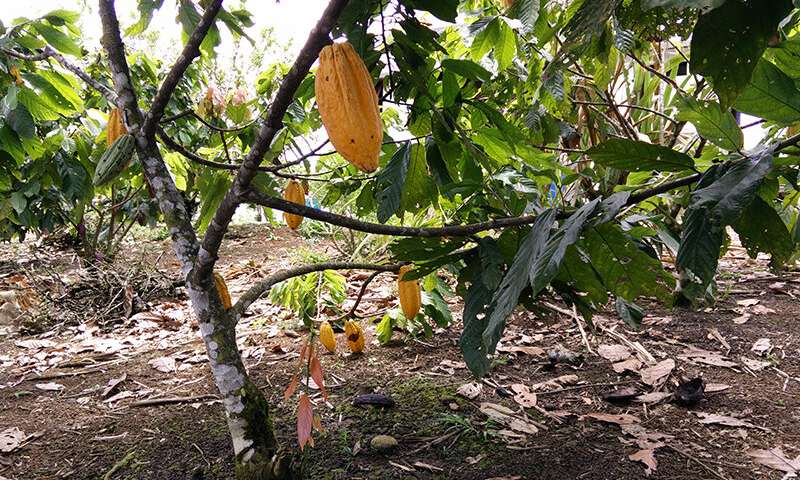
However, most crops like corn or sunflowers are replanted each year. This allows the lime to be mixed deep into the soil between crop seasons which is good. Cacao plants for chocolate, on the other hand, are trees that live for many years. It’s not possible to put lime into much of the soil without disturbing the roots of cacao. Farmers can only apply lime to the surface. 

“This crop is very different than other conventional plants. The information available for its management is scarce and outdated. Many farmers get the advice that adding lime will solve the issue. But we wanted to investigate this,” Argüello explains. 

The research team used an experiment where they planted cacao seedlings in pots in a greenhouse. This allowed them to add lime to the topsoil and subsoil and then test the cacao leaves for cadmium levels. 

The solution needs to be deep rooted

Their findings show that adding lime to both layers decreased cadmium in the cacao leaves, which was not surprising. They also found that liming only the top layer also decreased cadmium. However, they discovered that when only the top layer is limed, more cadmium is taken up from roots in the bottom layer. This means that researchers and farmers cannot ignore high cadmium levels deep in soils.
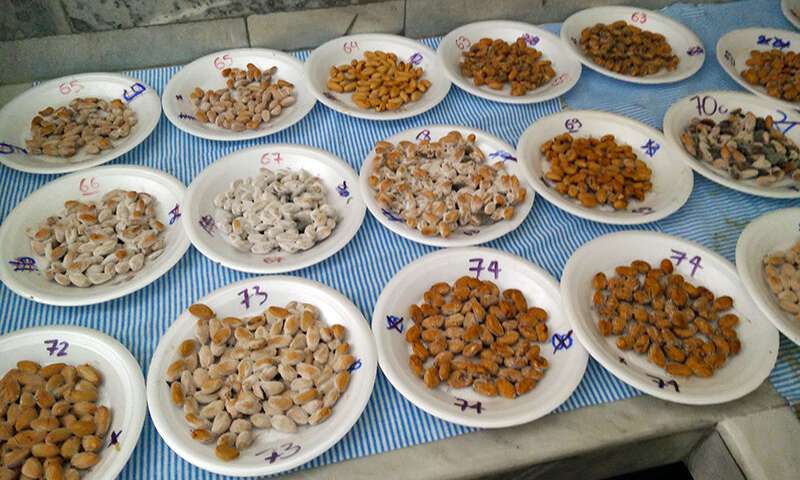
cacao beans, cadmium
The cacao beans were tested for amounts of cadmium in them. Results on how to apply lime can save the livelihood of smallholder farmers.

“Other nutrients, such as zinc, are chemically similar to cadmium,” Argüello says. “We hypothesize that the reduction of the availability of those nutrients in the top layer due to liming causes the roots in the bottom layer to compensate. During that process, zinc uptake increases but some undesired cadmium is also taken up as a mistake.”

The researchers say their findings have helped scientists understand how cacao plants behave and can possibly chart a path to finding an effective reduction strategy. Argüello hopes their work can help small cacao farmers sell their products. I hope they can find a way to create systems that lead to regenerative agricultural approaches (see the film Kiss the Ground with Woody Harrelson). Maybe there is a biosystem that can be created that can reduce the cadmium more naturally than just dumping lime on the problem.  

“I am from Ecuador and cacao is the most traditional export commodity for my country,” says Argüello. “Every time I travel and find a bar of chocolate produced in Ecuador, I feel happy and proud. I like to think that my work will help small cacao farmers sell their products and help my country to continue to be recognized worldwide.”

Looking for a guide to sustainable chocolate? We have to start somewhere, so you can start here.

Karin Kloosterman
Karin Kloostermanhttp://www.greenprophet.com
Karin Kloosterman is an award-winning journalist, innovation strategist, and founder of Green Prophet, one of the Middle East’s pioneering sustainability platforms. She has ranked in the Top 10 of Verizon innovation competitions, participated in NASA-linked challenges, and spoken worldwide on climate, food security, and future resilience. With an IoT technology patent, features in Canada’s National Post, and leadership inside teams building next-generation agricultural and planetary systems — including Mars-farming concepts — Karin operates at the intersection of storytelling, science, and systems change. She doesn’t report on the future – she helps design it. Reach out directly to [email protected]

Read More

TRENDING

A visit to Amirim, Israel’s first all-vegetarian village in the Galilee

Just 15 kilometers from Tzfat there is a moshav that was founded in the late 50s that was ideologically influenced by organic, vegetarian and vegan principles. My hostess at Ohn-Bar, the tzimmer where I stayed, explained that the people of Amirim were among the pioneers of Israel’s strong vegetarian movement.

Monitoring farmers’ tillage patterns from space

Tillage is one of the clearest signals of how a farm treats its soil. Intensive plowing can degrade structure, release carbon, and increase erosion. Conservation practices—no-till, cover cropping, minimal disturbance—do the opposite. They build soil, retain water, and support biodiversity. But until now, measuring these practices at scale has been slow, expensive, and often self-reported.

Tony Cho’s model for regenerative cities

Tony Cho is a regenerative developer and community builder focused on designing cities as living ecosystems that support human connection and ecological balance. A key figure in Miami’s urban transformation, he helped shape the Wynwood Arts District and founded the Magic City Innovation District. Influenced by an unconventional upbringing that included time in an ashram, Cho brings a spiritual lens to real estate, blending culture, community, and capital into what he calls regenerative placemaking.

Dark chocolate benefits means slowing aging: make Italian hot chocolate with this recipe

Eating dark chocolate can keep you looking young. Make your own healthy hot chocolate mix

Inflatable concrete homes: a California and Ontario case study

Across Ontario and California, builders are rethinking concrete housing through inflatable-shell design—an approach that replaces wooden formwork with air and innovation. A 1,000-square-foot low-carbon concrete shell, insulated with hempcrete, can be erected in a day and cost far less than conventional construction. Over time, the savings in energy, materials, and mortgage costs make this model a realistic response to rising living expenses and climate stress. With low-carbon cement, hempcrete walls, and renewable energy, inflatable concrete homes show how even the world’s most carbon-heavy material can become part of a sustainable future—if built smartly, and within local building codes.

Yerukim Forms a New Green Economy Where the Money is Really Green

The Yerukim members who pick up the recyclables get to keep the monetary reward, the public earns "green" bills that can be used in shops, and business owners get to be associated with environmentalism.

Choosing Riyadh over Dubai? What Investors Should Know

Saudi Arabia is deploying capital at unmatched scale to catalyze tourism and advanced industry while rewiring its power-and-water backbone. The investable frontier is widening—especially in renewables, grid storage, water efficiency/desal retrofits, and hospitality operating platforms. Prudent investors will insist on phased delivery, enforceable KPIs (energy, water, biodiversity), and RHQ/zone compliance—while pricing political-economy and reputational risks alongside growth upside.

Sell your cooking oil for biodiesel money

Want to make money on old french fry oil? Sell it.

Qatar Alternative Energy Summit Pairs Investors And Innovators

Alternative energy investors and innovators can meet n' greet in Doha, Qatar March 16 and 17.

Here’s How To Implement The Four Pillars Of Employee Engagement

If you throw a party for your work team and they are vegans, don't make it a barbecue. Know the sustainability values of your team to boost moral and retain good people.

Locals From Rishon Fight IKEA

Big Box stores are a pretty new concept in Israel, and thank God that not every Israeli city wants them in their backyard. A word from someone who has see the beautiful farmland around her hometown Newmarket, Ontario stripped and converted into vulgar strip malls of big box shops: they have no place in a healthy and sustainable town or city.

The Jewish National Fund Meets An Inconvenient Truth

According to the JNF, it has transformed thousands of acres of barren land into green forests in Israel. They state that each person emits about 23 tons of carbon per year, estimating that each tree planted can absorb one ton of carbon in its lifetime. That's a whole lot of trees you'd need to be planting. Could so many fit in Israel?

How to quiet noise from construction in your office

Streets need to be resurfaced in New York but the humming and grinding noise is unsettling. Noise is environmental pollution. 

Popular Categories