


This past March Abu Dhabi city has witnessed its most intense rain storm in recent memory. Storms usually do not make it to Arabian cities on the Gulf; they jump on summer monsoon winds from the Indian Ocean only to break on unfortunate shores of Oman. I happened to spend my teens in Abu Dhabi, and the scenes of destruction (albeit mild) in the aftermath is a novelty. From my experiential frame of reference, climate has changed.
How did we end up with this current state of affairs? Here’s one take on the original sin when it comes to the global environmental crisis. First, we need to switch on the time machine.
The environmental crisis started to become present in the consciousness of the West (Europe & North America) only in the 1960’s, once the works of 19th century European philosophies realized themselves on the physical, global stage. Capitalism was bound to create wealth, and Marxism emerged as a proposed solution to the distribution problem created by the former.
At the core of both doctrines, however, lies one god: material progress; for its sake which the natural world was sacrificed remorselessly by its worshipers. The god of material progress entailed massive industrialization by the European powers of the 18th & 19th centuries, which made available the technology and arms to embark on colonization sprees around the globe. Suddenly, the movers and shakers of Europe ruled over new worlds with infinite natural and human resources.
The wealth and land amassed gave the European powers a sense of complete independence from both Heaven and Earth. This philosophical revolution in the minds of Europeans had its roots in the Renaissance of the 16th & 17th centuries, during which the totality of Christianity started to weaken (in southern Europe at least), and the conception of man and his role in the universe was questioned.
All civilizations express themselves by means of arts that contain components of both the infinite and the absolute, and during the Renaissance period in Europe, Christian mysticism (representing the infinite) was relegated by more anthropomorphic art (the absolute).
It’s not a coincidence that Michelangelo’s sculptures, an icon of Renaissance art, were as concrete and absolutist as it gets. The sense of loss of the -heavenly- infinite in the psyche of Renaissance Europe was reflected in the continent’s expedition to rediscover it on earth during the scientific and industrial revolutions of the next couple of centuries.

- Michelangelo’s Pietà, St Peter’s Basilica
One might ask, what about the colonized?
Throughout the centuries, indigenous peoples of the Americas, India, Africa, the Middle East, Asia and Australia, did not lose their sense of limited terrestrial existence, and hence kept their human yearning to the infinite to the vertical, heavenly realm. Buddhism, Hinduism, Shintoism, Islam, Zoroastrianism, Judaism, African traditional religions, Mesoamerican religions, along with more localized traditional religions; all insisted on the sacredness of the natural world and limited its exploitation by their subscribers.
This explains the reason behind resisting heavy industrialization in these nations, or at least the absence of a scientific/industrial revolution à la 17th century Europe, and that’s despite the presence of prerequisite scientific thought and availability of raw materials (higher mathematics in Muslim Persia and gun powder in China, for corresponding examples).
These nations, however, had to eventually succumb to the colonizers’ ways to fight fire with fire and create the wealth needed to sustain this expensive route. The natural world became fully and justifiably exploitable in the minds of the (historically environmentally-prudent) colonized. Only then, heavy industrialization crept through non-Western nations throughout the 19th & 20th centuries: chemicals in India, fossilized energy in the Middle East, mining in Africa, forestry in South America, military industries in Japan, and manufacturing in China; the latter which became the poster child for everything wrong with unchecked heavy industrialization when it comes to the environment.
One figure, though, was the canary in the coal mine during that period: Ghandi; who believed India’s salvation lies in reviving the nation’s crafts as opposed to emulating the West. He encouraged Indians to wear what they weaved and put economic pressure on England, which was getting its cotton and yearn for next-to-nothing from India and selling it globally (including to India itself) for huge profit margins. Ghandi’s economic efforts didn’t stand against the English titanic industrial machine, of course, but his thought of non-violently challenging the status-quo outlived him and inspired countless human and environmental rights movements globally; most notably that of Martin Luther King, Jr. in the United States.
So, how did India do, environmentally speaking, as it surrendered to heavy industrialization? A paper published in the Journal of Indian Geophysical Union (July 2005) titled “Extreme Weather Events over India in the last 100 years” studied climatic extremes as defined by (i) Cold wave, Fog, Snow storms and Avalanches; (ii) Hailstorm, Thunderstorm and Dust storms; (iii) Heat wave; (iv) Tropical cyclones and Tidal waves; (v) Floods, Heavy rain and Landslides; and (vi) Droughts, concludes that “losses due to extreme events are increasing steeply specially in the last decade of the twentieth century…the global loss of US $ 50-100 billion annually are caused due to these natural hazards together with the loss of life is about 2,50,000.
However, these increased losses may be either due to a real increase in the frequency of the extreme weather events or due to increased vulnerability of cities, towns and the associated infrastructure and installations which have grown rapidly to meet the needs of a growing population.”
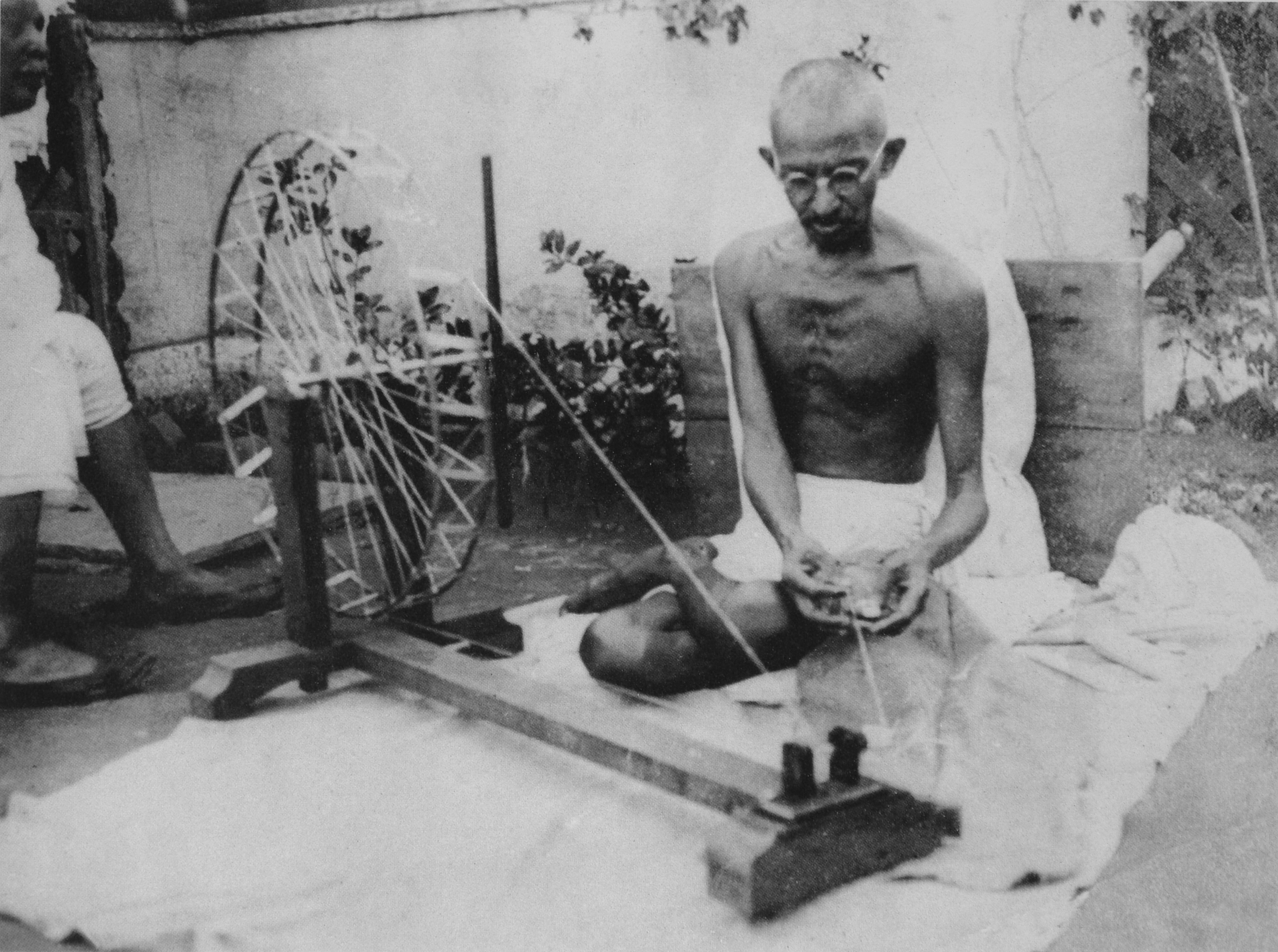
- Mahatma Gandhi spinning yarn
Back to the Future
The emergence of green parties in the 1970’s in Europe, followed by the rest of the world, was a logical political expression to what seemed socio-economic phenomena and their impact on the natural world. They advocated ecological wisdom, social justice, and non-violence, but didn’t always practice what they preached; for example, the German Green Party remained in a coalition and supported Chancellor Gerhard Schröder’s government in the 2001 war on Afghanistan.
Although green parties have had variable success in their electoral performance in Europe, they remain perceived as parties of protest in the US, UK, Canada, and Australia, vis-à-vis more traditional parties on both sides of the political spectrum. International cooperative efforts, on the other hand, hadn’t prove to be effective (yet) in combating climate change.
Twenty years after the birth of United Nations Framework Convention on Climate Change (UNFCCC), signatories of the Treaty seem to have failed in achieving their targeted emission reductions. Most recently, the 21st Conference of the Parties (COP21) held in Paris has failed to put forth binding fine print to the Treaty’s sections, in effect, surrendering to realpolitik and the corporate bottom line.
What is it that must be done?
Many intellectuals have written or lectured on the roots of the environmental crisis and what must be done to reclaim the lost balance. Seyyed Hossein Nasr, Lynn White, Andrew Weaver, Naomi Klein, David Suzuki, and Chris Hedges come to mind in North America. Each has tackled the issue from a different angle; be it political, scientific, activist, or behavioral, but all agreed that more technology is not the magic bullet that will save humanity from the wrath of nature. Eventually, the price that should be paid is death and rebirth: to fundamentally change the way we look at the world and our place in it. It is adopting St. Francis of Assisi’s belief that it is man’s duty to protect and enjoy nature as the steward of God’s creation; to live in a democracy of creation in which all creatures are respected.
This state of harmony with the exterior, however, cannot be achieved without creating a sense of interiority within man. Detachment from the material, and growth in the domain of the vertical, immaterial is an extremely difficult task, especially in a world awash with electronic hallucinations. Sporadic meditation doesn’t help either. Inner equilibrium requires decades-long and meaningful discipline in which meditation is only ancillary.
Once inner equilibrium is established within man, it can only then radiate to the exterior. Of course, not everyone in the West (or anywhere, for that matter) is expected to become a Zen master. But since the West has been setting the trends on the global stage for the past several millennia, it is imperative in the eyes of its sages to revive forgotten knowledge of Western spirituality and traditions within its populations if they are to resolve the questions of the environment.
Abu Dhabi city might have witnessed its most severe storm in recent times, but, unfortunately, the worst is yet to come. The city is expected to become a ghost town in a matter of few decades if climate change remains unchecked.