Treating snail fever and swollen bellies with prawns

snail-fever-africa

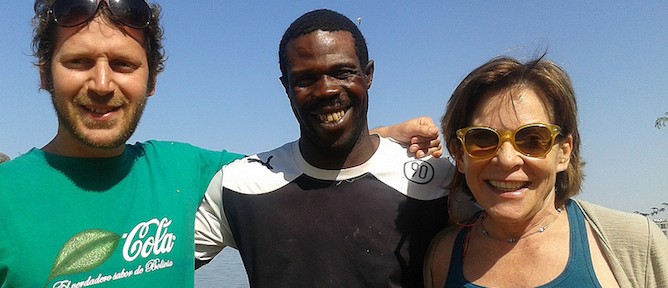
Amit Savaia (left), went to Africa for three months to volunteer after finishing his first degree in science. With four other Israeli students from Israel’s Ben-Gurion University of the Negev, he helped build a computer platform to connect African farmers with their neighbors.

What tugged at his heartstrings, though, was the problem of schistosomiasis, the “snail fever” caused by ingesting parasites. This disease causes the characteristic swollen bellies in African children.

While mortality rates are low from snail fever, it is the second most socioeconomically devastating disease in Africa, after malaria. The chronic illness can damage internal organs and can lead to slowed growth and cognitive development. In adults, it carries an increased risk of bladder cancer.
snail-fever-africa-amit-savaia-2

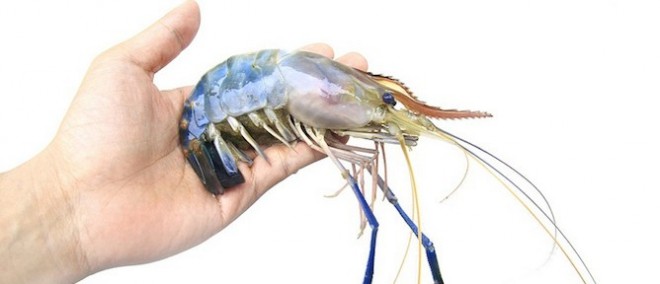
Savaia vowed to help Africa beat this problem. Today, earning a master’s degree, he is working with the Bill & Melinda Gates Foundation-funded organization Project Crevette to develop a natural way to stop schistosomiasis in Senegal — using cultured prawns based on research from Ben-Gurion University.

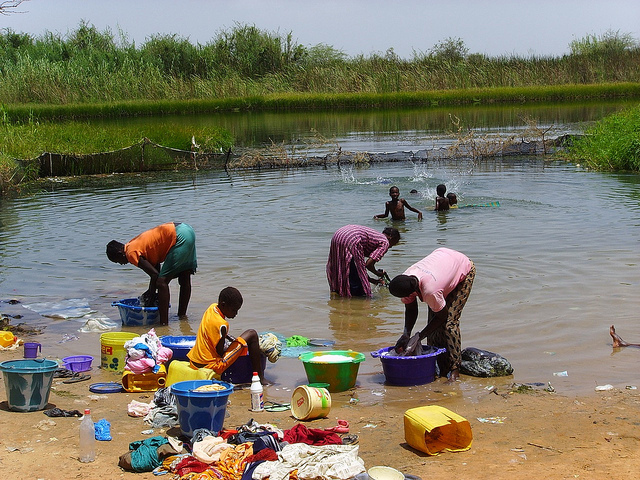
He is concentrating his efforts on the local watering hole in the Lampsar Village in Senegal. Savaia says that it’s next to impossible to get the villagers to stop swimming and urinating in the water, which keeps the parasitic cycle going.

Prawn release in Africa

This watering hole in Senegal is a breeding ground for snail fever. Says an impassioned Savaia, now looking for funding to take his research to the final stages: “Schistosomiasis, also known as bilharzia, has no sustainable cure or treatment. The only drug used today to heal the people is an old drug called Praziquantal (PZQ), which kills the mature worms inside the body. There is no vaccine, even though a lot of companies are trying to make one.”

Sustainable solution to disease in Africa
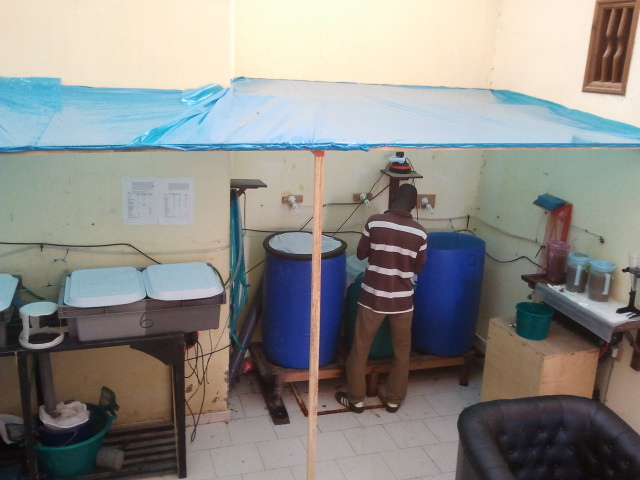
snail-fever-africa-amit-savaia-prawn

The back story is that a river in Senegal was dammed, and consequently female prawns – natural predators of snails — were blocked from laying their eggs. The parasite-carrying snail population in the watering hole skyrocketed, and the snail-fever parasite grew with it.

Working on the project since 2012, Savaia proposes using advanced breeding methods to reintroduce prawns to the river. The catch is, these prawns are particularly delicate and hard to grow, especially in captivity. “Not many people have done it before and we had only one reference on how to do it,” he says.

But he has much hope for the approach. It is innovative, sustainable, and creates a triple winning situation for the farmers, villagers and fisherman, he says.
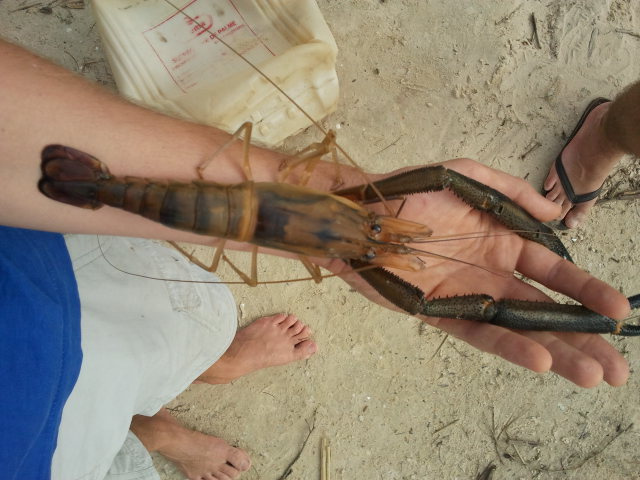
snail-fever-africa-amit-savaia

When he is able to prove the concept, “it could be applied in many more countries. These prawns are distributed almost all over the west coast of Africa. Senegal isn’t the only place where a dam started such a problem.”

Savaia’s academic supervisor, Prof. Amir Sagi, has done decades of research on prawns and crustaceans. Savaia also works with Prof. Dina Zilberg, Ben-Gurion’s expert on aquatic animal health.

They have learned that the larvae of this prawn species need to be reared in saline water for two months. After that, the crustacean goes through 14 cycles, or 15 molts, to become post-larvae of a small adult prawn.

Up until this point, “The animals are very delicate,” he says.

When they are reintroduced in the dammed river, they successfully eat the snails that harbor the parasite. A negative cycle is stopped. The question is how to turn this basic research into a project that Africa can do for itself.

Savaia has been strongly affected by seeing, first hand, the damage that the parasites do.

“I must say when we go to the villages you don’t see those awful pictures of children with big stomachs, and extremely sick people, because they stay at home or in hospitals,” he says.

“But when you take their urine and you filter it in order to know how sick they are [by counting how many eggs are in the sample], we find urine as red as blood. This comes from the eggs sitting on their kidneys and intestines.”

Savaia’s dream is big, but he’s unstoppable. “We want to make farms to teach farmers how to produce the prawns so they can sell some for the markets as a crop, because they are delicious, and the rest will be released in the river with an agreement of the health ministry.

“This way, everyone will be happy,” concludes Savaia.

Karin Kloosterman
Karin Kloostermanhttp://www.greenprophet.com
Karin Kloosterman is an award-winning journalist, innovation strategist, and founder of Green Prophet, one of the Middle East’s pioneering sustainability platforms. She has ranked in the Top 10 of Verizon innovation competitions, participated in NASA-linked challenges, and spoken worldwide on climate, food security, and future resilience. With an IoT technology patent, features in Canada’s National Post, and leadership inside teams building next-generation agricultural and planetary systems — including Mars-farming concepts — Karin operates at the intersection of storytelling, science, and systems change. She doesn’t report on the future – she helps design it. Reach out directly to [email protected]

Read More

1 COMMENT

TRENDING

Who Owns the Farm Robot? A State of Jefferson Startup Takes on Carbon Robotics

In California's self-proclaimed State of Jefferson, a small agricultural technology company is challenging the dominant laser-weeding business model. Laudando & Associates believes farmers should own and repair their AI-powered weeding tools rather than pay ongoing subscription fees. The approach has put the company on a collision course with industry leader Carbon Robotics, sparking a patent dispute that has pushed the Jefferson startup toward overseas markets while raising broader questions about ownership, right-to-repair, and the future of farm automation.

Dan Zaslavsky’s energy tower dream is rising again in Iran and China

The Energy Tower idea never made the leap from drawings and engineering studies to full-scale construction. But nearly two decades after most people stopped talking about it, the concept is quietly evolving in two unexpected places: China and Iran. The concept let dreamers dream and doers do - figuring out more pleasing designs and engineering.

A visit to Amirim, Israel’s first all-vegetarian village in the Galilee

Just 15 kilometers from Tzfat there is a moshav that was founded in the late 50s that was ideologically influenced by organic, vegetarian and vegan principles. My hostess at Ohn-Bar, the tzimmer where I stayed, explained that the people of Amirim were among the pioneers of Israel’s strong vegetarian movement.

Israeli Hydrogen Startup H2Pro Are Trying to Solve Clean Energy’s Hardest Problem

The company has attracted backing from major investors including Breakthrough Energy Ventures, the climate fund founded by Bill Gates, along with industrial partners such as Sumitomo, ArcelorMittal, and Temasek, a multi-billion dollar company that owns Singapore airlines. H2Pro has raised more than $100 million USD and is moving from pilot projects toward commercial-scale deployments.

Desalination experts debunk Aqua Solaire, the floating desalination barge

AI makes it easy to dream, develop, and create images of what could be world-changing ideas, until the reality sets in. A new project making the rounds is Aqua Solaire, an allged French concept for a solar-powered desalination vessel designed to bring drinking water to coastal communities facing drought, storms, and infrastructure failures.

Yerukim Forms a New Green Economy Where the Money is Really Green

The Yerukim members who pick up the recyclables get to keep the monetary reward, the public earns "green" bills that can be used in shops, and business owners get to be associated with environmentalism.

Choosing Riyadh over Dubai? What Investors Should Know

Saudi Arabia is deploying capital at unmatched scale to catalyze tourism and advanced industry while rewiring its power-and-water backbone. The investable frontier is widening—especially in renewables, grid storage, water efficiency/desal retrofits, and hospitality operating platforms. Prudent investors will insist on phased delivery, enforceable KPIs (energy, water, biodiversity), and RHQ/zone compliance—while pricing political-economy and reputational risks alongside growth upside.

Sell your cooking oil for biodiesel money

Want to make money on old french fry oil? Sell it.

Qatar Alternative Energy Summit Pairs Investors And Innovators

Alternative energy investors and innovators can meet n' greet in Doha, Qatar March 16 and 17.

Here’s How To Implement The Four Pillars Of Employee Engagement

If you throw a party for your work team and they are vegans, don't make it a barbecue. Know the sustainability values of your team to boost moral and retain good people.

Locals From Rishon Fight IKEA

Big Box stores are a pretty new concept in Israel, and thank God that not every Israeli city wants them in their backyard. A word from someone who has see the beautiful farmland around her hometown Newmarket, Ontario stripped and converted into vulgar strip malls of big box shops: they have no place in a healthy and sustainable town or city.

The Jewish National Fund Meets An Inconvenient Truth

According to the JNF, it has transformed thousands of acres of barren land into green forests in Israel. They state that each person emits about 23 tons of carbon per year, estimating that each tree planted can absorb one ton of carbon in its lifetime. That's a whole lot of trees you'd need to be planting. Could so many fit in Israel?

How to quiet noise from construction in your office

Streets need to be resurfaced in New York but the humming and grinding noise is unsettling. Noise is environmental pollution. 

Popular Categories