Enzootic makes male prawn fish farming a greener business

male prawn enzootic
There are evolutionary reasons why Tarzan is bigger than Jane. Most males of any species –– birds, bugs and prawns included –– grow bigger than their female counterparts. The phenomenon is called sexual dimorphism.
A new Israeli-American company, Enzootic, is taking sexual dimorphism and the ability to control it to the dinner table.

Based on research from Ben-Gurion University of the Negev, the company developed a one-time, non-chemical, non-genetic treatment method that allows hatcheries and aquaculture farmers to control and rear these crustaceans by gender.

This has big environmental and commercial payoffs, says Assaf Shechter, the CEO of Enzootic.

“We are directing their energy to growth,” he tells ISRAEL21c.

In some cases, it makes sense to grow males in artificial pools and in others just females, says Shechter.

But in all cases, it makes more sense and cents to grow the males apart from the females. When grown with females, males become more aggressive and the dominant males suppress the growth of the inferior ones. The bottom line is that there is less to harvest come time to go to market.

The technique is based on research by Prof. Amir Sagi, Shechter’s former PhD adviser. He is cofounder and CTO of the company.

Sagi’s team previously produced a cutting-edge biotechnological tool for crustacean sex reversal and mono-sex progeny production that was licensed to the Tiran Group, an Israeli shipping company with aquaculture farms in China. Tiran also signed an agreement to advance aquaculture in Vietnam using Sagi’s technology. This is a completely separate venture from Enzootic.

For the boys

Growing males only could mean a 60 percent increase in income for the prawn farmer, and a 45% increase for biomass producers. There are rewards for the hatcheries, too –– they could fetch heftier prices for the prized immature mono-sex prawn, says Shechter.

Where labor is cheap, like in Southeast Asia where the majority of freshwater prawns are grown and frozen for export, some farmers hand-select the males from the females, but this process is time-consuming and not practical.

Shechter is hoping to take this technology to the United States to provide tastier, fresher, more ethical prawn farming opportunities for a stagnant production market, in a society hungry for seafood.

Only one percent of the seafood harvest is actually produced in the United States and the Caribbean, says Shechter, because fish farmers could not compete with Southeast Asia’s labor and fuel prices.

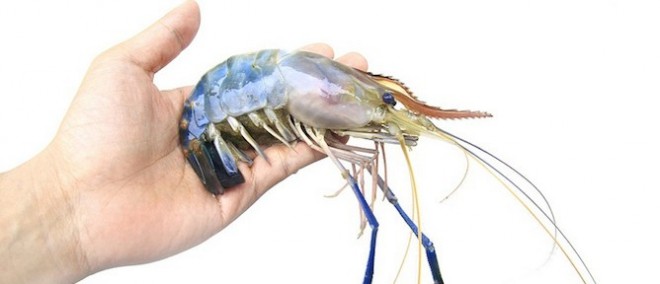
Freshwater male prawns.

But with a growing awareness of food miles, the importance of knowing what goes into your food, a desire for freshness and buying American –– Shechter hopes to be able to start a new revolution with Enzootic, pronounced en-zoo-tic.

“We are targeting the US, because the United States is such a huge consumer of prawns and shrimps, and we want to encourage farmers in the region to grow locally.”

He believes this biotech solution can make the business of crustacean aquaculture a booming business all over the United States, and especially in states that have mild winters. Shechter is also targeting regions within a one-hour plane ride of the United States.

How the technology works

Just after the Macrobrachium rosenbergii get past their larval stage, when they about the size of sea monkeys, Enzootic specialists inject them with an RNA-based material that allows them to “choose” the sex of future progeny.

Methods using hormones, for instance, are applied for sex selection in fish, but this is the first non-hormone treatment of its kind for freshwater prawns, and it may prove to be the safest for human consumption and to alleviate any fears associated with genetically modified foods.

“We use temporary gene silencing to create a generation of mono-sex freshwater prawns using RNAi,” says Shechter.

One prawn changed this way can lead to 100,000 offspring.

In the long term, the company hopes to use its technology as a biocontrol agent. The “treated” prawns sent out with no available mates could ingest invasive species, without any risk of invading the natural environment themselves.

“Defending the cost-effectiveness of a mono-sex culture isn’t a new idea. But until now there wasn’t a technology that can enable 100% all-male prawns,” says Shechter.

As world leaders scramble to look for more secure sources of protein for our world’s nine billion people and counting, Enzootic may be a logical choice. Freshwater prawns constitute about a $2.5 billion business.

Enzootic is based in both Irvine, California, and in Beersheva, Israel. The company employs six people and was founded in 2012, although it based on at least 30 years of research from Sagi’s lab.

The young company is already partnering with others, including an Israeli company called Vecoy that makes viruses commit suicide. Enzootic hopes to be able to create environmentally friendly treatments against aquaculture viruses with this partnership.

The company is current in a pilot phase, and is partnering with hatcheries in North America to produce mono-sex females for livestock.

::Enzootic

This story first appeared on ISRAEL21c – www.israel21c.org

Karin Kloosterman
Karin Kloostermanhttp://www.greenprophet.com
Karin Kloosterman is an award-winning journalist, innovation strategist, and founder of Green Prophet, one of the Middle East’s pioneering sustainability platforms. She has ranked in the Top 10 of Verizon innovation competitions, participated in NASA-linked challenges, and spoken worldwide on climate, food security, and future resilience. With an IoT technology patent, features in Canada’s National Post, and leadership inside teams building next-generation agricultural and planetary systems — including Mars-farming concepts — Karin operates at the intersection of storytelling, science, and systems change. She doesn’t report on the future – she helps design it. Reach out directly to [email protected]

Read More

TRENDING

Who Owns the Farm Robot? A State of Jefferson Startup Takes on Carbon Robotics

In California's self-proclaimed State of Jefferson, a small agricultural technology company is challenging the dominant laser-weeding business model. Laudando & Associates believes farmers should own and repair their AI-powered weeding tools rather than pay ongoing subscription fees. The approach has put the company on a collision course with industry leader Carbon Robotics, sparking a patent dispute that has pushed the Jefferson startup toward overseas markets while raising broader questions about ownership, right-to-repair, and the future of farm automation.

5 Reasons Why You Should Save Seeds (and plant them)

Saving seeds from tomatoes, peppers, herbs and flowers helps preserve biodiversity, strengthen food security, and keep heirloom varieties alive. Even a small balcony garden can make a difference.

Dan Zaslavsky’s energy tower dream is rising again in Iran and China

The Energy Tower idea never made the leap from drawings and engineering studies to full-scale construction. But nearly two decades after most people stopped talking about it, the concept is quietly evolving in two unexpected places: China and Iran. The concept let dreamers dream and doers do - figuring out more pleasing designs and engineering.

A visit to Amirim, Israel’s first all-vegetarian village in the Galilee

Just 15 kilometers from Tzfat there is a moshav that was founded in the late 50s that was ideologically influenced by organic, vegetarian and vegan principles. My hostess at Ohn-Bar, the tzimmer where I stayed, explained that the people of Amirim were among the pioneers of Israel’s strong vegetarian movement.

Israeli Hydrogen Startup H2Pro Are Trying to Solve Clean Energy’s Hardest Problem

The company has attracted backing from major investors including Breakthrough Energy Ventures, the climate fund founded by Bill Gates, along with industrial partners such as Sumitomo, ArcelorMittal, and Temasek, a multi-billion dollar company that owns Singapore airlines. H2Pro has raised more than $100 million USD and is moving from pilot projects toward commercial-scale deployments.

Yerukim Forms a New Green Economy Where the Money is Really Green

The Yerukim members who pick up the recyclables get to keep the monetary reward, the public earns "green" bills that can be used in shops, and business owners get to be associated with environmentalism.

Choosing Riyadh over Dubai? What Investors Should Know

Saudi Arabia is deploying capital at unmatched scale to catalyze tourism and advanced industry while rewiring its power-and-water backbone. The investable frontier is widening—especially in renewables, grid storage, water efficiency/desal retrofits, and hospitality operating platforms. Prudent investors will insist on phased delivery, enforceable KPIs (energy, water, biodiversity), and RHQ/zone compliance—while pricing political-economy and reputational risks alongside growth upside.

Sell your cooking oil for biodiesel money

Want to make money on old french fry oil? Sell it.

Qatar Alternative Energy Summit Pairs Investors And Innovators

Alternative energy investors and innovators can meet n' greet in Doha, Qatar March 16 and 17.

Here’s How To Implement The Four Pillars Of Employee Engagement

If you throw a party for your work team and they are vegans, don't make it a barbecue. Know the sustainability values of your team to boost moral and retain good people.

Locals From Rishon Fight IKEA

Big Box stores are a pretty new concept in Israel, and thank God that not every Israeli city wants them in their backyard. A word from someone who has see the beautiful farmland around her hometown Newmarket, Ontario stripped and converted into vulgar strip malls of big box shops: they have no place in a healthy and sustainable town or city.

The Jewish National Fund Meets An Inconvenient Truth

According to the JNF, it has transformed thousands of acres of barren land into green forests in Israel. They state that each person emits about 23 tons of carbon per year, estimating that each tree planted can absorb one ton of carbon in its lifetime. That's a whole lot of trees you'd need to be planting. Could so many fit in Israel?

How to quiet noise from construction in your office

Streets need to be resurfaced in New York but the humming and grinding noise is unsettling. Noise is environmental pollution. 

Popular Categories