Abu Dhabi energy pylons confuse perceptions of “land” use

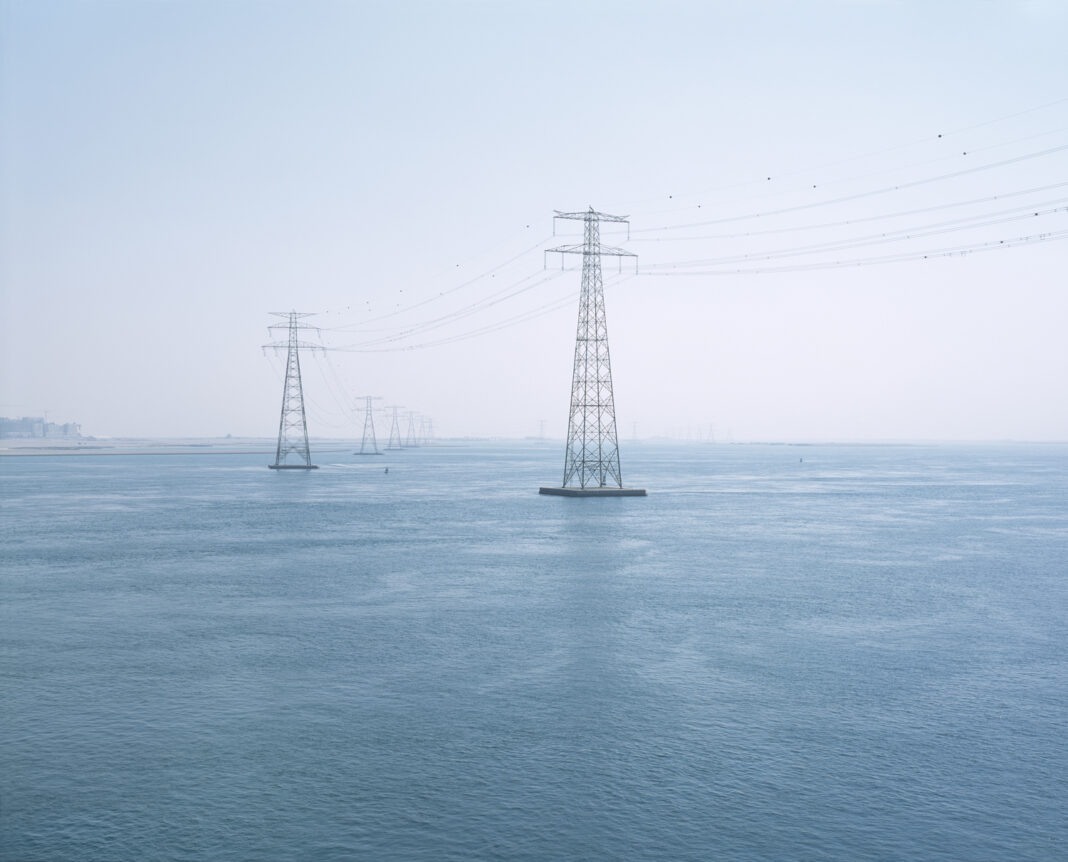
Abu Dhabi, pylons, thirst for energy,  environmental photography, urban development, Richard Allenby-PrattAn awe-inspiring sight, as one departs Abu Dhabi towards Saadiyat and Yas Islands, these pylons seems to disappear into the distant sea. But we are actually looking inland and they are delivering energy to, rather than from, the city center.

As a relatively infrequent visitor, the confusion of islands and waterways in this area ( 24°30’58.91″N  54°24’19.77″E) and the network of fast highways, reclaimed land, and new developments make instinctive navigation challenging, to say the least.

Pylons tend to be the scourge of scenic photographers. They stand so aggressively in the landscape, these most obvious and ubiquitous symbols of our relentless thirst for energy.

As a young photographer my tendency was to romanticise the landscape and avoid ugly intrusions, like pylons, in my compositions. Many was the occasion when I would elect not to waste film on an otherwise beautiful scene because it was marred by incongruous metal intrusions.

With the tools we have available today I doubtless would have taken the pictures anyway and removed the pylons afterwards on my computer. What a sad deception it would have been though!

Note from the editor: this photograph is part of a series called “Consumption” that seeks to document consumerism’s impact on the environment. From resource extraction and commodity production all the way down the supply chain to retail stores and waste processing facilities, Richard artfully examines what nature has come to mean in a world that depends on buying stuff.

Richard Allenby Pratt
Richard is a British photographer living and working in Dubai, UAE. His concerns about the sustainability of the way we live and our economic systems only really became urgent after the birth of his son in 2008. As a landscape photographer he found the obvious way to express these concerns was by making photographs of the places impacted on by human activity, and particularly those places that best display the terrifying scale of our consumption. His basic method is to study google earth and then visit the most intriguing and inexplicable places thereby discovered.

Read More

TRENDING

SolCold wants to cool buildings using sunlight

For centuries people living in hot climates have tried...

EU Ports Still Power Russia’s Arctic Gas Exports Despite Phase-Out Pledge

The findings suggest that rather than declining, Europe’s reliance on Yamal LNG intensified in 2025. Yamal cargoes accounted for 14.3% of the EU’s total LNG imports, equivalent to roughly one in every seven LNG ships arriving at European terminals.The findings suggest that rather than declining, Europe’s reliance on Yamal LNG intensified in 2025. Yamal cargoes accounted for 14.3% of the EU’s total LNG imports, equivalent to roughly one in every seven LNG ships arriving at European terminals.

Ecomondo 2025: Italy’s Green Expo Powers Global Circular Innovation

Each November, a quiet city on Italy’s Adriatic coast becomes the epicenter of the world’s circular economy conversation. What began in 1997 as a local waste management trade show has grown into Ecomondo, a global forum for environmental innovation, resource regeneration, and ecological transition.

Helion Energy, AI, and the New Cold Fusion War With China

Helion’s model plays to America's old strength: innovation through agility, not top-down megaprojects. Instead of waiting for 2050, Helion’s compact reactors aim to deliver electricity in a matter of years—and not just for cities, but for data centers, isolated industries, military bases, even disaster zones. Their current prototype, Polaris, is scheduled to fire in 2025. If Helion succeeds, it won’t just disrupt global energy. It could redraw the world map.

Trump’s “Shower Liberation” Proposal: A Disastrous Step Back or a New Path to Efficiency?

New findings revealed that at any given flow rate, higher-pressure showers were associated with lower water consumption. While low-flow showers delivered less water than high-flow-rate showers, high-pressure showers used less water overall because they were turned off sooner.

Yerukim Forms a New Green Economy Where the Money is Really Green

The Yerukim members who pick up the recyclables get to keep the monetary reward, the public earns "green" bills that can be used in shops, and business owners get to be associated with environmentalism.

Choosing Riyadh over Dubai? What Investors Should Know

Saudi Arabia is deploying capital at unmatched scale to catalyze tourism and advanced industry while rewiring its power-and-water backbone. The investable frontier is widening—especially in renewables, grid storage, water efficiency/desal retrofits, and hospitality operating platforms. Prudent investors will insist on phased delivery, enforceable KPIs (energy, water, biodiversity), and RHQ/zone compliance—while pricing political-economy and reputational risks alongside growth upside.

Sell your cooking oil for biodiesel money

Want to make money on old french fry oil? Sell it.

Qatar Alternative Energy Summit Pairs Investors And Innovators

Alternative energy investors and innovators can meet n' greet in Doha, Qatar March 16 and 17.

Here’s How To Implement The Four Pillars Of Employee Engagement

If you throw a party for your work team and they are vegans, don't make it a barbecue. Know the sustainability values of your team to boost moral and retain good people.

Locals From Rishon Fight IKEA

Big Box stores are a pretty new concept in Israel, and thank God that not every Israeli city wants them in their backyard. A word from someone who has see the beautiful farmland around her hometown Newmarket, Ontario stripped and converted into vulgar strip malls of big box shops: they have no place in a healthy and sustainable town or city.

The Jewish National Fund Meets An Inconvenient Truth

According to the JNF, it has transformed thousands of acres of barren land into green forests in Israel. They state that each person emits about 23 tons of carbon per year, estimating that each tree planted can absorb one ton of carbon in its lifetime. That's a whole lot of trees you'd need to be planting. Could so many fit in Israel?

How to quiet noise from construction in your office

Streets need to be resurfaced in New York but the humming and grinding noise is unsettling. Noise is environmental pollution. 

Popular Categories