
Ancient River Valley Reclaimed: Saudi’s Sweet Success Story

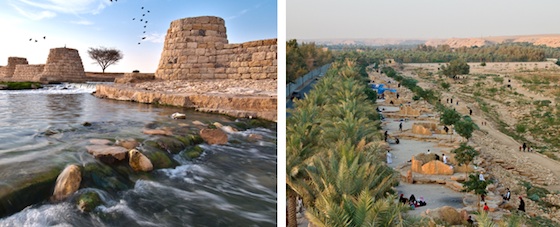
wetlands, Saudi, Wadi Hanifah, bio-remediation, river rehabilitation, waterFor hundreds of years, Saudi’s Wadi Hanifah River carved out a scenic valley extending from sand dunes and agricultural land pocked with date plantations into the heart of Riyadh before it seeped underground. But the city’s expansion into a thumping metropolis of 7 million people brought the 4500 sq km catchment area close to extinction as sewage and construction waste was dumped in the river.

As a result, the Arriyadh Development Authority commissioned the Canadian architecture and planning firm Moriyama & Teshima and Buro Happold – a UK engineering firm – to submit a Master Plan and Restoration Program to restore the area’s ecological health. One decade later and the Wadi is once again a thriving desert oasis.
wetlands, Saudi, Wadi Hanifah, bio-remediation, river rehabilitation, water

This massive reclamation project involved various stages. First it was necessary to clean up the river waste, which involved removing 1.5 million cubic meters of debris ranging from construction waste to dead animals.

The riverbed hand to be cleared and a nearby tannery that was releasing toxic chemicals into the river was shut down.

Water mains, sewage lines, and even overhead power lines were relocated, and stone walls were erected to demarcate the boundaries between public and private land.

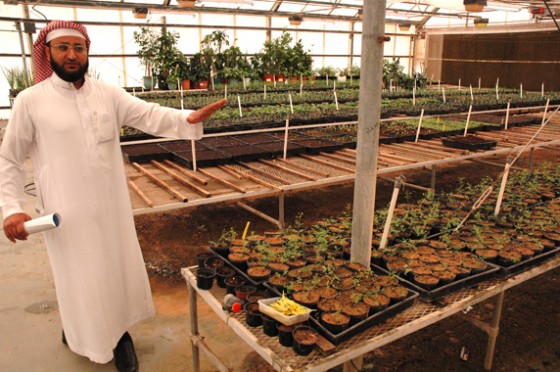
Meanwhile, 35,000 indigenous shade trees were cultivated in greenhouses along with native grasses. Although the local people resisted the re-introduction of these species, believing them to be weeds, the design team prevailed by creating 150 shaped clusters of plants that were actually very beautiful.

Using native species to re-vegetate the wadi was essential for two reasons: first, they have adapted to extreme weather conditions such as low rainfall (just 100mm a year) and high temperatures, and they have provided flood control for centuries. Prone to flooding, the wadi could no longer cope as asphalt replaced wetland plants that can retain moisture and sediment.
wetlands, Saudi, Wadi Hanifah, bio-remediation, river rehabilitation, water

These clusters were placed along a 70km stretch of the river, which is now accessible by a new 53km road that provides links to 6 new parks! There are also 43km of promenades and walkways that allow local people to hike, bike or stroll along the new rehabilitated and  verdant urban oasis.

Perhaps the most impressive aspect of the project to date, which is expected to continue for at least 100 hundred years as other sick watersheds (including within Mecca and Medina) receive similar treatment, is the bio-remediation of the sewage plant that has re-introduced treated water into the river system.

Using a constructed wetland system, the team introduced four powerful air pumps that blast dissolved oxygen into the treatment plant, which destroys existing bacteria. Then they added a layered textile mat, where algae and other micro-organisms proliferate, digesting any particulates. Then a series of tilapia feed on the algae so that the water is almost 100% clean and clear when it comes out.

This treated wastewater is so clean and free of odor that it has been allowed to continue along the river and forms the basis of an additional 28km of green parks.

wetlands, Saudi, Wadi Hanifah, bio-remediation, river rehabilitation, waterIf you’re interested to learn more about the project, which is even more impressive than we’ve been able to express, please visit the MT Planners website.

Images via Arriyadh Development Authority 

More on Greening Saudi:

Saudi Could Export Solar for the Next 20 Centuries

The Red Sea is Filled With Tiny Researchers Saudi is Intent to Discover 
$109 Billion Solar Plan to Power Saudi

Tafline Laylin
Tafline Laylinhttp://www.greenprophet.com
As a tour leader who led “eco-friendly” camping trips throughout North America, Tafline soon realized that she was instead leaving behind a trail of gas fumes, plastic bottles and Pringles. In fact, wherever she traveled – whether it was Viet Nam or South Africa or England – it became clear how inefficiently the mandate to re-think our consumer culture is reaching the general public. Born in Iran, raised in South Africa and the United States, she currently splits her time between Africa and the Middle East. Tafline can be reached at tafline (at) greenprophet (dot) com.

Read More

1 COMMENT
  1. Double standards. While Saudis re-claim their rivers, their developers snatch public natural reserves in Lebanon, and ignore the Lebanese environmentalists asking to preserve these natural landscape.

LEAVE A REPLY

Please enter your comment!
Please enter your name here

TRENDING

Hormuz 2026 Conflict Poses an Energy and Food Security Dilemma in a Warming World

As tensions rise in one of the world’s most critical maritime chokepoints, the ripple effects go far beyond oil—touching food systems, climate pressures, and regional stability

Baby teeth read like tree rings paint a picture of toxins in early life

A new study from the Icahn School of Medicine at Mount Sinai in New York offers a striking insight into how the environments we are born into can quietly shape our brains years later. By analyzing naturally shed baby teeth, the ones tucked under pillows for the tooth fairy, researchers have reconstructed a detailed timeline of exposure to environmental metals during pregnancy and early infancy.

Poop in the East River shows the city’s rat problem and what people like to eat

New York ecology and health can be monitored by a jug of water a week.

Is your groundwater too young? New study finds risks for Parkinson’s and type of water you drink

People whose drinking water came from newer groundwater had a higher risk of developing Parkinson’s disease than those whose drinking water came from older groundwater, according to a preliminary study released March 2, 2026, that will be presented at the American Academy of Neurology’s 78th Annual Meeting taking place April 18–22, 2026, in Chicago and online.

The Saudi Startup Turning Desalination’s Toxic Waste Into Its Own Disinfectant

For millennia, the Middle East's water crisis seemed an immutable fact of geography — a region defined as much by what it lacked as by what lay beneath its sands. Today, a convergence of plummeting solar costs, advancing membrane technology, and hard-won engineering expertise is rewriting that story.

How to quiet noise from construction in your office

Streets need to be resurfaced in New York but the humming and grinding noise is unsettling. Noise is environmental pollution. 

EarthX and a blueprint for sustainable investing

Trammell S. Crow, a Dallas-based businessman and father of four, is focusing his efforts on impact investing, and media that focuses on saving the planet through EarthX.

Mining Afghanistan’s Mineral Discoveries Similar to Avatar

Now that American forces in Afghanistan are commemorating the longest period of any war that America has been involved in, including the 1965-73 Vietnam War, the recent discoveries of large and extremely valuable mineral and metal deposits may finally bring to light a reason to continue the presence of US fighting forces in this war torn and backward country.

From Pilot Plant to Global Stage: How Aduro Clean Technologies’ 2026 Expansion Signals a Turning Point for Chemical Recycling Investors Like Yazan Al Homsi

The company's Next Generation Process (NGP) Pilot Plant in London, Ontario, has officially moved into initial operating campaigns, generating the kind of structured, repeatable data that separates laboratory promise from commercial viability.

Nobul’s Regan McGee on Shareholder Value: “Complacency Is the Silent Killer” 

Why the governance framework designed to protect shareholders so...

Should You Invest in the Private Market?

startustartup Unlike public stock exchanges, which offer daily trading, strict...

How to build a 100-year-company

Kongō Gumi is a Japanese construction company, purportedly founded in 578 A.D., making it the world's oldest documented company. What can we learn about building sustainable businesses from them?

How AI Helps SaaS Companies Reduce Repetitive Customer Support Work

SaaS products are designed for large numbers of users with different levels of experience, and also in renewable energy.

Popular Categories