‘A Palace for Nature’ kills the idea that rich Arabs aren’t green

A Palace for Nature, Qatar architecture, green design, sustainable design, eco-design, solar power, water scarcity Middle East, botanical oasis, daylighting, energy efficient design, recycled gray water, on-site desalinationLiving large isn’t sustainable, at least that is what most green hearts tend to believe, but Sanzpont Arquitectura disagrees. Invited to participate in an international competition to design a private residence in Qatar, the studio came up with ‘A Palace for Nature’ – a magnificent solar-powered palace modeled after the sidra tree.

Sanzpont Arquitectura was among a select group of architects asked to submit a proposal for the palatial residence, and received third prize with ‘A Palace for Nature.’

Most curious to us, who have watched the green design movement slowly gather pace throughout the Middle East, is the extent to which the Spanish/Mexican architects emphasized nature in their proposal.

A Palace for Nature, Qatar architecture, green design, sustainable design, eco-design, solar power, water scarcity Middle East, botanical oasis, daylighting, energy efficient design, recycled gray water, on-site desalination

Whereas so many projects give a passing nod to daylighting or solar energy, this design proposal literally establishes a palace for nature. Not in it. But for it.

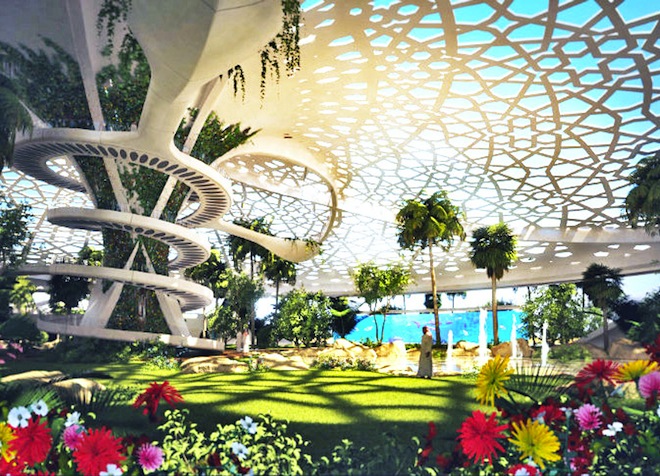
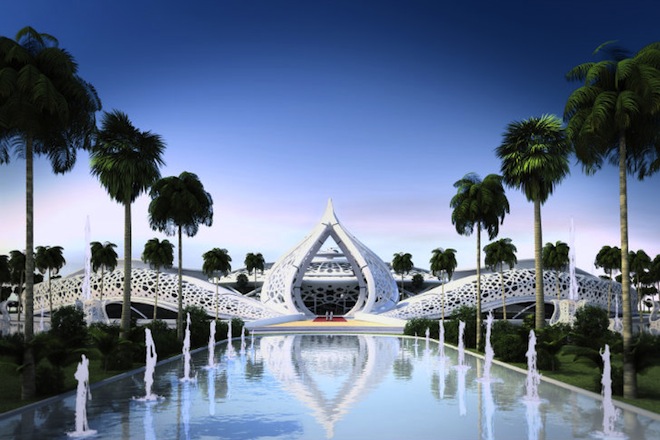
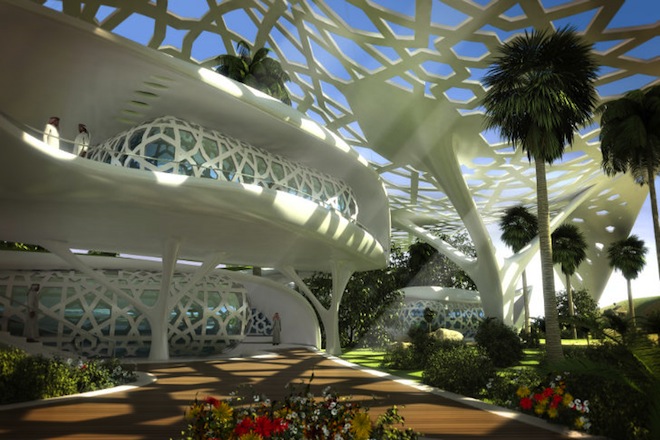
A contemporary take on various cultural motifs, such as the ubiquitous dome, and modeled after the sidra tree indigenous to the region, the 2,2925 square meter grounds incorporate both indoor and outdoor gardens, a sweeping shaded entryway, and the main dome covered with a perforated, undulating roof.

Photovoltaic panels are integrated into the roof’s outer skin, while a misting system built into the inner skin helps to maintain a comfortable microclimate. Everywhere there is greenery, a veritable oasis.

But Qatar is in the desert. How can the palace grounds be so lush? This is where it gets, tricky, where it so frequently gets tricky in the Middle East.
A Palace for Nature, Qatar architecture, green design, sustainable design, eco-design, solar power, water scarcity Middle East, botanical oasis, daylighting, energy efficient design, recycled gray water, on-site desalination

Too often, even in the middle of the desert where it’s not appropriate, developers in the Middle East associate being green with actual greenery – even the kind that can’t sustain itself in an arid, hot environment, where water is terribly scarce.

To account for this problem, Sanzpont proposes to not only recycle grey water, which is great, and an essential component of any new project in water scare Gulf countries, but there is one small way in which this firm that we typically respect a great deal goes wrong: they hope to derive water from underground aquifers.

Granted, in most coastal regions, groundwater is so salty that it is currently not fit for drinking, which is why Sanzpont proposes to build an on-site desalination facility and store water in landscaping pools, but the Gulf peninsula’s underground aquifers are incredibly valuable – not just for this generation, but for those to come, so they ought to be protected at all costs.

Are we really going to use it to make a palace so verdant?
A Palace for Nature, Qatar architecture, green design, sustainable design, eco-design, solar power, water scarcity Middle East, botanical oasis, daylighting, energy efficient design, recycled gray water, on-site desalination

Other than that, this project reveals that the Middle East is embracing more responsible design, that not all Arabs drive gold Mercedes and drink bottled water worth nearly $3,000.

In addition to producing its own clean energy, the energy that the residence does require is reduced by natural ventilation, daylighting, and LED lights.

“Architecture design should be integrated with its surrounding environment should reflect its culture in time,” writes Sanzpont, “so we studied their historical typologies and architectural language to evolve it into innovative vanguard design plenty of cultural heritage.”

Tafline Laylin
Tafline Laylinhttp://www.greenprophet.com
As a tour leader who led “eco-friendly” camping trips throughout North America, Tafline soon realized that she was instead leaving behind a trail of gas fumes, plastic bottles and Pringles. In fact, wherever she traveled – whether it was Viet Nam or South Africa or England – it became clear how inefficiently the mandate to re-think our consumer culture is reaching the general public. Born in Iran, raised in South Africa and the United States, she currently splits her time between Africa and the Middle East. Tafline can be reached at tafline (at) greenprophet (dot) com.

Read More

2 COMMENTS

TRENDING

Self-repairing contact lenses and desalination membranes that fix themselves?

Could the humble contact lens become a sustainability breakthrough? Researchers in Korea have developed a self-healing hydrogel lens that repairs scratches with just one hour of UV light exposure. Beyond reducing waste from disposable contacts, the technology could one day help extend the life of solar panels, water filtration systems, and other plastic-based products.

Collecting kinetic energy from roads; REPS turns traffic into a power plant

REPS announced a $23.6M equity financing round to scale...

Baby teeth read like tree rings paint a picture of toxins in early life

A new study from the Icahn School of Medicine at Mount Sinai in New York offers a striking insight into how the environments we are born into can quietly shape our brains years later. By analyzing naturally shed baby teeth, the ones tucked under pillows for the tooth fairy, researchers have reconstructed a detailed timeline of exposure to environmental metals during pregnancy and early infancy.

Eco-Friendly Flashlights for Off-Grid Travel and Home Preparedness

Reliable light matters in more places than ever. It matters on a back road after sunset, in a cabin with limited power, and at home during a storm outage. Research across sustainability guidance, preparedness resources, and off-grid living coverage points to one clear takeaway: people want lighting that works well, lasts longer, and creates less waste.

Renewables hit 5,149 GW in 2025 as the world edges away from oil shocks and fossil-fueled conflict

“In the midst of uncertain time, renewable energy remains consistent and steadfast in its expansion,” said Francesco La Camera, IRENA’s Director-General. “A more decentralised energy system, with a growing share of renewables and more market players, is structurally more resilient.”

Yerukim Forms a New Green Economy Where the Money is Really Green

The Yerukim members who pick up the recyclables get to keep the monetary reward, the public earns "green" bills that can be used in shops, and business owners get to be associated with environmentalism.

Choosing Riyadh over Dubai? What Investors Should Know

Saudi Arabia is deploying capital at unmatched scale to catalyze tourism and advanced industry while rewiring its power-and-water backbone. The investable frontier is widening—especially in renewables, grid storage, water efficiency/desal retrofits, and hospitality operating platforms. Prudent investors will insist on phased delivery, enforceable KPIs (energy, water, biodiversity), and RHQ/zone compliance—while pricing political-economy and reputational risks alongside growth upside.

Sell your cooking oil for biodiesel money

Want to make money on old french fry oil? Sell it.

Qatar Alternative Energy Summit Pairs Investors And Innovators

Alternative energy investors and innovators can meet n' greet in Doha, Qatar March 16 and 17.

Here’s How To Implement The Four Pillars Of Employee Engagement

If you throw a party for your work team and they are vegans, don't make it a barbecue. Know the sustainability values of your team to boost moral and retain good people.

Locals From Rishon Fight IKEA

Big Box stores are a pretty new concept in Israel, and thank God that not every Israeli city wants them in their backyard. A word from someone who has see the beautiful farmland around her hometown Newmarket, Ontario stripped and converted into vulgar strip malls of big box shops: they have no place in a healthy and sustainable town or city.

The Jewish National Fund Meets An Inconvenient Truth

According to the JNF, it has transformed thousands of acres of barren land into green forests in Israel. They state that each person emits about 23 tons of carbon per year, estimating that each tree planted can absorb one ton of carbon in its lifetime. That's a whole lot of trees you'd need to be planting. Could so many fit in Israel?

How to quiet noise from construction in your office

Streets need to be resurfaced in New York but the humming and grinding noise is unsettling. Noise is environmental pollution. 

Popular Categories