
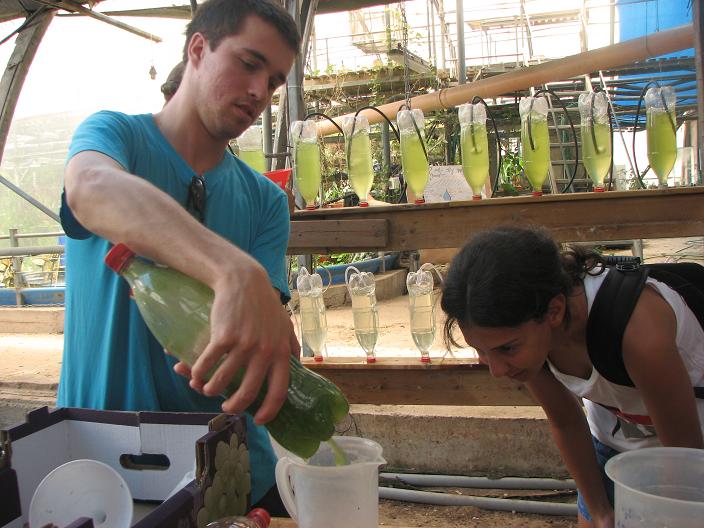

 Despite the many wounds that cripple cooperation between the Israeli and Palestinian governments, Arab and Jewish teenagers work side by side to further algae research in Israel. Established in 2008, the Micro Algae Educational Project packs two important imperatives into one succinct program for high school students: ecology and social healing.
Conducted in the Eco Greenhouse on Kibbutz Ein Shemer, the project aims to establish the ideal growing conditions for algae and then foster a variety of real-world applications, including food, medicine, bio-fuels and water treatment. So far, more than 300 Arab and Jewish students equipped with little more than a curious mind and a healthy dose of tolerance have participated in the project, and many more are on track to do the same.
 Initially a communal greenhouse established in 1977, the Eco Greenhouse evolved organically over the years until a non-profit organization was established in 2004 in order to forge a more concrete educational model that would benefit both the scientists and students who were drawn to the space.
“From year to year the greenhouse expanded,” Educational Manager Noam Geva told Green Prophet. “The number of teenagers grew, and more and more fields were added which one could study, build and develop.”
 “At the same time, the educational staff expanded and a complete didactic concept formed, based on project-based learning, teamwork and enabling the young people to choose and self-instruct.”
Since 2004, roughly a dozen Arab and Jewish schools have become involved in the initiative and the fields of study have expanded further still. But perhaps none are so promising as the multidisciplinary Micro Algae project.
“In recent years, the field of single cell algae research is drawing attention among bio-tech industries, researchers and entrepreneurs – who wish to utilize their findings in fields of medicine, in fisheries, food industries, water treatment and energy industries,” Geva explains.
 “As educators, we see tremendous potential in the field – as it is a platform that integrates science, ecology, agriculture and sustainable social models. The Greenhouse staff has recently explored opportunities of integrating these themes into our work in fields of water research – and have found them inspiring and suitable for our educational model.”
But tomorrow belongs to our youth, so involving them in the exploratory process is a crucial element of the program. Not only does this bode well for science, but fostering such intimate cooperation between the two religious groups transcends whatever political disaster has seized the day.
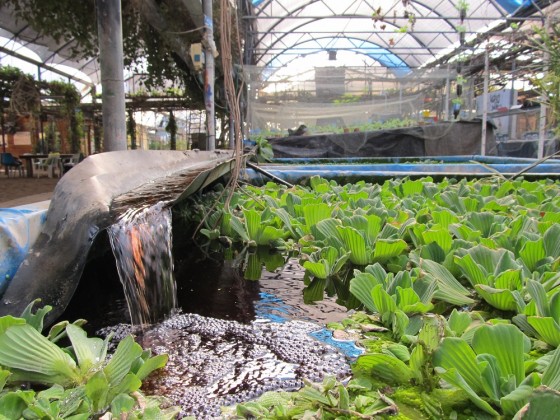
“One of the project’s main goals is to grow the future researchers, entrepreneurs and scientists,” said Geva, who strives to “Expose the students to global environmental challenges, enable them to research and deal with advanced scientific topics under the supervision of academic researchers and experts from the agricultural industry, and plant the seeds of curiosity.”
One of the most advanced of its kind on earth, this fantastic green curriculum can be used as a prototype for similar educational institutions not only in Israel, but anywhere.



Dear Karin Friedemann,
Self hatred is a terrible affliction. It blurs rational thinking, invents nonsense and then spews it into a cesspool of emotional garbage.
While such masochism may be accepted as someone’s individual choice, it is not acceptable when it deliberately poisons and indeed harms other people. Your irrational, vitriolic response to this positive article is a perfect example of hurting others through your own masochism. So very sad.
As an Arab Jew whose family truly was “ethnically cleansed” from Egypt I find your Knee-jerk characterization of Israel as “Illegal Ashkenazi immigrants” both racist and misguided.
Coming from a family of 150,000 Egyptian Jews, I stand with the Iraqi Jews, Syrian Jews, Yemeni Jews, Moroccan Jews, Tunisian Jews, Libyan Jews who make Israel their new home.
Take your soapbox speech and go some place else. Your words are ignorant and despicable and don’t serve the cause of peace.
I agree.
I think it’s great to see them working together peacefully. This could be the beginning of a peace epidemic in the region that is LOOOONG overdue. I salute all people in the project and would love to come tour the facilities and educate myself. Great job guys! For the sustainable and ecological aspects of what you’re doing and also for working and coexisting together peacefully. I can’t express how impressed I am.
Nice story, but it just grates at my soul how the article is using the term “Arabs” instead of referring to them as Palestinians. To call them Arabs is racist because it negates the history of Palestine and downplays Zionist genocide and ethnic cleansing. Also, the headline is misleading because it talks about Palestinian and Israeli governments, implying that this project involves Palestinians living in the occupied territories, but then it takes away the Palestinian identity of the students.
I would rather read, “Palestinians work with illegal Ashkenazi immigrants on green fuel projects.” Now that would be progressive.