Sharing Eden – Green Teachings from Jews, Christians and Muslims (Book Review)

sharing-eden-green-religion-islam-jew-christianFaith is something which the Middle East has a lot of. Whether that faith is being used solely for good is another matter altogether – some are trying to change that by invoking the shared green aspects of the Abrahamic faiths

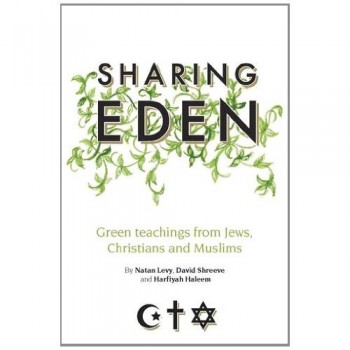
Sharing Eden – Green teachings from Jews, Christians and Muslims is a small book which is trying to do a big thing:  encourage those of faith to take more positive action for the environment. And therein lies the strengths and also the weaknesses of this book. Three writers from each faith explore issues such as sustainability, water, food and biodiversity through the lens of their faith.

They look at the teachings from the Torah, Bible and Qur’an whilst also highlighting practical action faith groups and communities are taking across the continents. It’s only 100 (small!) pages long, it’s very readable with lots of images and I managed to go through it all in a short train journey. The writers manage to fit a lot of spiritual and practical information into a very short space but there is naturally a lot still missing.

There was no exploration of the fact that there are some aspects of all faiths that will struggle to align with the environmental agenda. For example, in Islam the Hajj pilgrimage is seen as problematic as the international travel and use of natural resource that occurs during the pilgrimage can only be minimized and not be eliminated altogether.

There was also no interaction between the three faiths in terms of their similarities and differences and although that could be explained away by lack of space, it still would have been nice. Saying that, it was lovely to be able to read about the three different faiths in one book and hopefully that will mean the readers (of whatever faith or of no faith) got a taster of all three too.

The book seemed to have a naïve belief (in my opinion) that once you told people of faith of these green ethics, that they would change their deep-rooted behaviours. From personal experience, I’ve found this to be untrue and that people often need more than just information to change their actions. As such, it would have been nice if the barriers that those of faith experience whilst trying to take environmental action were explored more fully and the more difficult and contentious nature of green action discussed.

A little bit more climate science would have also been nice and would have rooted the need for action in two spheres – faith and science.
Indeed, the book could have made more of an effort to link those of faith with the broader environmental movement in terms of other (non-faith) groups, organisations, campaigns and also news sites.

No, this isn’t about the fact that GreenProphet.com wasn’t mentioned, as no green news sites were mentioned at all (!) although that could have been a vital way to strengthen faith followers’ knowledge and understanding of climate change related issues.

After reading all that, you probably think I didn’t enjoy the book but I really did. The writing was great, the chapters on food and biodiversity were particularly interesting and I think for someone new to the issue, this is a GREAT introduction.

It was also great to have all three faiths together in one book and I will definitely be passing my copy around. However, for those looking for a little bit more in-depth exploration of the faith-environment nexus then this probably isn’t for you.

Sharing Eden – Green teachings from Jews, Christians and Muslims 

By Natan Levy, David Shreeve and Harfiyah Haleem

Kube Publishing in association with The Conservation Trust

2012

$8.99 / £4.99

For more green faith communities see: 

London Mosques Start Beekeeping Trend – Interview
The Eco-Mosque Checklist – 7 Steps to a Greener Mosque

Consumerism, Ecology and the Sabbath

Arwa Aburawa
Arwa Aburawahttp://www.greenprophet.com
Arwa is a Muslim freelance writer who is interested in everything climate change related and how Islam can inspire more people to care for their planet and take active steps to save it while we can. She is endlessly suspicious of all politicians and their ceaseless meetings, especially as they make normal people believe that they are not part of the solution when they are the ONLY solution. Her Indian auntie is her model eco-warrier, and when Arwa is not busy helping out in the neighborhood alleyway garden, swap shopping or attempting fusion vegetarian dishes- with mixed success, she’d like to add- she can be found sipping on foraged nettle tea.

Read More

2 COMMENTS
  1. I’m so glad you reviewed the book Arwa. I was invited to the book launch and couldn’t make it, but I thought very similarly about the little book. It’s more of an introduction, saying ‘this’ is what we should be like, ‘this’ is how believers typically are, but it wasn’t as inspiring or pragmatic as hoped.

    It’s always the little disciplined actions that lead to greater movements, the book missed that element.

    Much love and dua.

TRENDING

10 Amazing Facts About the Sidr Tree

Most people in the West have never heard of the Sidr tree. That's strange when you think about it. This tough, thorny desert tree has fed people, bees, birds, and camels for thousands of years. It appears in Islamic tradition. Its honey sells for astonishing prices.

What Is Liberty HealthShare, and Should I Learn More?

Health insurance is a regulated financial product. Insurers operate under binding contracts, overseen by state insurance commissioners, that legally obligate them to pay claims meeting policy terms. Policyholders who believe a covered claim was wrongfully denied have legal recourse through state regulatory channels.

The Christ’s thorn (sidr tree) is also a well-known folk medicine

Christ’s thorn jujube (Ziziphus spina-christi) also known as the sidr tree is a real, identifiable tree native to the Middle East, and it appears—directly or indirectly—in Islam, Judaism, and later Christian tradition. The connections between the three faiths are not theological agreements but overlapping uses, names, and symbolic associations rooted in the same landscape.

In The Dark Review – An Immersive Music Experience in Total Darkness at St Andrew Holborn

In complete darkness, inside the holy space of St Andrew Holborn, listening begins to feel like a form of prayer. With no light and no distraction, sound fills the church and holds the room. For an hour, attention itself becomes the shared act.

Sustainable Architect Ronak Roshan on the Politics Behind the Houston Ismaili Center

Roshan’s reflection situates the Houston Ismaili Center within a broader discussion about architecture as diplomacy — where aesthetics, faith, and geopolitics intersect. Her words challenge readers to question whether “green” design and grand symbolism can coexist without transparency and accountability.

Yerukim Forms a New Green Economy Where the Money is Really Green

The Yerukim members who pick up the recyclables get to keep the monetary reward, the public earns "green" bills that can be used in shops, and business owners get to be associated with environmentalism.

Choosing Riyadh over Dubai? What Investors Should Know

Saudi Arabia is deploying capital at unmatched scale to catalyze tourism and advanced industry while rewiring its power-and-water backbone. The investable frontier is widening—especially in renewables, grid storage, water efficiency/desal retrofits, and hospitality operating platforms. Prudent investors will insist on phased delivery, enforceable KPIs (energy, water, biodiversity), and RHQ/zone compliance—while pricing political-economy and reputational risks alongside growth upside.

Sell your cooking oil for biodiesel money

Want to make money on old french fry oil? Sell it.

Qatar Alternative Energy Summit Pairs Investors And Innovators

Alternative energy investors and innovators can meet n' greet in Doha, Qatar March 16 and 17.

Here’s How To Implement The Four Pillars Of Employee Engagement

If you throw a party for your work team and they are vegans, don't make it a barbecue. Know the sustainability values of your team to boost moral and retain good people.

Locals From Rishon Fight IKEA

Big Box stores are a pretty new concept in Israel, and thank God that not every Israeli city wants them in their backyard. A word from someone who has see the beautiful farmland around her hometown Newmarket, Ontario stripped and converted into vulgar strip malls of big box shops: they have no place in a healthy and sustainable town or city.

The Jewish National Fund Meets An Inconvenient Truth

According to the JNF, it has transformed thousands of acres of barren land into green forests in Israel. They state that each person emits about 23 tons of carbon per year, estimating that each tree planted can absorb one ton of carbon in its lifetime. That's a whole lot of trees you'd need to be planting. Could so many fit in Israel?

How to quiet noise from construction in your office

Streets need to be resurfaced in New York but the humming and grinding noise is unsettling. Noise is environmental pollution. 

Popular Categories