

 Can the Energy Tower slated for US Mexico border create clean power and mitigate climate change? If Americans put Man on the moon, why not, argues Brian.
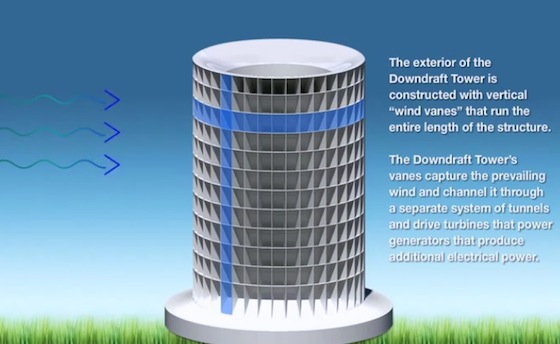
Professor Dan Zaslavsky and Dr. Rami Guetta from Technion-Israel Institute of Technology are trying to develop an idea first patented by Phillip R. Carlson in 1975. In what is known as a downdraft energy tower, water is sprayed onto solar heated air at the top of a hollow tower. Now cooled and denser, this air falls rapidly to the bottom of the tower where it drives turbines and generates electricity. Annapolis Maryland – based Clean Wind Energy Tower, Inc (CWET) has plans to build two such towers near the US – Mexican border in San Luis, Arizona. At 3000 feet, the tower’s height will surpass Burj Khalifa, but unlike most skyscrapers, this one is designed to give more than it takes, in the form of clean electricity.
[youtube]http://www.youtube.com/watch?v=Iftbh_Nj9Tk[/youtube]
Downdraft energy towers…an idea so bold, so fantastic, so crazy…
At first glance, this idea seems incredibly simple when compared with mile deep oil rigs and nuclear reactors.
There are significant technical challenges to building any 3000 foot high structure, much more so when the tower contains an artificial thundercloud and generates electricity. Evaporative-cooled downdraft towers such as this require a very dry climate.
The deserts of the US southwest, the Mideast and North Africa seem ideal for this, but that cooling water has to come from somewhere. So designers have proposed that saltwater should be used to cool the air.
The side benefit is that this could become part of a desalination system, the downside is corrosion of turbines and structural components.
Another problem is that it takes energy to pump water 3000 feet into the air, about a kilowatt-hour for every 1000 liters pumped. To compensate for this loss, Zaslavsky and Guetta proposed to install vertical wind turbines into the walls of the tower. Their models show that it should be possible to generate electricity for between one and four cents per kilowatt-hour.
Energy Towers might just work
Of course there must be careful planning of water usage, environmental impact, distance from energy consumers, cradle-to cradle carbon footprint.
But if this project succeeds, it will pave the way for all of us. Solar energy, reusable grocery bags and buying local will no longer seem like such far-out lunatic ideas.
As Green Prophet’s Tafline Laylin pointed out, Israel is a world leader in producing green technology which is used everywhere except Israel. So if this bold Mideastern idea comes to fruition, San Luis, Arizona USA will have bragging rights.
Clean Wind Energy Towers, Inc already received approval to lease land for this project and began seeking zoning approval a few days ago. But in the strange world of business economics, their progress was taken as bad news and CWET shares plummeted.
Clearly this project is not for the faint of heart but hey– the US is a country which sent men to the moon. This is a country which boldly flings hundred billion dollar bailouts in the same way circus clowns toss candy.
Just a stone’s throw from the tower’s proposed site in San Luis is a three layer 18-foot high stretch of wall fence which extends for 87 miles to the west and 379 miles to the east.
This is a nearly completed portion of a $6 billion wall which is designed to protect this bold country from stone-throwing Mexican teenagers. Nevermind the fact that teenagers can climb it in 20 seconds, assuming an average height of 3 meters over its length gives an area of approximately 2 million square meters for the San Luis section of wall.
So if Mexican teenagers glued solar panels onto their side, the wall would generate about 600 Megawatts of electricity. The panels would cost $500 million at Chinese “dumped” photovoltaic prices, a fraction of what the US paid for that ungreen concrete and steel wall and probably less than the stock market dips every time Ben Bernanke blows his nose.
Even if it never generates as much electricity as Mexico’s photovoltaic border wall would, this 3000 foot high energy tower is already a success. It helps us think outside of the wall box.


Lucy,
My point was that the nearby wall was a huge, expensive project which has not been very effective (especially given that there are already about 10 million undocumented immigrants living on the U.S. side of the wall and much of our economy depends on their labor– talk about locking the barn door after the horse has fled…
Some young women showed how the wall could be scaled in about 15 seconds. Parts of the wall have already been disassembled and sold for scrap in Mexico. Illegal immigration is a problem but I don’t think this was a solution any more than Senator Joseph McCarthey was a solution to communism.
I mentioned the wall because it is so close to the proposed location of the tower and represents another colossal project which is widely regarded as a failure (even most of those who promoted it are abandoning the idea as a waste of taxpayer money.)
I could also argue that Congress’s mishandling of corn ethanol subsidies drove up the cost of a Mexican staple food and help create an economic vacuum which was filled by violent drug lords. Clearly this wasn’t the only cause but treating this as a problem “over there” which can be walled off ignores economic realities and the fact that there wouldn’t be so many powerful drug lords in Mexico if there weren’t so many good drug customers on the U.S. side of the wall.
P. Michael, actually the plan is for a dual energy tower, both the downdraft tower and vertical turbines driven by prevailing winds will be used to increase efficiency. The article explains this in more detail.
I’ve got news for you. That wall/fence you describe that is between the US and Mexico is NOT to protect the US from stone throwing Mexican teenagers. The US is trying to control the unbridled influx of gun carrying drug cartels, those trafficking in human suffering, and others who are just crossing the borders illegally in search of a better life. Have you been in our border states and walked along the desert on the US side? The litter is unutterably disgusting, as illegal border crossers just ditch their trash as they go. They have turned our beautiful deserts into one enormous garbage dump. The ecosystems are damaged from all the garbage left behind. Talk about trying to go green…do a little more research before you make comments that are patently false. It undermines your message of bringing sustainable energy to the area, which, if successful, could raise the economic levels of people on both sides of the fence.
The description of the Energy Tower (ET) that appears in the figure is incorrect. The ET does not capture the prevailing wind. It creates energy by harnessing the flow generated by the cooling effect of the spray of water at its top. The ET project has been investigated by a large group at the Technion – Israel Institute of Technology headed by Prof. D. Zaslavsky. The prevailing wind slightly reduces its efficiency. There is no question that it is based on sound and proved physical laws. Its Achilles tendon, is the large cost of building such a tower, which is a typical feature of energy producing devices that use natural resources, like hydroelectric power plants. As it has never been tried before, it is hard to raise the money to build one.
I’ve never bought into the idea the environmentalism should chain itself to one particular political philosophy nor that environmentalism is necessarily anti-business (and therefore feared by business-loving political parties.) The Soviet states were leftists and they were ecological disasters. It turns out that neither government (left) nor big business (right) are sufficiently agile, engaged and detail-oriented to look after our world. That’s why its necessary for PEOPLE to do this, regardless of their political persuasion. That’s why I’m here. I hope that’s why you are here.
Truthful scientific consensus or not, climate change is costing progressivism votes on a massive scale and could keep Liberals out of power for a decade! (condemning the voter’s children to a CO2 death has spurred a backlash to the fear machine and environmentalism now needs new PR and rebranding)
A wave of former believer rage has arrived:
-“Socialist” Canadian voters voted in a prime minister accused of being a climate change denier to a majority government no less!
-The Occupywallstreet movement is the leading edge of progressivism and does not support “anything” about CO2 (bank funded carbon trading stock markets)
-“Socialist” Canada killed Y2Kyoto.
-Obama has not mentioned a climate crisis in two state of the unions.