In Remotest Anatolia, Lone NGO Speaks Up On Nature’s Behalf

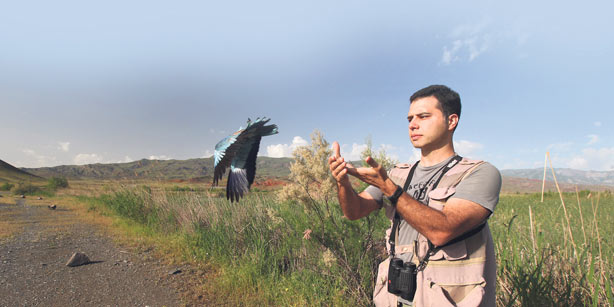
Çağan ŞekercioğluÇağan Şekercioğlu founded ecological research and conservation NGO KuzeyDoğa in 2007 to promote biodiversity and resist environmental degradation in Turkey’s fast-developing eastern region.

As thermal power plants and hydroelectric dams pop up more and more across Turkey’s landscape, the effects of these developments on the natural environment go largely unseen. Especially in Turkey’s rural, lightly settled eastern region, few locals know the detriments of pollution, flooding, and overgrazing on wildlife. Even fewer can do anything about it.One passionate Turkish conservationist, however, has been trying to counter and spread awareness about environmental degradation through KuzeyDoğa (NorthEast), an NGO he founded four years ago. And he’s getting results.

The issue

The northeastern corner of Turkey marks the confluence of two biodiversity hotspots, the Irano-Anatolian and the Caucasus, and contains 22 key biodiversity areas. Lakes, rivers, and other wetlands across the region are the primary habitats for many rare bird species endemic to Anatolia.

But flooding from hydroelectric dams, overgrazing, and air pollution from the increasing number of coal- and gas-fired power plants being built in eastern Turkey has damaged these environments, threatening the populations of birds and mammals that rely on them.

A champion for biodiversity

Enter Çağan Şekercioğlu, an Istanbul native who now sits on the faculty at the University of Utah, specializing in community-based conservation, ecology, ornithology, and tropical biology.

Since founding KuzeyDoğa four years ago, Şekercioğlu and his NGO have completed myriad projects to conserve and protect the wildlife of northeastern Turkey. The organization has banded almost 40,000 birds at two research and education centers, and opened a “vulture restaurant” — don’t worry, not a literal restaurant! — where ecotourists can observe and photograph vultures from behind a wildlife blind in Mount Ağrı National Park.

At Lake Kuyucuk, the most important bird wetland in the northeastern Kars region of Turkey, KuzeyDoğa built Turkey’s first artificial island for bird conservation on an old road that used to bisect the lake. Now, birds can roost and breed safely on the island.

KuzeyDoğa’s most ambitious project yet is currently in process: Turkey’s first wildlife corridor, an undisturbed, 81-kilometer-long path of wilderness that would cut across Turkey’s eastern half. Şekercioğlu believes such a corridor would decrease the number of bear attacks on humans in the area, give the bears in Turkey’s Sarıkamış National Forest more space, and assist the Turkish Ministry of Environment and Forestry with its overall reforestation goals. Ministry officials have already traveled the proposed route, mapped it in detail, and checked the site conditions.

Teaching Turkey’s next generation of conservationists

“A major component of this project is contributing to the education of future scientists,” Şekercioğlu told Turkey’s Today’s Zaman.

KuzeyDoğa staff have held theoretical and applied training workshops on conservation and large carnivore research for biology students from Turkey’s Kafkas University. The training entails field studies with camera-collected data in Sarıkamış Forest and the Allahüekber Mountains National Park, as well as surveys about large carnivores in the surrounding villages.

The major challenge facing KuzeyDoğa? Funding.

“We need Turkey’s support to continue our good work,” Şekercioğlu says. “I hope the government and the Turkish public will support our conservation efforts and ecological work more so KuzeyDoğa can become financially stable and won’t have to rely on foreign donations. The world’s 17th biggest economy shouldn’t have to rely on international charity to conserve its globally important biodiversity.”

:: Today’s Zaman

Read more about threatened biodiversity in Turkey and the region:
Helping Turkish Wildlife Cross The Road
Turkey’s Touristic Beach Towns: Sun, Sea — And A Little Animal Exploitation?
Landmines and Eco-Tourism Protect Lebanon’s Vulnerable Cedar Forests

Image via Today’s Zaman

Julia Harte
Julia Hartehttp://www.greenprophet.com
Julia spent her childhood summers in a remote research station in the Rocky Mountains of Colorado, helping her father with a 25-year-old experiment in which he simulated global warming over a patch of alpine meadow. When not measuring plant species diversity or carbon flux in the soil, she could be found scampering around the forests and finding snowbanks to slide down. Now she is a freelance journalist living in Istanbul, where her passion for the environment intersects with her interest in Turkish politics and grassroots culture. She also writes about Turkish climate and energy policy for Solve Climate News.

Read More

TRENDING

Can Scientists Predict Coral Bleaching Before It Happens?

Now researchers at the Woods Hole Oceanographic Institution (WHOI) in the US say they have developed a way to predict coral bleaching five to six months before it occurs, potentially giving reef managers enough time to intervene and save vulnerable corals.

Abortion Pills, Plan B and Mifepristone and what the new US mail ban means

Abortion pills, often confused with Plan B (the morning-after pill), and historically referred to as RU486 (mifepristone), are part of a broader category of reproductive health medications that women have been using for decades. But they are not the same thing.

40 more migratory animals need protecting, warns UN group

The Convention on the Conservation of Migratory Species of Wild Animals (CMS), governments agreed to extend protection to 40 more migratory species, from cheetahs and striped hyenas to snowy owls, giant otters, and great hammerhead sharks. Too many of them are slipping toward extinction .

Koh Phangan’s angels for the dogs and the cats

Koh Phangan may be known for yoga, detox retreats, and full moon parties, but beyond the curated paradise lies a different reality—one of injured stray animals and the quiet work of rescue. This story explores PACS (Phangan Animal Care for Strays), a grassroots animal shelter tackling overpopulation, disease, and neglect on the island. Through firsthand experience with teens, it reveals how meaningful travel, volunteerism, and compassion offer a deeper kind of healing—far from the Instagram version of paradise.

Locals From Rishon Fight IKEA

Big Box stores are a pretty new concept in Israel, and thank God that not every Israeli city wants them in their backyard. A word from someone who has see the beautiful farmland around her hometown Newmarket, Ontario stripped and converted into vulgar strip malls of big box shops: they have no place in a healthy and sustainable town or city.

The Jewish National Fund Meets An Inconvenient Truth

According to the JNF, it has transformed thousands of acres of barren land into green forests in Israel. They state that each person emits about 23 tons of carbon per year, estimating that each tree planted can absorb one ton of carbon in its lifetime. That's a whole lot of trees you'd need to be planting. Could so many fit in Israel?

How to quiet noise from construction in your office

Streets need to be resurfaced in New York but the humming and grinding noise is unsettling. Noise is environmental pollution. 

EarthX and a blueprint for sustainable investing

Trammell S. Crow, a Dallas-based businessman and father of four, is focusing his efforts on impact investing, and media that focuses on saving the planet through EarthX.

Mining Afghanistan’s Mineral Discoveries Similar to Avatar

Now that American forces in Afghanistan are commemorating the longest period of any war that America has been involved in, including the 1965-73 Vietnam War, the recent discoveries of large and extremely valuable mineral and metal deposits may finally bring to light a reason to continue the presence of US fighting forces in this war torn and backward country.

From Pilot Plant to Global Stage: How Aduro Clean Technologies’ 2026 Expansion Signals a Turning Point for Chemical Recycling Investors Like Yazan Al Homsi

The company's Next Generation Process (NGP) Pilot Plant in London, Ontario, has officially moved into initial operating campaigns, generating the kind of structured, repeatable data that separates laboratory promise from commercial viability.

Nobul’s Regan McGee on Shareholder Value: “Complacency Is the Silent Killer” 

Why the governance framework designed to protect shareholders so...

Should You Invest in the Private Market?

startustartup Unlike public stock exchanges, which offer daily trading, strict...

Popular Categories