How Food Insecurity Fuels Anger in the Middle East

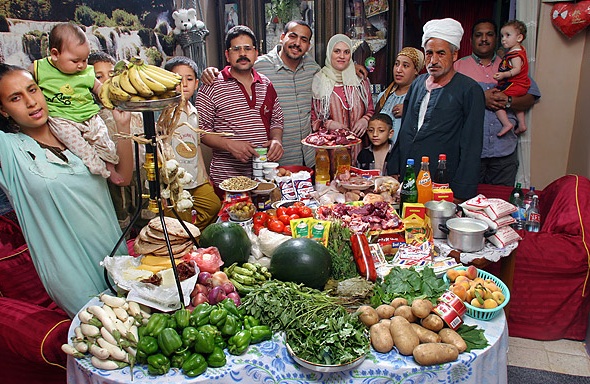
food egypt cairoThe Ahmad Family in Egypt shows us what they eat.

As popular uprisings continue to spread in Middle East, rising food costs for stable crops like rice and wheat cannot be ignored as underlying factors in the political unrest. In a region where Islam and anti-Westernism are usually blamed for driving populist politics, the impact of the global food crisis, combined with rising unemployment, may have surfaced unexpectedly in these countries, but not without warning.

According to Food and Agriculture Organization (FAO), the Arab world imports more than 50 percent of the food consumed and is the largest net importer of cereal in the world, larger than Asia. The same source reports 31 million of hungry people in the Arab countries, which translates to 10 percent of the total population.

Although the disparity in access to food among the 22 countries of the Arab League is wide and uneven, even oil-rich GCC countries are vulnerable. A study by NCB Capital, an offshoot of Saudi Arabia’s largest bank, National Commercial Bank, estimates that food imports account for more than 70 per cent of the total Arab farm imports in 2008.

The agricultural sector accounts for one to four per cent of the GCC’s gross domestic product, significantly lower than its 10–15 per cent contribution in relatively more water-rich Middle East nations such as Egypt and Turkey and 15–20 per cent in India and China.

Reports expect a surge in the food import bill by the GCC nations in the coming years because of investment in overseas farm ventures, the limited agricultural potential at home, low investment in the agricultural sector and rapid growth in the domestic population. This is exacerbated by an absence of unified Arab action to develop agricultural exports while farm subsidies to farmers have decreased as the prices of agricultural inputs have gone up.

In sum, the recent events in North Africa are a reminder that the Arab world is suffering acute food shortage and a future of increased food insecurity. Even the GCC countries are not immune. It would be very difficult to foresee a scenario that would eliminate food insecurity in the Arab countries.

However, as part of a broader regional and global food security plan, improved agricultural techniques would help contain the resulting food insecurity gap. Less than 1% of the value of agricultural production is allocated to scientific research in Arab nations, compared with 2.4% in developed countries. Relevant research into protected agriculture, solar energy for desalinization and greenhouse hydroponics for example have the potential to enhance domestic food self-sufficiency in the GCC countries.

As the Food and Agriculture Organization’s Food Price Index touched its highest level in January, the events of the Middle East are reminders of the urgent need for massive new investment in sustainable agriculture to provide adequate food for all.

More on Middle East-North Africa fragility:
Rising Food Prices Behind Riots in Algeria and Tunisia
Climate Change Killing the First Crops in the Cradle of Civilization
Egypt To Grab Sudanese Land To Meet Its Wheat Needs

Image via 770

Rola Tassabehji
Rola Tassabehjihttp://www.grenea.com
A global citizen, of Lebanese origin, Rola began her career in Unilever Arabia and from there moved into several roles in the marketing/communication function in Unilever, including: Brand Manager Skin Care, Unilever Arabia; Brand Development Manager, Dove, Unilever Africa, Middle East, and Turkey; and Communication Manager for Unilever North Africa and Middle East. After ten years with Unilever, she relocated to Abu Dhabi with her family and joined the team that launched INSEAD Middle East. She is currently working as Marketing Director of a new start-up, Grenea (www.grenea.com), focusing on building sustainable real estate development projects in emerging markets. After working with multi-nationals on skin care and business education, she has found a new interest in the convergence of environmental and social justice and is passionate about the possibilities that a restorative resource-based economy can bring to the people of the Middle East. Email [email protected]

Read More

TRENDING

Regenerative Wool or Greenwashing? Zentera Responds to Critics

Zentera responds to questions about ZQ wool, animal welfare, regenerative farming, ethical fashion and the fallout from PETA's New Zealand investigation.

Dan Zaslavsky’s energy tower dream is rising again in Iran and China

The Energy Tower idea never made the leap from drawings and engineering studies to full-scale construction. But nearly two decades after most people stopped talking about it, the concept is quietly evolving in two unexpected places: China and Iran. The concept let dreamers dream and doers do - figuring out more pleasing designs and engineering.

Tanner Winterhof on the Custom Harvesters Quietly Holding American Agriculture Together

In late January, in a Des Moines hotel ballroom that smelled faintly of diesel and convention coffee, Tanner Winterhof spent three days hosting the members and attendees of the  U.S. Custom Harvesters Inc. annual convention on his podcast as Farm4Profit’s official media partner for the show.

Make Guarapo De Piña (it’s fermented pineapple juice)

In Cuba, guarapo is simply freshly-pressed sugar cane juice, and is drunk on the spot, without waiting for it to ferment. But in Colombia, Venezuela, Peru and Mexico, they homebrew guarapo from pineapples or oranges, and the fragrant fluid sits on the kitchen counter top to ferment until it's bubbly.

Baby teeth read like tree rings paint a picture of toxins in early life

A new study from the Icahn School of Medicine at Mount Sinai in New York offers a striking insight into how the environments we are born into can quietly shape our brains years later. By analyzing naturally shed baby teeth, the ones tucked under pillows for the tooth fairy, researchers have reconstructed a detailed timeline of exposure to environmental metals during pregnancy and early infancy.

Locals From Rishon Fight IKEA

Big Box stores are a pretty new concept in Israel, and thank God that not every Israeli city wants them in their backyard. A word from someone who has see the beautiful farmland around her hometown Newmarket, Ontario stripped and converted into vulgar strip malls of big box shops: they have no place in a healthy and sustainable town or city.

The Jewish National Fund Meets An Inconvenient Truth

According to the JNF, it has transformed thousands of acres of barren land into green forests in Israel. They state that each person emits about 23 tons of carbon per year, estimating that each tree planted can absorb one ton of carbon in its lifetime. That's a whole lot of trees you'd need to be planting. Could so many fit in Israel?

How to quiet noise from construction in your office

Streets need to be resurfaced in New York but the humming and grinding noise is unsettling. Noise is environmental pollution. 

EarthX and a blueprint for sustainable investing

Trammell S. Crow, a Dallas-based businessman and father of four, is focusing his efforts on impact investing, and media that focuses on saving the planet through EarthX.

Mining Afghanistan’s Mineral Discoveries Similar to Avatar

Now that American forces in Afghanistan are commemorating the longest period of any war that America has been involved in, including the 1965-73 Vietnam War, the recent discoveries of large and extremely valuable mineral and metal deposits may finally bring to light a reason to continue the presence of US fighting forces in this war torn and backward country.

From Pilot Plant to Global Stage: How Aduro Clean Technologies’ 2026 Expansion Signals a Turning Point for Chemical Recycling Investors Like Yazan Al Homsi

The company's Next Generation Process (NGP) Pilot Plant in London, Ontario, has officially moved into initial operating campaigns, generating the kind of structured, repeatable data that separates laboratory promise from commercial viability.

Nobul’s Regan McGee on Shareholder Value: “Complacency Is the Silent Killer” 

Why the governance framework designed to protect shareholders so...

Should You Invest in the Private Market?

startustartup Unlike public stock exchanges, which offer daily trading, strict...

Popular Categories