
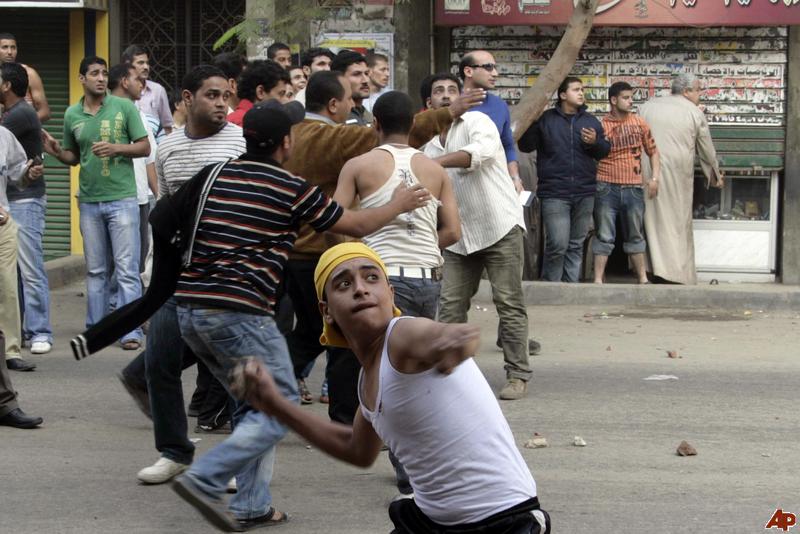

 It started with cotton and oil: the Middle East oppressed now seek freedom and a future. image via AP
The autocratic rule now being challenged in Tunisia, Egypt and elsewhere in the Middle East has its roots in the state system that developed in the region during the twentieth century. This system is based on a political economy that was created largely to expediently transfer resources — principally fossil fuels — from the region to the industrializing world.
It is a system that not only oppresses the populations of the states that were formed but that has had a pivotal role in generating climate change.
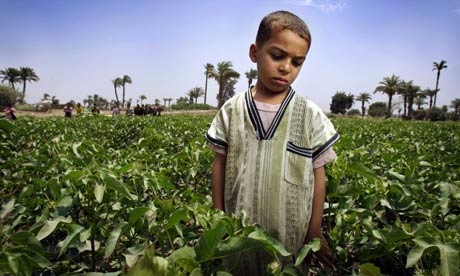 Child labor for cotton, in Egypt. image via the Guardian
This state system in today’s Middle East derives from the European imperial enterprise in the region which had as its objective the acquisition of natural resources — at first cotton and later oil — and strategic assets, including waterways and territorial footholds in Asia and Africa.
These resources and assets would serve both economic and geopolitical objectives that were an integral part of industrialization and European and North American economic expansion from the late eighteenth century onward.
Cotton from the Nile basin would provide much of the raw material needed for English mills during the early years of the Industrial Revolution. Further trade and cultural ties led to an expanding European political and military presence in the region. Britain, France, Russia, Italy and Germany vied for influence and power in the Middle East, which had been ruled for centuries by the Ottoman Empire. By the early twentieth century, rivalries between the European powers gave rise to World War I.
With the fall of the Ottoman Empire as a result of the War, British and French and Italian possessions and spheres of influence in the Middle East enabled these powers to create polities and install ruling elites where none had previously existed to further their economic and other strategic interests.
In the British sphere, sheikdoms, kingdoms and emirates were created in Egypt, Sudan, Oman, Arabia, the Trucial States (now the United Arab Emirates), Palestine, Iraq, Transjordan and Kuwait. In the French sphere parts of Morocco, Algeria, Tunisia, Syria and Lebanon were also allocated to ruling elites whose interests coincided with those of the European powers. Libya was created out of Italian holdings.
The Oil Factor
As a result of the growing industrialization in the West and the need for oil to power it, the Middle East became increasingly important as a source of fossil fuels. With the rise of Arab, Persian and other nationalist opposition to direct rule and colonialism in the first half of the 20th century, alternative forms of control were devised that would grant nominal independence to the inhabitants of the region while insuring the flow of cheap petroleum to the West.
The Western powers entered into a series of mandates, treaties of protection and other agreements with local strongmen and elites. These included tribal, religious and ethnic leaders – the Hashemites (Palestine, Jordan, Iraq), the Saudis (Saudi Arabia), the al-Khalifas (Bahrain), the Abu Saids (Oman), the al-Thanis (Qatar), the al-Sabahs (Kuwait), the Pahlavis (Iran) – as well as economic elites such as the Maronites in Lebanon and military strongmen as in Syria and Egypt to create an array of states – emirates, kingdoms and autocratic republics.
The polities that emerged often lacked any historical continuity or geographical integrity, nor did they conform to social, cultural or linguistic realities. Some ethno-national groups such as the Kurds whose country, Kurdistan, was a distinct socio-cultural entity throughout history were divided by the borders of five newly created states (Turkey, Syria, Iraq, Iran and the former Soviet Union).
No less absurd, a country called Iraq was created out of a mélange of Kurdish, Sunni Arab and Shiite Persian regions.
So, too, the gargantuan country known as Sudan was carved out of a predominantly Arab region in the north onto which an African south was grafted solely so that Britain could have access to the Nile, the rich cotton and other crop lands along it and ultimately the petroleum fields of the South.
Religious and social currents were manipulated and legitimizing creeds created to justify the ascent to power of the various newly-installed elites and their treasuries were infused with royalties paid to them from the petroleum bounty – revenues derived from the sale of black gold, petroleum that was increasingly coveted by the West.
Fossil Fuels for the North
The new elites installed in the Middle East enjoyed European and American (and in the Syrian, Egyptian and the former Yemen Democratic Republic cases, Soviet) patronage and were partnered with Western petroleum companies – Shell (formerly Royal Shell, a mixed Dutch-British concern), British Petroleum (BP) formerly Anglo-Persian), and the American firms Gulf, Texaco, Mobil, Standard of California and Standard of New Jersey.
These and other companies employed a particularly insidious business model that guaranteed exorbitant profits to European and American shareholders and declining revenues to the treasuries of the newly created states. Nationalists and intellectuals contested this system of resource transfer which essentially subsidized the wealthy economies without benefit accruing to the peoples of the region; cycles of unrest, cooptation, and repression ensued.
Only the rulers of these countries, the elites that had been installed by the western government gained from the arrangement. This has led to an enduring anti-Western sensibility among large numbers of inhabitants along with distrust and contempt for the ruling elites.
A Culture of Repression
The dominant political culture in the Middle East over the past six decades has been characterized by authoritarian government, anti-democratic repression, human rights violations, the absence of civil liberties and economic exploitation of masses of citizens and disenfranchised foreign workers.
Tens of millions of people throughout northern Africa, west Asia and the Arabian Peninsula no longer acquiesce to passive acceptance of an inherently unjust system. These people are now demanding to be heard and they are insisting on a fair piece of the future.
As Egypt, Tunisia, Yemen, Jordan and Lebanon – and, one can assume the rest of the region, sooner or later — contend with shifting tides of disaffection on the part of citizens who are unwilling to be objects of abuse and exploitation, a new era is beginning in the region. Not only is justice potentially in the offing for tens of millions of people, but the system that brought climate change – cheap fossil fuels and hyper-capitalization – is tottering.
This in no way guarantees that alternative energy sources and sustainable economic systems will become dominant tomorrow. However, with these new winds of change it is possible that a key link in the world’s carbon addiction may come undone:
The new Middle East might be driven by rulers whose interests are less interested in amassing personal wealth based on oil riches and more on providing for the basic needs of their people.
Read more environment news on Egypt:
Egyptian Energy Crisis Sends Protestors To The Streets
In the Face of “Nile-lessness” Egyptians Protest Water Shortage
What Egyptian Regime Change May Mean for Regional Energy Cooperation
Egypt To Grab Sudanese Land To Meet Its Wheat Needs
21st Century Egypt Powers Two Villages Entirely With Solar Power
Egypt in Top 22 Nations for Renewable Investment Potential


Iraq was created by British colonial officials strictly to accomodate colonial interests in the 1920s. It has nothing to do with historicl Mesopotamia.
As for advocating an apartheid state, you are far off the mark. A democratic Middle East based not on sectarianism but on common challenges and a shared future is what I aspire to.
YG
Iraq has been a country (Mesopotamia) even befoore Moses was born. You will not get your will od dividing your “Hemisphere” into ethnic and sectarion countries to justify an APARTHIED Jewish state