

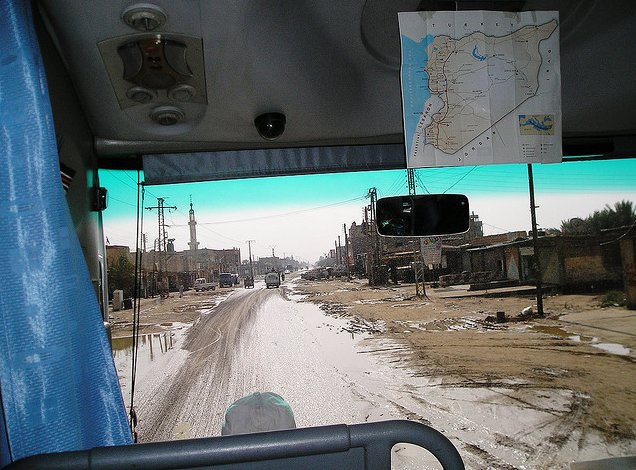
 Natural disasters are expected to rise in the coming years in the Middle East. The UN supplies a quick DIY list of tips to keeping developing communities risk-free from floods.
While it’s not exactly flash flood season in the Middle East, now is the time to prepare: Floods have got bigger, droughts in countries like Syria more intense and threats posed by waterborne diseases a bit too much to handle for poor countries trying to use their limited resources to adapt to a moodier climate. “Money isn’t everything,” Alastair Morrison, of the Stockholm International Water Institute (SIWI), wrote in the latest edition of the think-tank’s quarterly journal. “Many of the most effective water-related adaptation measures are free,” she says. Here is a list, based on some of Morrison’s suggestions and community-based adaptation measures on preventing flood damage.
And the best news, most of the tips can be implemented for free. This is a handy resource for development aids and agencies in poorer Middle Eastern regions.
1. The conventional response is to build levees and walls, and in many instances this was a “practical solution”, Morrison said. If you don’t have the money, you could provide hazard warnings and escape routes or shelters. In a community-based approach in the Philippines, communities learnt how to draw maps to plot the most flood-prone areas and vulnerable communities. These were the first to be warned and evacuated when threatened.
2. Rotate buildings when they are being erected so that a corner points into the flood flow and water is diverted around the structure.
3. Raise buildings on stilts or earth mounds. This is a response rooted in traditional knowledge, Morrison pointed out. “Most houses in south-east Asia used to be raised on stilts, allowing floodwater to pass safely underneath.”
4. Drawing up restrictions doesn’t cost money; impose zoning restrictions and enforce them. “Inappropriate developments – those that block drainage runs, pollute watercourses, and increase rainfall runoff and downstream flooding – must be stopped,” Morrison urged.
5. Press ahead with policy on improving land ownership. “Poor communities are forced to live in dangerous floodplains, on riverbanks and in ravines,” Morrison said. “This is not due to a lack of overall land availability – population densities are still relatively low – but because powerful elites own most of the safe and productive areas.”
Landslides
If you don’t have a budget for concrete retaining walls, plant vetiver grass (Chrysopogon zizanioides), a non-invasive Indian clump grass cultivated for centuries for essential oil. The roots of the grass and its dense undergrowth hold the soil in place, according to the Vetiver Network international.
But, for all risks it would make sense to have a plan to reduce the chance of a disaster, which, of course, costs nothing.
Read more on floods:
Flash Floods in Turkey Signal Global Warming
Cell Phone Towers Predict the Next Big Flood
Flash Floods Cause Havoc in Yemen


[…] year in the Middle East: flash floods come without warning, and are hard to predict (check out our flash flood survival guide), but now Arab scientists at the King Abdullah University of Science and Technology (KAUST) in […]
[…] and floods are on different sides of the same coin, both equally devastating. Pakistan’s cries for help are […]