
Baking Sourdough Bread, Part III (The Recipe)

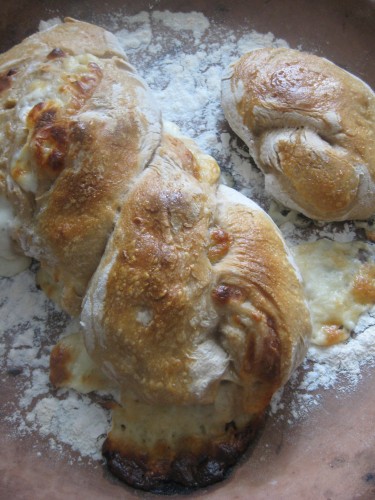
image-sourdough-cheese-breadFinally, the recipe for sourdough bread!

We’ve broken it up in parts, because it’s complicated, but today we’ll put it all together so it’ll makes sense if you’ve been following the parts. Last week we started with making a sourdough starter, and dedicated a whole post on how to care for and feed your sourdough starter (click here). Cutting to the chase, today you get the basic recipe.

SOURDOUGH BREAD, A Basic Recipe
Yield: 1 loaf.

STEP 1. Make a sponge. Time: 8 hours.

Take 1 cup of your active starter, put it into a bowl and to it add 1 cup of flour and 1 of water.

At this point, leave the sponge and feed your starter: 1 cup of flour and 1 cup of water, as in Part II. Leave the refreshed starter out a few hours and then put it away. You can create a bigger starter at any point simply by adding greater quantities of flour/water.

Return to your sponge: mix well, cover, and allow it to proof, that is, ferment and rise, up to  24 hours. The longer it sits, the more sour the resulting dough. Count on 8 hours anyway.

When the sponge is frothy and smells sour, you can proceed to…

STEP 2. Make your dough. Time: 3-4 hours

Take your 2 cups of sponge and to it, add

2 tablespoons of  organic oil or melted butter
4 teaspoons of sugar or honey
2 teaspoons of sea salt
optional: 1 teaspoon baking soda, if you want to reduce the sour tang of fermentation.

Stir well, then start adding flour, 1/2-cup at a time. Knead it vigorously; you will probably use about 3 cups to achieve a dough of good consistency.

Cover the dough with a clean kitchen towel and allow it to rise in a warm place till doubled. Sourdough takes longer to rise than conventional doughs, so expect a wait of 2-3 hours.

Punch the dough down, kneading briefly as usual. Shape a loaf and allow it to rise till double again, on a greased baking sheet. This second rising will take approximately an hour.

STEP 3. Bake. Time: 30-45 minutes.

Preheat the oven to 350° F., 170° C.

Before putting the loaves in the oven, take a very sharp knife, or a razor, and slash the dough in a long line down its length. This is to keep the dough from rising into an unwieldy “flying crown”. Don’t be nervous about cutting too deeply, just apply a little pressure to slash.

Bake for 1/2 hour to 45 minutes. As for the conventionally-leavened loaf, it will be done when the bottom sounds hollow upon thumping. Another way is to insert a clean, dry toothpick into the thickest part of the loaf. If no crumbs cling to the toothpick when you take it out, the loaf is done.

Don’t tear into your hot bread, no matter how tempting – wait till the loaf is cool before slicing. The flavor is best when the loaf has cooled down.

Enjoy, and be proud of your home-made sourdough bread!

Miriam wound up the sourdough series with a useful sourdough schedule. Look for Sourdough Part IV here.

Classic Middle-Eastern recipes on Green Prophet:
Majadra, Lentils and Rice
Muhamarra, a Red Pepper Spread< Baba Ganoush

Miriam Kresh
Miriam Kreshhttps://www.greenprophet.com/
Miriam Kresh is an American ex-pat living in Israel. Her love of Middle Eastern food evolved from close friendships with enthusiastic Moroccan, Tunisian and Turkish home cooks. She owns too many cookbooks and is always planning the next meal. Miriam can be reached at miriam (at) greenprophet (dot) com.

Read More

4 COMMENTS

TRENDING

5 Reasons Why You Should Save Seeds (and plant them)

Saving seeds from tomatoes, peppers, herbs and flowers helps preserve biodiversity, strengthen food security, and keep heirloom varieties alive. Even a small balcony garden can make a difference.

A visit to Amirim, Israel’s first all-vegetarian village in the Galilee

Just 15 kilometers from Tzfat there is a moshav that was founded in the late 50s that was ideologically influenced by organic, vegetarian and vegan principles. My hostess at Ohn-Bar, the tzimmer where I stayed, explained that the people of Amirim were among the pioneers of Israel’s strong vegetarian movement.

What’s in season in June – plus recipes and forager’s notes

Middle Eastern markets are bursting with the color and aromas of summer's soft fruits. This is the guide to getting the most out of June. 

Jailhouse Booze For Home Bootleggers

You don’t have to languish in jail to make Jailhouse Booze. It’s an easy, fun project you can make in your own kitchen, with fruit juice. Old-time jailbirds used to call it Pruno. We also have another, no-waste, alternative wine recipe: Pea Pod Wine.

Make Guarapo De Piña (it’s fermented pineapple juice)

In Cuba, guarapo is simply freshly-pressed sugar cane juice, and is drunk on the spot, without waiting for it to ferment. But in Colombia, Venezuela, Peru and Mexico, they homebrew guarapo from pineapples or oranges, and the fragrant fluid sits on the kitchen counter top to ferment until it's bubbly.

Yerukim Forms a New Green Economy Where the Money is Really Green

The Yerukim members who pick up the recyclables get to keep the monetary reward, the public earns "green" bills that can be used in shops, and business owners get to be associated with environmentalism.

Choosing Riyadh over Dubai? What Investors Should Know

Saudi Arabia is deploying capital at unmatched scale to catalyze tourism and advanced industry while rewiring its power-and-water backbone. The investable frontier is widening—especially in renewables, grid storage, water efficiency/desal retrofits, and hospitality operating platforms. Prudent investors will insist on phased delivery, enforceable KPIs (energy, water, biodiversity), and RHQ/zone compliance—while pricing political-economy and reputational risks alongside growth upside.

Sell your cooking oil for biodiesel money

Want to make money on old french fry oil? Sell it.

Qatar Alternative Energy Summit Pairs Investors And Innovators

Alternative energy investors and innovators can meet n' greet in Doha, Qatar March 16 and 17.

Here’s How To Implement The Four Pillars Of Employee Engagement

If you throw a party for your work team and they are vegans, don't make it a barbecue. Know the sustainability values of your team to boost moral and retain good people.

Locals From Rishon Fight IKEA

Big Box stores are a pretty new concept in Israel, and thank God that not every Israeli city wants them in their backyard. A word from someone who has see the beautiful farmland around her hometown Newmarket, Ontario stripped and converted into vulgar strip malls of big box shops: they have no place in a healthy and sustainable town or city.

The Jewish National Fund Meets An Inconvenient Truth

According to the JNF, it has transformed thousands of acres of barren land into green forests in Israel. They state that each person emits about 23 tons of carbon per year, estimating that each tree planted can absorb one ton of carbon in its lifetime. That's a whole lot of trees you'd need to be planting. Could so many fit in Israel?

How to quiet noise from construction in your office

Streets need to be resurfaced in New York but the humming and grinding noise is unsettling. Noise is environmental pollution. 

Popular Categories