Corruption Plagues Lebanese Environment Movement and Energy Exploration

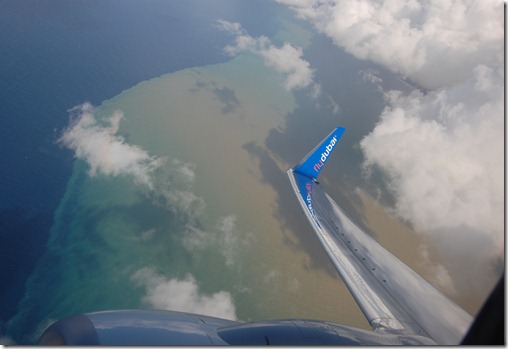
lebanon oil spill from the airIf Lebanese sewage dumping can be seen from the air, it is centainly seen, and smelled on ground level.

Rampant corruption and nepotism among Lebanese government officials is causing a delay in improving the country’s environment, according to the Lebanon Daily Star. The remarks were made by the country’s environment minister, Mohammad Rahhal during a conference ‘The State of the Environment in Lebanese Courts, which was held in Beirut on World Environment Day in May. Mr. Rahhal said: “When we go to the Cabinet to submit plans or legislation we first have to go through the administration – so we go to one office which must have signatories from another office which is then ratified by another department … and so forth.”

Of course, anyone familiar with the way such business is carried on in many parts of the Middle East, cannot be surprised that this is very “par for the course ” in regards to how such matters are dealt with, especially if all kinds of  “vested interests” are involved – especially by local authorities.

According to the local reporter in Lebanon, there is currently no implemental law that can be used to target environmental abusers in Lebanon, with the closest law being Law 444 – the Environmental Protection Framework Law – 2002 which stipulates that all public and private proponents must undertake an environmental assessment for all projects which are likely to affect the environment.

Perhaps this might explain why such environmental abuses such as the huge Sidon garbage mound at the sea are so bad that “it can be smelled long before it can be seen,” and the fact that sewage plants are allowed to dump their waste straight into the sea causing grief and low catches for local Lebanese fishermen.

Despite the Lebanese Prime Minister Saad Hariri wanting to eliminate corruption, this effort may be sooner said than done, due to the tremendous influence the Hezbollah has in Lebanese politics, in which they demand that their own vested interests be dealt with first.

Corruption within Lebanese political circles may also be influencing the country’s energy exploration in the eastern Mediterranean; right now there are disputes over rights to drill in natural gas fields in which the Lebanese claim ownership in gas fields discovered by Israel.

While Israel has a signed agreement with Jordan on the sea border in the Gulf of Eilat, and unwritten agreements with Egypt and the Palestinian Authority, no such agreements have so far been reached with Lebanon.

And with a Lebanese government not able to solve its own environmental problems, due a lot to various political factions not being able to work together.  there is no way that international issues such as rights to oil and natural gas fields in the eastern Mediterranean seabed will be solved any time soon.

More articles on Lebanese environmental issues:

Sidon’s Garbage Mound is Worse Than Just the Smell

Lebanese Garbage Trucks Dump Directly into the Sea

Lebanese Environment Inaction May Affect Entire Region

Maurice Picow
Maurice Picowhttps://www.greenprophet.com/
Maurice Picow grew up in Oklahoma City, U.S.A., where he received a B.S. Degree in Business Administration. Following graduation, Maurice embarked on a career as a real estate broker before making the decision to move to Israel. After arriving in Israel, he came involved in the insurance agency business and later in the moving and international relocation fields. Maurice became interested in writing news and commentary articles in the late 1990’s, and now writes feature articles for the The Jerusalem Post as well as being a regular contributor to Green Prophet. He has also written a non-fiction study on Islam, a two volume adventure novel, and is completing a romance novel about a forbidden love affair. Writing topics of particular interest for Green Prophet are those dealing with global warming and climate change, as well as clean technology - particularly electric cars.

Read More

TRENDING

Mona Khalil, Orange House Project founder, sea turtle protector killed in Lebanon

Mona Khalil spent decades protecting Lebanon's sea turtles and coastal ecosystems. Her death in the ongoing conflict between Israel and Hezbollah shines a light on a broader environmental tragedy unfolding across northern Israel and southern Lebanon. From damaged wetlands and disrupted bird migrations to threatened seed banks and endangered wildlife, the region's ecosystems are becoming casualties of a war with no clear end in sight.

Self-repairing contact lenses and desalination membranes that fix themselves?

Could the humble contact lens become a sustainability breakthrough? Researchers in Korea have developed a self-healing hydrogel lens that repairs scratches with just one hour of UV light exposure. Beyond reducing waste from disposable contacts, the technology could one day help extend the life of solar panels, water filtration systems, and other plastic-based products.

Dan Zaslavsky’s energy tower dream is rising again in Iran and China

The Energy Tower idea never made the leap from drawings and engineering studies to full-scale construction. But nearly two decades after most people stopped talking about it, the concept is quietly evolving in two unexpected places: China and Iran. The concept let dreamers dream and doers do - figuring out more pleasing designs and engineering.

A visit to Amirim, Israel’s first all-vegetarian village in the Galilee

Just 15 kilometers from Tzfat there is a moshav that was founded in the late 50s that was ideologically influenced by organic, vegetarian and vegan principles. My hostess at Ohn-Bar, the tzimmer where I stayed, explained that the people of Amirim were among the pioneers of Israel’s strong vegetarian movement.

Israeli Hydrogen Startup H2Pro Are Trying to Solve Clean Energy’s Hardest Problem

The company has attracted backing from major investors including Breakthrough Energy Ventures, the climate fund founded by Bill Gates, along with industrial partners such as Sumitomo, ArcelorMittal, and Temasek, a multi-billion dollar company that owns Singapore airlines. H2Pro has raised more than $100 million USD and is moving from pilot projects toward commercial-scale deployments.

Yerukim Forms a New Green Economy Where the Money is Really Green

The Yerukim members who pick up the recyclables get to keep the monetary reward, the public earns "green" bills that can be used in shops, and business owners get to be associated with environmentalism.

Choosing Riyadh over Dubai? What Investors Should Know

Saudi Arabia is deploying capital at unmatched scale to catalyze tourism and advanced industry while rewiring its power-and-water backbone. The investable frontier is widening—especially in renewables, grid storage, water efficiency/desal retrofits, and hospitality operating platforms. Prudent investors will insist on phased delivery, enforceable KPIs (energy, water, biodiversity), and RHQ/zone compliance—while pricing political-economy and reputational risks alongside growth upside.

Sell your cooking oil for biodiesel money

Want to make money on old french fry oil? Sell it.

Qatar Alternative Energy Summit Pairs Investors And Innovators

Alternative energy investors and innovators can meet n' greet in Doha, Qatar March 16 and 17.

Here’s How To Implement The Four Pillars Of Employee Engagement

If you throw a party for your work team and they are vegans, don't make it a barbecue. Know the sustainability values of your team to boost moral and retain good people.

Locals From Rishon Fight IKEA

Big Box stores are a pretty new concept in Israel, and thank God that not every Israeli city wants them in their backyard. A word from someone who has see the beautiful farmland around her hometown Newmarket, Ontario stripped and converted into vulgar strip malls of big box shops: they have no place in a healthy and sustainable town or city.

The Jewish National Fund Meets An Inconvenient Truth

According to the JNF, it has transformed thousands of acres of barren land into green forests in Israel. They state that each person emits about 23 tons of carbon per year, estimating that each tree planted can absorb one ton of carbon in its lifetime. That's a whole lot of trees you'd need to be planting. Could so many fit in Israel?

How to quiet noise from construction in your office

Streets need to be resurfaced in New York but the humming and grinding noise is unsettling. Noise is environmental pollution. 

Popular Categories