
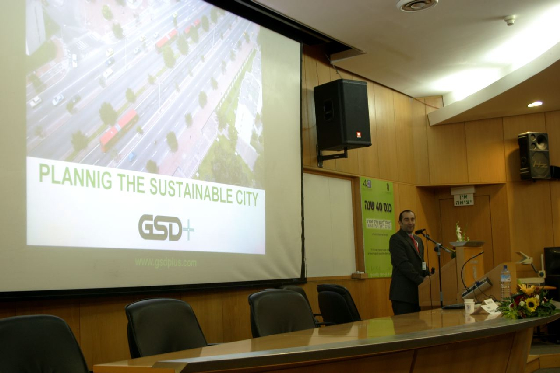

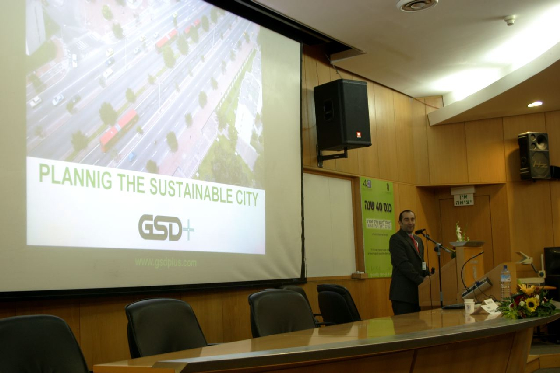
Mr. Oscar Diaz Inspires Israeli Planners to Build For People, Not Cars.
We promised to bring more news from the Technion-Israel’s Institute of Technology, where the Center for Urban and Regional Studies’ 40th anniversary conference was held yesterday, 3rd June 2010. After brief greetings from representatives of The Center for Urban & Regional Studies, the Urban and Regional Planning Program, and the Municipality of Haifa. And after the Technion’s President and the Dean of the Faculty of Architecture also gave brief introductions, the keynote lecturer Professor Dani Shefer introduced Oscar Edmundo Diaz.
Partner of the consulting firm GSD+ and formerly Senior Program Director at the Institute for Transportation and Development Policy and Senior Advisor to the City Mayor of Bogota, Diaz addressed the Israeli Planning audience about successful methods for planning a sustainable city.
Children Come First in Sustainable Cities
Though as a shout out to the concentration of Israel’s urban planning experts he acknowledges his background is in Finance and International Affairs this does not diminish his experience. Mr. Diaz helped Bogota’s mayor transform the city from a crime ridden city full of illegal slums, to a city with less crime, less congestion and pollution, and more public spaces. He tells us how.
Diaz showed pictures of some of Bogota’s filthy, hilly slums with raw sewage running through the streets. Among other things, these images depict that even the most destitute neighborhoods reserve space for children to play. This is important, according to Diaz, because children are important. In fact, he would argue that children are the most important members of any society. As a result, the government of Bogota built 51 new schools in and around the poorest neighborhoods. They built swimming pools and community centers, as well as libraries, all to emphasize that learning, rather than shopping, should receive preferential treatment.
Cars come last in sustainable cities
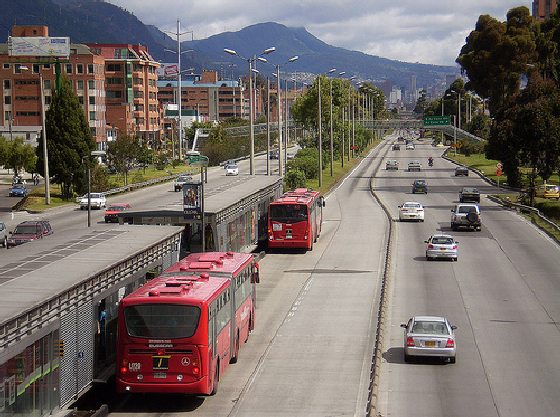
Another key to urban planning, he says, is to prioritize people, rather than cars. Most cities are built for cars: cars parked on sidewalks that often lead to nowhere and putting pedestrians at risk, and parking lots usurping what should be vibrant public space. And it doesn’t help to keep building roads, he says, since a surplus of roads will encourage more cars.
To illustrate his point, he showed images of construction projects in Tel Aviv that cause traffic bottlenecks. “Traffic actually helps us,” says Diaz to a crowd of chuckling motorists, because when getting to work by car is slow and tedious, then commuters will be encouraged to park their cars and use public transport instead.
City planners make the change
In a personal interview, we discussed the necessity of shifting public perception away from cars and towards public transportation and bicycles. Diaz suggested that the impetus lies with planners to create that shift. He also explained that if a city treats its citizens roughly, then they will act in kind. Everybody knows that Israeli bus drivers can be unfriendly and rough. If they’re rough, because their schedules are tight and their conditions are unpleasant, then that attitude will ripple among the people.
On the other hand, if the people are treated respectfully, and the system is bike and bus friendly, then the people will gladly keep pace. I asked him if it would be impossible to shift the Israeli mentality. Diaz replied that “everybody says that,” but it’s not true: given the right infrastructure, any city can embrace a better quality of life with less cars.
Biking Is Best for Sustainable Cities
Diaz spoke at great length about making cities more bicycle friendly. He noted that 33% of Copenhagen’s population commutes by bicycle, though officials aim for 50%, and it doesn’t matter what the weather is like. Diaz showed images of committed cyclists riding to work in the snow.
Although only 5% of Bogota’s residents commute by bike, that amounts to 350,000 citizens who forsake their cars to enjoy 350km of bicycle path. And yes, Mr. Diaz rides to work every day.
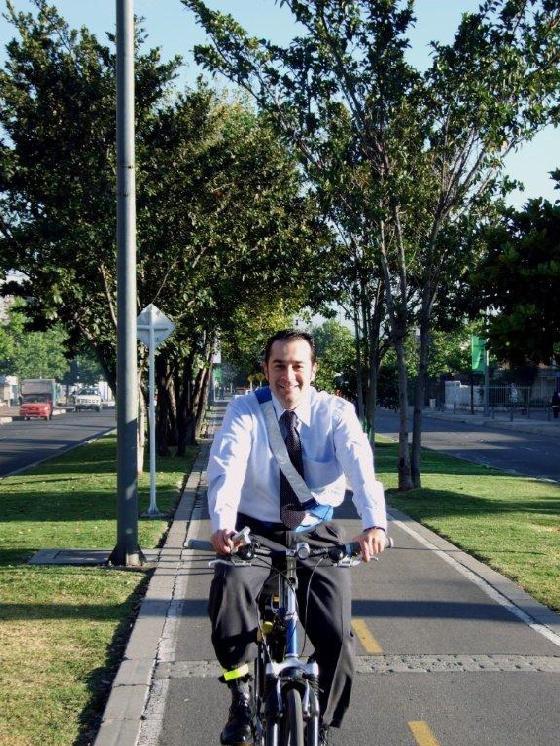
After his lively presentation, which drew plenty of applause, Diaz was given a professional tour of the Technion’s visitor center, and met with Ricardo, Karen, and Michael, all students from Colombia. They shared their personal histories and academic ambitions with Mr. Diaz, whose commitment to a quality and sustainable life for everybody makes him a role model for all students.
More on Sustainable Urban Planning:
Jordanian Sustainable Building Conference Encourages Everyone to Think Green
Calling all Young Architects and Grad Students to Join ECOWEEK 2010
Construction Underway on Rawabi, First Planned Palestinian City



First, thanks to the Prophet and Tafline for such wonderful coverage of our conference.
Second, my personal favorite line from Oscar’s talk (may be paraphrasing here), “I don’t know of a single country’s constitution that guarantees citizens the right to free parking.”
Third, can anyone photoshop an “n” into that first picture?!
Cheers.