
The Limits of Growing Biofuel Crops on a Desert Island

Quick, name the scarcest natural resources in Israel. I’m sure that “land” and “water” would feature prominently in most people’s answers.

Israel is, to all intents and purposes, a “desert island’, with finite – very finite – natural resources. Not your romantic desert island, and not an island geographically, but rather politically. Not a desert entirely, but dominated by arid lands, and with much of the rest what might be considered recovering or rehabilitated. Some of that is again under threat from various forces, mainly driven by economic and political factors, population growth and lifestyle.

So, while there have been few serious proposals for converting Israeli agricultural production to bio-fuel crop production, would it in theory make sense to ever do so?

Not if one applies the understandings shared by noted German economist Hans Werner Sinn in this Jerusalem Post article. The president of the Ifo Institute for Economic Research was visiting Israel last week to give the D.B. Doran Lecture on Population, Resources and Development at the Hebrew University of Jerusalem lecturing about the problems of land use for biofuel.

According to Sinn:

In much of the world, bio-fuels are produced from food crops using vast amounts of land, Sinn explained, which means that energy and food are now competing for the same space and resources. That hasn’t happened since the Middle Ages, when energy meant horses to ride or pull things, and they needed hay to eat.

The Industrial Revolution introduced coal as an energy source and freed up land to be planted for food. The major population boom that occurred in the years since can be traced to that shift. At the dawn of the industrial age, there were approximately 600 million people in the world, he said.

“And now there are seven billion, which means that linking the cost of energy and the cost of food is much more problematic. Food riots in 2007 and 2008 can be attributed to the rapid increase in bio-fuel production, particularly in America,” he told the Post.

[…]

“If one would replace just the energy needed for transportation, which is one fifth of the energy man uses, we would need the total acreage of the world planted as bio-fuel crops,” he pointed out.

Referring specifically to Israel, the article concluded:

Israeli scientists are working on energy crops that are not food crops and that can thrive on marginal land. While Israel still lacks the great swaths of land needed to grow energy crops, the technology will be marketed worldwide.

Given the momentum behind the conversion to bio-fuels, perhaps it’s time for Israel to draw up a set of “acceptable use” guidelines for production, e.g.:

  • Prime agricultural land not to be used for bio-fuel production, which should instead be limited to marginal lands
  • Crops should not be water intensive, i.e. require irrigation (no field crops)
  • Make use of agricultural waste, where this cannot be returned to the land
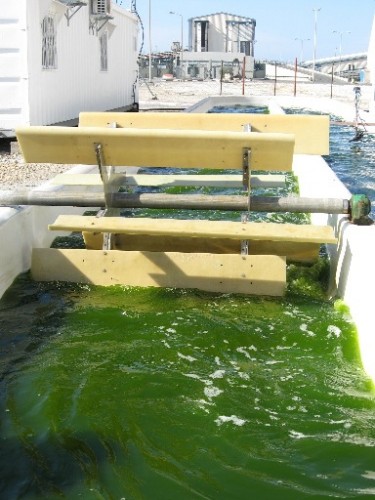
  • Focus on innovative technologies. Think algae rather than fibre or bulk.

At a more philosophical level, we need to get away from the mindset (driven by the oil or energy industry) that energy consumption will continue at existing or higher levels, and that this insatiable demand needs to be met somehow. Instead, we should focus on energy conservation (both active and passive, e.g. green building technologies), truly renewable energy sources and a massive shift away from private to public transport. In a nutshell, shifting to simply living in a more sustainable way; supporting the changes that millions of individuals, companies and (especially) the lower tiers of government worldwide have begun making in their lives and day-to-day operations.

The “desert island” need not and should not become a factory farm for producing bio-fuel.

Photo:www.seambiotic.com

:: Top economist: Bio-fuels may lead to land shortages

Read more on biofuel:

Kaiima Doubles Chromosomes To Make More Plant Power
Biofuels Spark Regional Cooperation Between Israel, Palestinians and Germany
Algae Into Biofuel a Greener Story In $10 Million Joint Israeli and Chinese Project
German Firm to Invest in Green Israeli Jet Fuel From Algae


Russel Cohen
Russel Cohenhttp://blog.maskil.info
Russell became interested in the intersection between Judaism, Zionism and the environment as a teenager in the 70s, reinforced by a year as a kibbutz volunteer in the early 80s. That interest took a back seat to the need to earn a living, and he spent the next several decades in corporate IT with one of the Big 4 banks in South Africa. He has returned to his first love by writing on Jewish affairs, the environment and technology as a blogger and freelance writer, while also providing support to small office/home office (SOHO) computer users. He writes under the screen name Maskil and tries to collect his thoughts here (http://blog.maskil.info). Russell lives in the urban village of Norwood in Johannesburg with his wife and daughter. Russell can be reached at russell (at) greenprophet (dot) com.

Read More

TRENDING

Dan Zaslavsky’s energy tower dream is rising again in Iran and China

The Energy Tower idea never made the leap from drawings and engineering studies to full-scale construction. But nearly two decades after most people stopped talking about it, the concept is quietly evolving in two unexpected places: China and Iran. The concept let dreamers dream and doers do - figuring out more pleasing designs and engineering.

A visit to Amirim, Israel’s first all-vegetarian village in the Galilee

Just 15 kilometers from Tzfat there is a moshav that was founded in the late 50s that was ideologically influenced by organic, vegetarian and vegan principles. My hostess at Ohn-Bar, the tzimmer where I stayed, explained that the people of Amirim were among the pioneers of Israel’s strong vegetarian movement.

Can Scientists Predict Coral Bleaching Before It Happens?

Now researchers at the Woods Hole Oceanographic Institution (WHOI) in the US say they have developed a way to predict coral bleaching five to six months before it occurs, potentially giving reef managers enough time to intervene and save vulnerable corals.

Israeli Hydrogen Startup H2Pro Are Trying to Solve Clean Energy’s Hardest Problem

The company has attracted backing from major investors including Breakthrough Energy Ventures, the climate fund founded by Bill Gates, along with industrial partners such as Sumitomo, ArcelorMittal, and Temasek, a multi-billion dollar company that owns Singapore airlines. H2Pro has raised more than $100 million USD and is moving from pilot projects toward commercial-scale deployments.

AC Water Uses: How to Reuse Air Conditioner Condensate Water for Plants, Cleaning and Water Conservation

That means the water dripping from your air conditioner may already be usable for gardening, cleaning, flushing toilets, topping up humidifiers, or cooling systems — instead of disappearing into the sewer. A new study. Is it safe?

Locals From Rishon Fight IKEA

Big Box stores are a pretty new concept in Israel, and thank God that not every Israeli city wants them in their backyard. A word from someone who has see the beautiful farmland around her hometown Newmarket, Ontario stripped and converted into vulgar strip malls of big box shops: they have no place in a healthy and sustainable town or city.

The Jewish National Fund Meets An Inconvenient Truth

According to the JNF, it has transformed thousands of acres of barren land into green forests in Israel. They state that each person emits about 23 tons of carbon per year, estimating that each tree planted can absorb one ton of carbon in its lifetime. That's a whole lot of trees you'd need to be planting. Could so many fit in Israel?

How to quiet noise from construction in your office

Streets need to be resurfaced in New York but the humming and grinding noise is unsettling. Noise is environmental pollution. 

EarthX and a blueprint for sustainable investing

Trammell S. Crow, a Dallas-based businessman and father of four, is focusing his efforts on impact investing, and media that focuses on saving the planet through EarthX.

Mining Afghanistan’s Mineral Discoveries Similar to Avatar

Now that American forces in Afghanistan are commemorating the longest period of any war that America has been involved in, including the 1965-73 Vietnam War, the recent discoveries of large and extremely valuable mineral and metal deposits may finally bring to light a reason to continue the presence of US fighting forces in this war torn and backward country.

From Pilot Plant to Global Stage: How Aduro Clean Technologies’ 2026 Expansion Signals a Turning Point for Chemical Recycling Investors Like Yazan Al Homsi

The company's Next Generation Process (NGP) Pilot Plant in London, Ontario, has officially moved into initial operating campaigns, generating the kind of structured, repeatable data that separates laboratory promise from commercial viability.

Nobul’s Regan McGee on Shareholder Value: “Complacency Is the Silent Killer” 

Why the governance framework designed to protect shareholders so...

Should You Invest in the Private Market?

startustartup Unlike public stock exchanges, which offer daily trading, strict...

Popular Categories