Monkey love: When Females Rule fornication, Mother Earth Delights

Can humans learn from their primate cousins about sex and the stewardship of the planet?

From the world of science comes data that suggests males who share are more likely to copulate, and with greater frequently, than their stingier counterparts.

Granted, the males in this study were of the chimp variety, and what they were sharing was raw meat, however, the researchers point out that this study lays the foundation for future human studies. (Chimpanzees exchange meat for sex, study shows)

Before any homo sapiens dismiss these results as monkey business, remember that we share upwards of 97-99% of our genetic code with our lower primate cousins, chimpanzees being just one of them. And we all know that sex is subject to the same forces of nature vs. nurture as just about every aspect of the human condition.

Besides, animal behavior can teach us much about ourselves. If we combine this recent data on chimp sharing with what we know about another species – the Bonobos to be exact – there’s an intriguing question to be asked.

It might not seem close to the Middle East culture, but what would our planet be like if females ruled fornication?

Sex and the Stewardship of Mother Earth

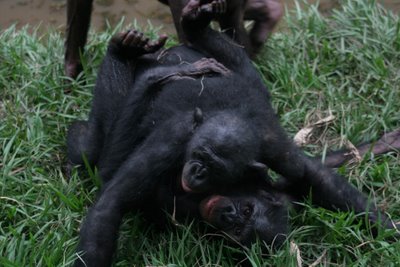
The answer to that question may be as close as your nearest zoo. Those who study primates point to the unique sexual behavior of this species. Once upon a time, they were called ‘pygmy chimps’ because they resemble small chimpanzees. And like the chimps, they share 98% of their DNA with humans. But the bonobos have a exceptional social structure and method for keeping the peace.

First, theirs is a matriarchal society, which means to ladies lead the pack, and second, they have sex. Lots of it.

The bonobos have found the solution to world peace. It’s called love. Whenever there is a dispute, they resolve it with a good bout of nooky. A bit of masturbation here, a little tickle where it feels really good there, and soon enough the tension is relieved. Have a problem? Not after you’ve had sex, bonobo style.

And if you have any doubt about female satisfaction, rest assured that these apes know how to swing. Wink wink, nod nod, grunt grunt, sigh. In fact, in their natural habitats, Bonobos have rarely demonstrated hostile or violent behaviors towards another.

Now we are not suggesting that we become a matriarchal society (although some balance is still very much in order around the world), nor are we suggesting that world leaders start mounting each other at summits for peace. That just is too strange for our imaginations. But don’t you agree that we can learn something here?

Mother Earth is suffering from our mistreatment. Her waters run foul, her air breathes heavy, and her children live in fear of mutual annihilation. Those of us in the Middle East know particularly well the problems we face, and the relationship between peace and the environment. As much as nature knows no boundaries, perhaps challenging our own views on sexual morays may also benefit humankind?

In a previous column (Polyamory and sex could save the planet, author argues) we discussed how characteristics of sexually open relationships – sharing and resource allocation – may hold one key to redirecting our current, environmentally unconscious course. Now, in this post, we ask readers to consider what our primate friends may have to teach us on the topic.

Because we have a sneaky suspicion that if the bonobos could talk to us, they’d tell us this: you can’t have too much (age-appropriate, consensual, mutually satisfying) sex, but you can (and do), have too much war.

“Their sexual behavior is too human like for most of us to be comfortable with…”

Watch Susan Savage-Rumbaugh talk about her work with bonobos on a TED talk:

[youtube width=”560″ height=”400″]http://www.youtube.com/watch?v=a8nDJaH-fVE[/youtube]

Tinamarie is a regular contributor to Greenprophet.com. Follow her @ModernLoveMuse. She blogs at www.tinamariebernard.com.


Tinamarie Bernard
Tinamarie Bernardhttps://www.greenprophet.com/
Tinamarie combines her interests in two of her favorite topics – relationships and the environment – for Greenprophet.com. As our eco-sexpert, she explores ways to make our personal lives more sustainable, whether it’s between a couple, the sheets or our ears. While eco-sexuality is a new term and still unfamiliar to many, being conscious about what we use in moments of intimacy is connected to better stewardship of the planet. The idea that green is sexy and sex can be green is one she is thoroughly enjoying discovering. This married mom of two also believes we owe it to our children to teach them to love themselves, each other, and the environment for futures to come. Intimacy isn’t something we are born knowing. Neither is good stewardship of the earth. In her spare time, she muses about sacred sexuality, conscious love, intimacy, feminism and parenting as the top-rated Modern Love column for Examiner.com and several other media outlets. She composes poetry (mostly in her heart), mediates (when time allows), rides horses in the Galilee, and searches for delicious parve dessert recipes. She considers chocolate a righteous sin, and won’t give up a single pair of red shoes. You can find her on Facebook, follow her on twitter @ModernLoveMuse, or send her an email at tinamarie (at) greenprophet.com.

Read More

3 COMMENTS

TRENDING

Self-repairing contact lenses and desalination membranes that fix themselves?

Could the humble contact lens become a sustainability breakthrough? Researchers in Korea have developed a self-healing hydrogel lens that repairs scratches with just one hour of UV light exposure. Beyond reducing waste from disposable contacts, the technology could one day help extend the life of solar panels, water filtration systems, and other plastic-based products.

Collecting kinetic energy from roads; REPS turns traffic into a power plant

REPS announced a $23.6M equity financing round to scale...

Baby teeth read like tree rings paint a picture of toxins in early life

A new study from the Icahn School of Medicine at Mount Sinai in New York offers a striking insight into how the environments we are born into can quietly shape our brains years later. By analyzing naturally shed baby teeth, the ones tucked under pillows for the tooth fairy, researchers have reconstructed a detailed timeline of exposure to environmental metals during pregnancy and early infancy.

Married People Have Lower Cancer Risk, But the Reason is Complex

According to the research, cancer risk was 68% higher in never-married men and 85% higher in never-married women.

Saving Gourmet Wild Plants For The Future

Think of truffles, a gourmet wild food. The European...

Yerukim Forms a New Green Economy Where the Money is Really Green

The Yerukim members who pick up the recyclables get to keep the monetary reward, the public earns "green" bills that can be used in shops, and business owners get to be associated with environmentalism.

Choosing Riyadh over Dubai? What Investors Should Know

Saudi Arabia is deploying capital at unmatched scale to catalyze tourism and advanced industry while rewiring its power-and-water backbone. The investable frontier is widening—especially in renewables, grid storage, water efficiency/desal retrofits, and hospitality operating platforms. Prudent investors will insist on phased delivery, enforceable KPIs (energy, water, biodiversity), and RHQ/zone compliance—while pricing political-economy and reputational risks alongside growth upside.

Sell your cooking oil for biodiesel money

Want to make money on old french fry oil? Sell it.

Qatar Alternative Energy Summit Pairs Investors And Innovators

Alternative energy investors and innovators can meet n' greet in Doha, Qatar March 16 and 17.

Here’s How To Implement The Four Pillars Of Employee Engagement

If you throw a party for your work team and they are vegans, don't make it a barbecue. Know the sustainability values of your team to boost moral and retain good people.

Locals From Rishon Fight IKEA

Big Box stores are a pretty new concept in Israel, and thank God that not every Israeli city wants them in their backyard. A word from someone who has see the beautiful farmland around her hometown Newmarket, Ontario stripped and converted into vulgar strip malls of big box shops: they have no place in a healthy and sustainable town or city.

The Jewish National Fund Meets An Inconvenient Truth

According to the JNF, it has transformed thousands of acres of barren land into green forests in Israel. They state that each person emits about 23 tons of carbon per year, estimating that each tree planted can absorb one ton of carbon in its lifetime. That's a whole lot of trees you'd need to be planting. Could so many fit in Israel?

How to quiet noise from construction in your office

Streets need to be resurfaced in New York but the humming and grinding noise is unsettling. Noise is environmental pollution. 

Popular Categories