
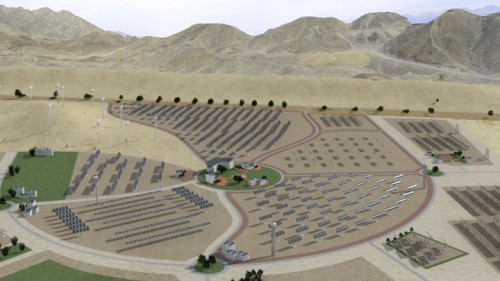

 Artistic rendition of the Timna Renewable energy park In Eilat
During a speech at the recent 2009 Israel Presidents Conference, Prime Minister Netanyahu remarked that Israel is embarking on programs to enable it to be almost entirely reliant on alternative energy systems by the year 2020. This plan, which many people see as more of a visionary dream (because Israel won’t even be able to curb its greenhouse gases by 2030), may be much closer to becoming reality following the upcoming Eilat-Eilot Renewable Energy Conference, scheduled to take place in Israel’s southernmost city on February 16-18, 2010.
In fact, the very theme of the upcoming conference, sponsored by the Eilat Eilot Renewable Energy Authority, may make it one of the most important of its kind as it will also include the inauguration of a special 200 MW Timna Renewable Energy Park, a center for the development of renewable energy projects.
The Authority is planning to unveil a model for solving the world’s energy shortages that it hopes will be adopted by governments worldwide. Noam Ilan head of business development for the Eilat region, was quoted as saying that “Israel has become known throughout the world as a clean energy powerhouse and the country’s technological and governmental accomplishments in this industry will be on full display at the upcoming event.”
The model that Ilan and other members of the Renewable Energy Authority are working on will be composed of a number of factors, including raising renewable awareness and education, combined with research and development, commercialization of technology, energy conservation, and the production of energy from renewable resources.
The above mentioned Timna Renewable Park, when completed will include two 50 MW solar thermal terminals, a hybrid solar thermal project, a desalination plant, and a solar turbine power plant the will produce energy from municipal waste. Producing energy from sewage is already being worked on as a pilot by an Israeli company, Applied Clean Tech, in partnership with an American bio tech company, Qteros. The Center at Timna will receive half of its financing from the Israeli government, amounting to around $14 million.
More than 2,000 people are expected to attend the conference, including former US Ambassador to Israel Richard Jones, who is now the Deputy Executive Director of the International Energy Agency; Michael Peevey, President of California Public Utility Commission and Dr. Hermann Scheer, General Chairman of the World Council for Renewable Energy.
With the idea of attracting investors and entrepreneurs in the projects that will be on display during the conference, the meet will provide new Israeli energy technology companies with a platform to present their innovations to the delegates who will be attending. The Eilat Eilot Regional Energy Authority, the conference hosts, hope to be able to produce 100% of their regions energy from renewable sources within the next ten years. Will you be there?



[…] The 2010 Eilat Eilot Renewable Energy Conference Looks To Carbon New Eilat-Eilot Clean Tech Center May Boost Solar And Wind Energy Eilat to Host Major International Energy Conference AKPC_IDS += "40504,"; […]
[…] southernmost city of Eilat, which hosts the annual Eilat Eilot Renewable Energy Conference, will now get a further renewable energy boost by receiving a concession to build a new renewable […]
[…] generation without disrupting the desert ecosystem. One example of such an approach is the planned Timna Renewable Energy Park, which is slated to be built on degraded lands once used for copper mining. AKPC_IDS += […]
[…] about zigzags in government policy and bureaucratic obstacles, the mood at the third annual Eilat-Eilot International Energy Conference & Exhibition seemed upbeat during Day 1 of the three-day event, which opened in Eilat on Tuesday. The CEO of […]
[…] made its announcement to coincide with the beginning of the 2010 Eilat-Eilot Renewable Energy Conference, scheduled to open in Israel’s southernmost city next […]
[…] Banet, a co-chair of the upcoming Eilat-Eilot Renewable Energy Conference, tells ISRAEL21c that she hopes the conference will help Israel to color itself greener at home, […]
Regardless of the response to answering society’s need for sustainable energy, the problem of nuclear waste is one that will not go away. Presently, hundreds of temporary storages hold spent fuel at densities that approach those in reactor cores, creating a high potential for radioactive leakage and terrorist attack. About 500,000 tons of the depleted uranium, which could be a major resource of nuclear energy, is now being managed as waste. A process to safely convert the most hazardous waste products of industrial society (carbon dioxide, plutonium and depleted uranium) into high energy density fuel (20,000kWh/g vs. oil’s 0.01kWh/g or solar flux 0.2kW/m2), pioneered by a small California company, will significantly reduce global warming and the threat of nuclear terrorism. In addition, a test facility that employs no fissionable material could be used to analyze the key design parameters. The process, involving a sub-critical reactor and a proliferation-resistant fuel cycle without uranium enrichment or separation actinides from rare earths, will avoid keeping the mobile fission fragments restrained in the fuel elements, which is an innovative strategy used to monitor and control the reactor. Control systems that included some aspects of this design were tested in the mid 1980s and demonstrated that uses of electrical properties of actinide dioxide could lead to essential improvement of current reactors. Since the Seebeck coefficient for uranium oxide is three times greater than the best thermoelectric material, actinide oxides could be used as a part of the fission electrical fuel element from which either a direct or alternating current may be obtained.
Regardless of the response to answering society’s need for sustainable energy, the problem of nuclear waste is one that will not go away. Presently, hundreds of temporary storages hold spent fuel at densities that approach those in reactor cores, creating a high potential for radioactive leakage and terrorist attack. About 500,000 tons of the depleted uranium, which could be a major resource of nuclear energy, is now being managed as waste. A process to safely convert the most hazardous waste products of industrial society (carbon dioxide, plutonium and depleted uranium) into high energy density fuel (20,000kWh/g vs. oil’s 0.01kWh/g or solar flux 0.2kW/m2), pioneered by a small California company, will significantly reduce global warming and the threat of nuclear terrorism. In addition, a test facility that employs no fissionable material could be used to analyze the key design parameters. The process, involving a sub-critical reactor and a proliferation-resistant fuel cycle without uranium enrichment or separation actinides from rare earths, will avoid keeping the mobile fission fragments restrained in the fuel elements, which is an innovative strategy used to monitor and control the reactor. Control systems that included some aspects of this design were tested in the mid 1980s and demonstrated that uses of electrical properties of actinide dioxide could lead to essential improvement of current reactors. Since the Seebeck coefficient for uranium oxide is three times greater than the best thermoelectric material, actinide oxides could be used as a part of the fission electrical fuel element from which either a direct or alternating current may be obtained.
Regardless of the response to answering society’s need for sustainable energy, the problem of nuclear waste is one that will not go away. Presently, hundreds of temporary storages hold spent fuel at densities that approach those in reactor cores, creating a high potential for radioactive leakage and terrorist attack. About 500,000 tons of the depleted uranium, which could be a major resource of nuclear energy, is now being managed as waste. A process to safely convert the most hazardous waste products of industrial society (carbon dioxide, plutonium and depleted uranium) into high energy density fuel (20,000kWh/g vs. oil’s 0.01kWh/g or solar flux 0.2kW/m2), pioneered by a small California company, will significantly reduce global warming and the threat of nuclear terrorism. In addition, a test facility that employs no fissionable material could be used to analyze the key design parameters. The process, involving a sub-critical reactor and a proliferation-resistant fuel cycle without uranium enrichment or separation actinides from rare earths, will avoid keeping the mobile fission fragments restrained in the fuel elements, which is an innovative strategy used to monitor and control the reactor. Control systems that included some aspects of this design were tested in the mid 1980s and demonstrated that uses of electrical properties of actinide dioxide could lead to essential improvement of current reactors. Since the Seebeck coefficient for uranium oxide is three times greater than the best thermoelectric material, actinide oxides could be used as a part of the fission electrical fuel element from which either a direct or alternating current may be obtained.
Green Prophet » The 2010 Eilat Eilot Renewable Energy Conference … http://bit.ly/1b32Lv
Alt Energy News: Green Prophet » The 2010 Eilat Eilot Renewable Energy Conference … http://bit.ly/3Nozew
Green Prophet » The 2010 Eilat Eilot Renewable Energy Conference … http://bit.ly/1VAuwo
Green Prophet » The 2010 Eilat Eilot Renewable Energy Conference … http://bit.ly/oJGsN
Green Prophet » The 2010 Eilat Eilot Renewable Energy Conference …: During a speech at the recent 2009 Israel.. http://bit.ly/1pcVWg
Green Prophet » The 2010 Eilat Eilot Renewable Energy Conference … http://bit.ly/1iBTrW
The 2010 Eilat Eilot Renewable Energy Conference Looks To Carbon-Free Energy: Green Prophet (blog)
The Eilat Ei.. http://bit.ly/4GEPG8
Environmentalist: The 2010 Eilat Eilot Renewable Energy Conference Looks To Carbon-Free Energy – Green Prophet .. http://bit.ly/4kjFGA
Green Prophet » The 2010 Eilat Eilot Renewable Energy Conference … http://bit.ly/4pfx41
Green Prophet » The 2010 Eilat Eilot Renewable Energy Conference …: Middle East environment news covering reg.. http://bit.ly/1KvmNp