
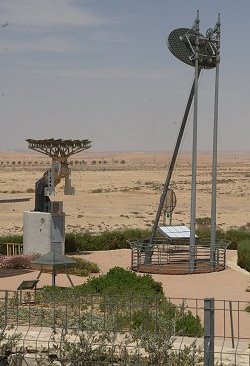



(Images: Solar concentrator – presents advanced technology for the concentration of solar radiation and various applications of its energy. The Solar Park’s Evaporative Cooling Tower – this exhibit shows how to cool a large space, based on the principles of natural ventilation, evaporative cooling and solar power.)
How does a rural educational community located in the middle of the desert become a model of environmental progress that attracts thousands of young people from Israel and around the world?
Nitzana has the answer.
The Nitzana Rural Educational Community, part of the Jewish Agency’s network of Youth Villages, is located deep in the Negev desert, on the border with Egypt. Driving to the village, it is unusual to see another car in a 50 mile radius. But Nitzana has transformed itself into an ecological village that practices what is teaches.
“We are changing the way people relate to the environment,” says Nitzana’s director David Palmach. “And this is just the beginning.”
Nitzana’s Recycling Center, built from discarded waste, teaches the community’s new immigrant students from the former Soviet Union and Ethiopia, and Israeli high school students, how to minimize their ecological footprint.
“The goal of the Center is to create awareness among new immigrant and veteran Israeli youth about the products they use, and the choices they make, in relation to the environment,” says Karen Kellerman, 45, an enthusiastic volunteer from Kentucky who is now on staff and living at Nitzana.
“These students are the next Israeli citizens, lawmakers, regional council members and educators. They need to learn about the importance of conservation when they are young.”
Through interactive workshops the students learn practical tips for everyday life. Drinking hot liquid from a styrofoam cup can be dangerous to your health.
Choosing plastic milk bags over milk cartons is better, as milk cartons have a coating that harms the environment.
Washing a cup is better than using plastic cups, which are not bio-degradable.
Turning the computer off everyday saves a tremendous amount of electricity.
Taking a shower instead of a bath conserves water.
Batteries and cleaning liquid containers should not be put in the garbage, as they create toxins that can seep into the underwater aquifers and damage the drinking water.
“These things sound so simple,” says Kellerman. “But many kids just aren’t aware of the environment.”
The Center also teachers about recycling, and at Nitzana there are bins for paper recycling, bottle and can recycling, newspapers that are sent to make cardboard boxes, a compost for organic matter, and new white and color glass recycling bins.

Teaching about choosing the right products at the recycling center.
Even clothes are reused at the Village’s second-hand shop. The oil used in the dining room is sold for bio-diesel fuel, and plans are in the works to make the dining room completely green, including the introduction of organic fruits and vegetables.
At the same time, Nitzana boasts a state-of –the art Solar Park that focuses on harnessing the power of the sun for alternative energy, and includes a unique evaporative cooling tower, a heat exchanger, a solar still and solar concentrator.
This park attracts thousands of visitors each year. With the support of the Sacta-Rashi Foundation and Keren Hayesod, 33 percent of the Park has been completed, and additional partners are being sought for the second phase.
Over 12,000 students from Israel and around the world participate annually in Nitzana’s Negev Desert Seminars. Through bicycling, camel riding, hiking, camping and exploring the desert, the seminar participants experience the unique desert culture, and learn how ancient civilizations survived in the area.
The Follow the Sun program hosts over 3,000 pupils each year, many from the surrounding Bedouin villages, and teaches them about solar energy, biology and ecology.
For more, visit the Jewish Agency website.

[…] (not yet on the market) My favorite is not yet on the market: the Eco Clock is a brilliant way to extract every bit of power from discarded AA batteries. Twelve slots on the clock’s face host used batteries which […]
RT @greenprophet Nitzana’s An Ecological Village That Practices What It Preaches http://tinyurl.com/ogtl33
Nitzana’s An Ecological Village That Practices What It Preaches http://tinyurl.com/ogtl33
Nitzana’s An Ecological Village That Practices What It Preaches http://ow.ly/6o2V